Departamento de Física (DF), Universidad Nacional del Sur (UNS), Bahía Blanca, Argentina.
DF-UNS, Grupo de Biofísica, Instituto de Física del Sur (IFISUR, UNS/CONICET), Bahía Blanca, Argentina.
PLoS Comput Biol. 2018 Apr 16;14(4):e1006082. doi: 10.1371/journal.pcbi.1006082. eCollection 2018 Apr.
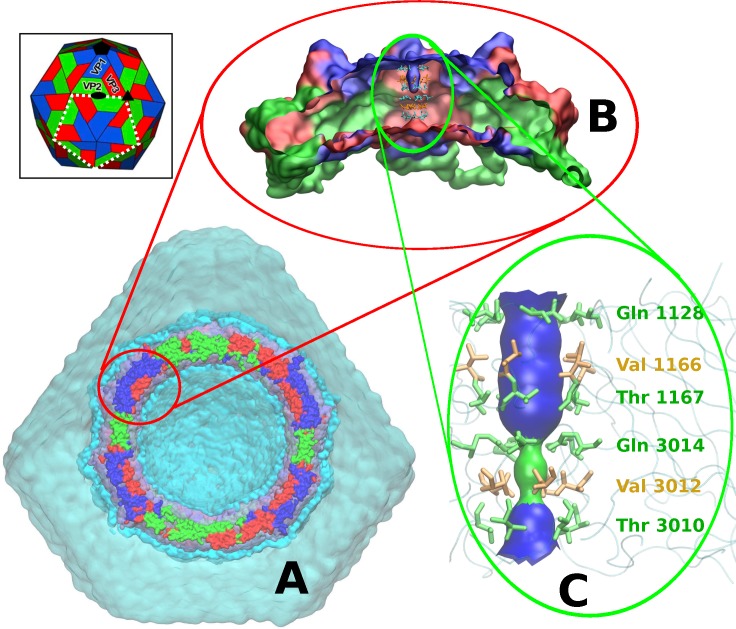
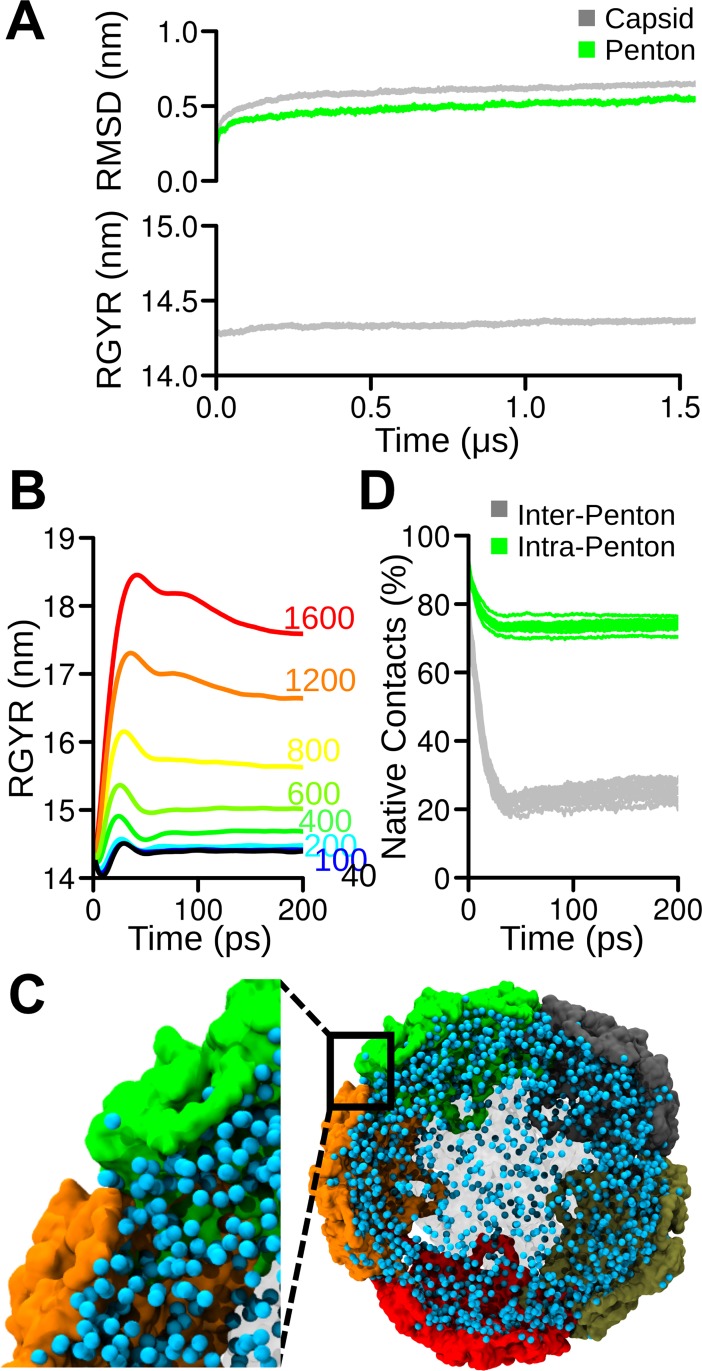
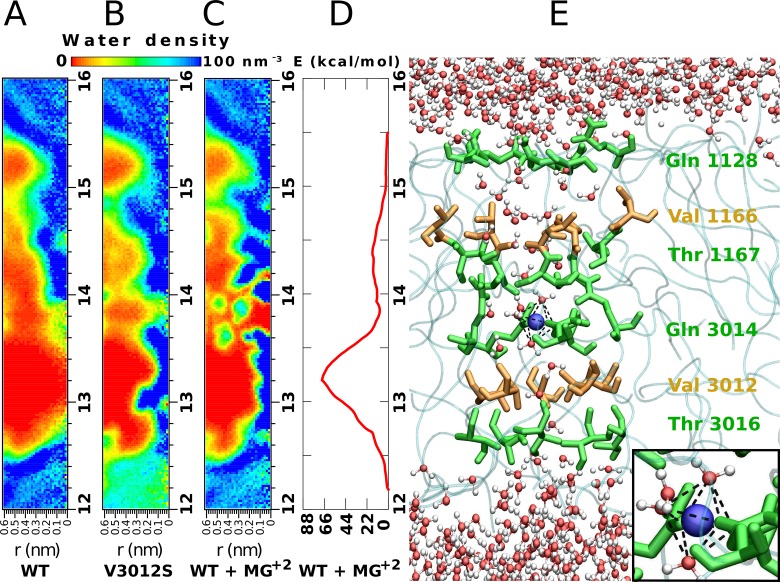
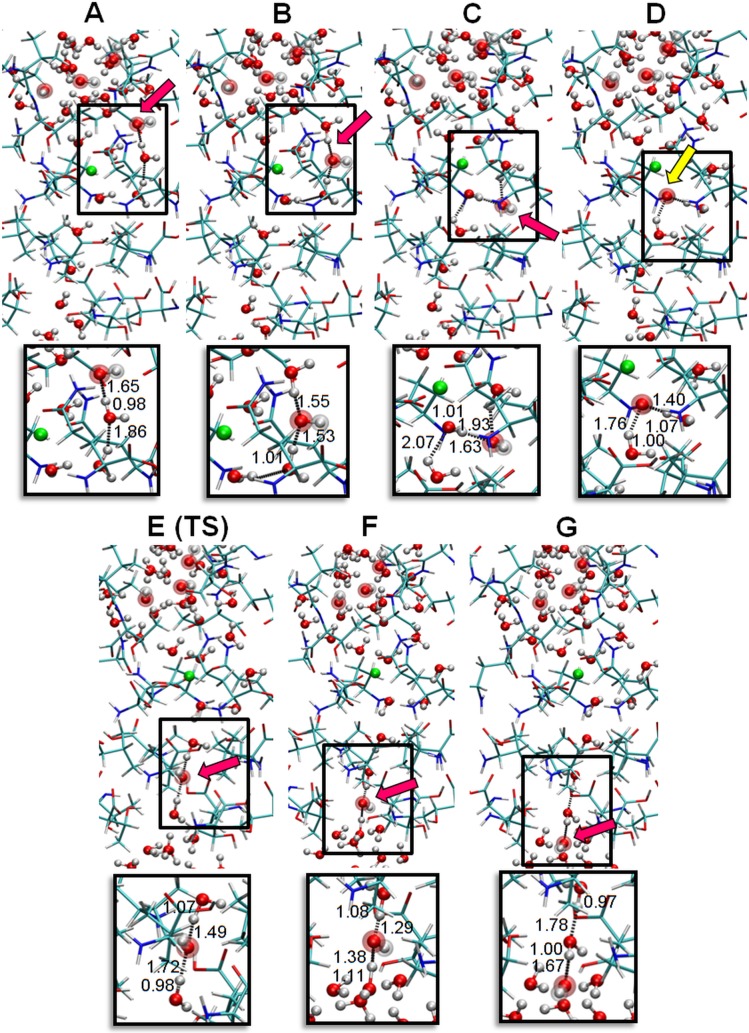
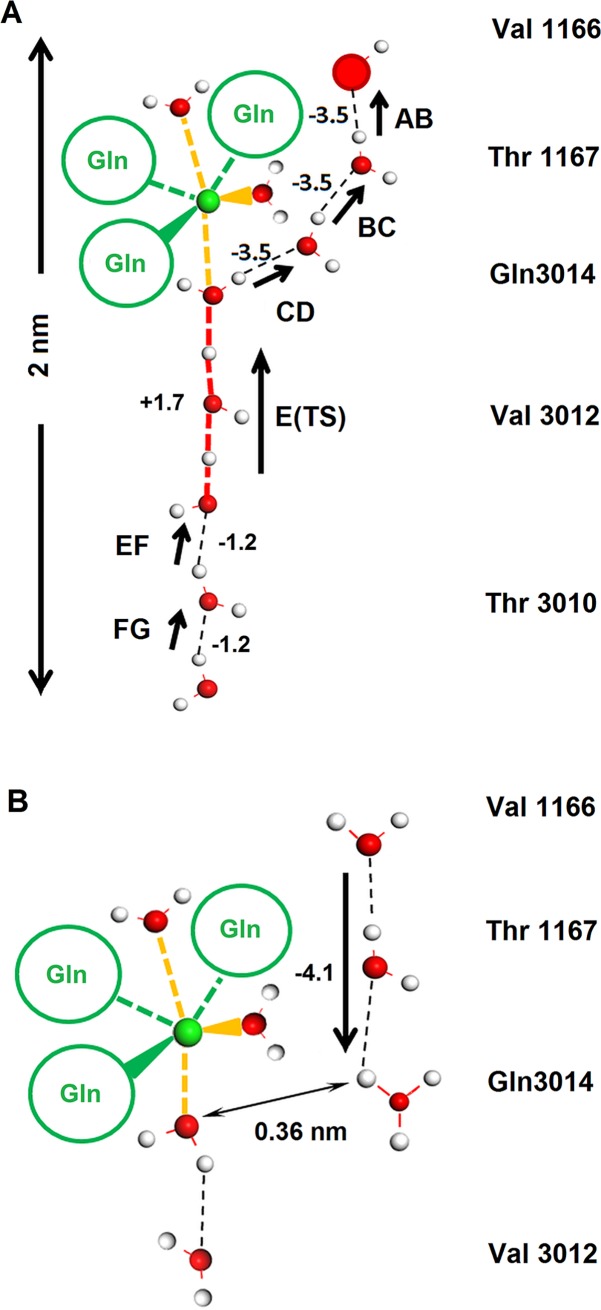
In this work, we assess a previously advanced hypothesis that predicts the existence of ion channels in the capsid of small and non-enveloped icosahedral viruses. With this purpose we examine Triatoma Virus (TrV) as a case study. This virus has a stable capsid under highly acidic conditions but disassembles and releases the genome in alkaline environments. Our calculations range from a subtle sub-atomic proton interchange to the dismantling of a large-scale system representing several million of atoms. Our results provide structure-based explanations for the three roles played by the capsid to enable genome release. First, we observe, for the first time, the formation of a hydrophobic gate in the cavity along the five-fold axis of the wild-type virus capsid, which can be disrupted by an ion located in the pore. Second, the channel enables protons to permeate the capsid through a unidirectional Grotthuss-like mechanism, which is the most likely process through which the capsid senses pH. Finally, assuming that the proton leak promotes a charge imbalance in the interior of the capsid, we model an internal pressure that forces shell cracking using coarse-grained simulations. Although qualitatively, this last step could represent the mechanism of capsid opening that allows RNA release. All of our calculations are in agreement with current experimental data obtained using TrV and describe a cascade of events that could explain the destabilization and disassembly of similar icosahedral viruses.
在这项工作中,我们评估了一个先前提出的假设,该假设预测了在小而无包膜的二十面体病毒的衣壳中存在离子通道。为此,我们以 Triatoma Virus (TrV) 作为案例研究。该病毒在高度酸性条件下具有稳定的衣壳,但在碱性环境中会解体并释放基因组。我们的计算范围从微妙的亚原子质子交换到代表数百万个原子的大规模系统的拆卸。我们的结果为衣壳在实现基因组释放方面所起的三个作用提供了基于结构的解释。首先,我们首次观察到在野生型病毒衣壳的五重轴沿线的腔中形成了一个疏水性门,该门可以被位于孔中的离子破坏。其次,该通道允许质子通过单向的 Grotthuss 样机制穿透衣壳,这是衣壳感知 pH 值的最可能过程。最后,假设质子泄漏导致衣壳内部电荷失衡,我们使用粗粒化模拟来模拟内部压力,该压力迫使外壳破裂。尽管从定性的角度来看,这最后一步可能代表了允许 RNA 释放的衣壳打开机制。我们的所有计算都与使用 TrV 获得的当前实验数据一致,并描述了一系列事件,这些事件可能解释了类似二十面体病毒的失稳和解体。