Department of Surgery, The University of Melbourne, Austin Hospital, Heidelberg, Victoria, Australia.
Department of Intensive Care, Austin Hospital, Heidelberg, Victoria, Australia.
PLoS One. 2018 Apr 16;13(4):e0195931. doi: 10.1371/journal.pone.0195931. eCollection 2018.
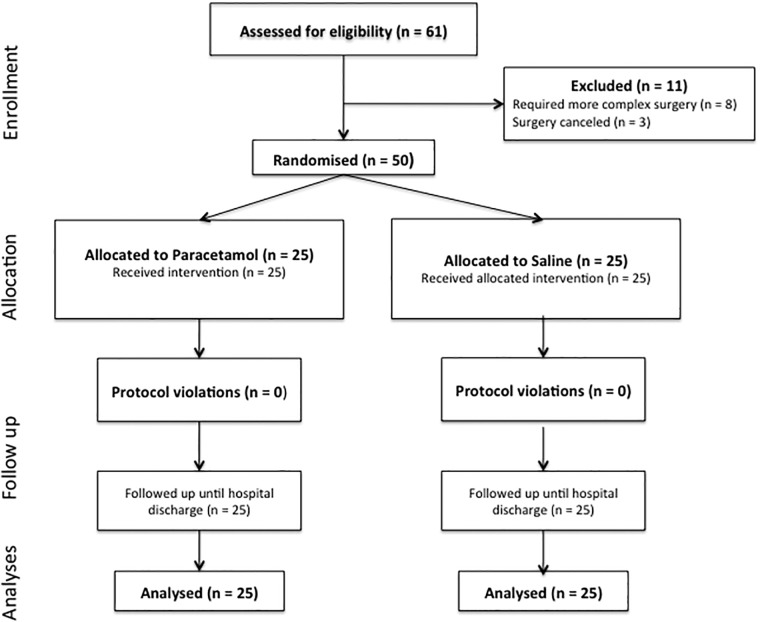
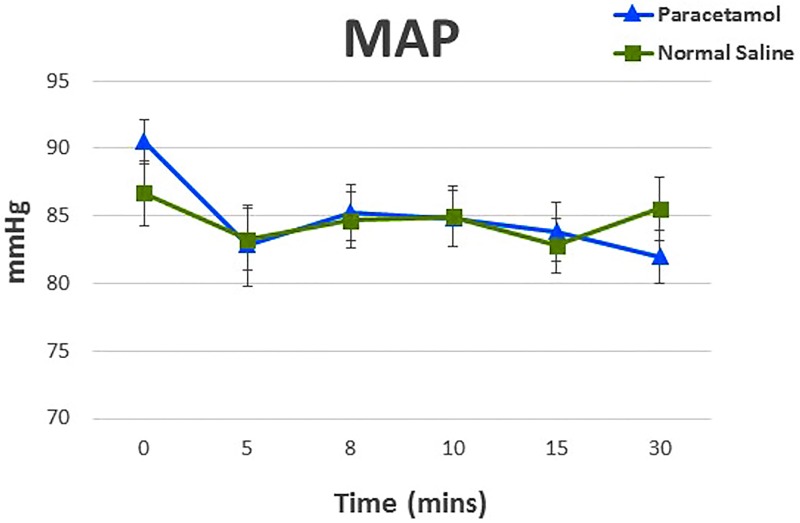
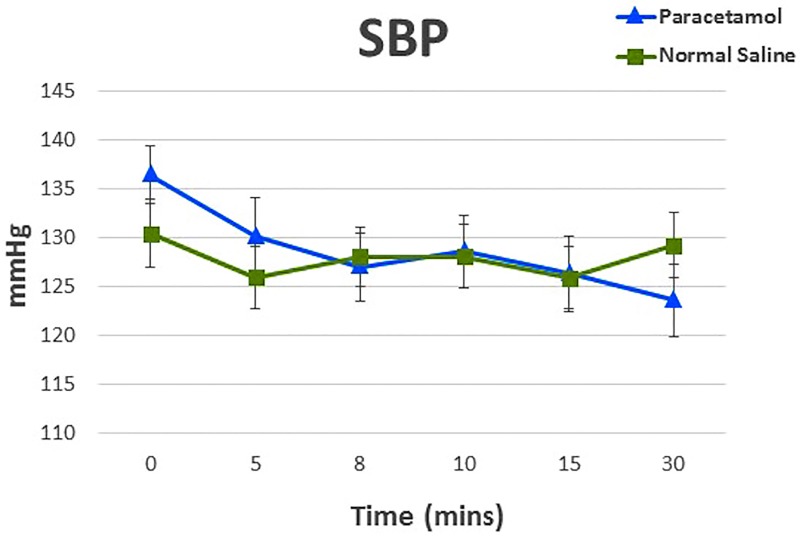
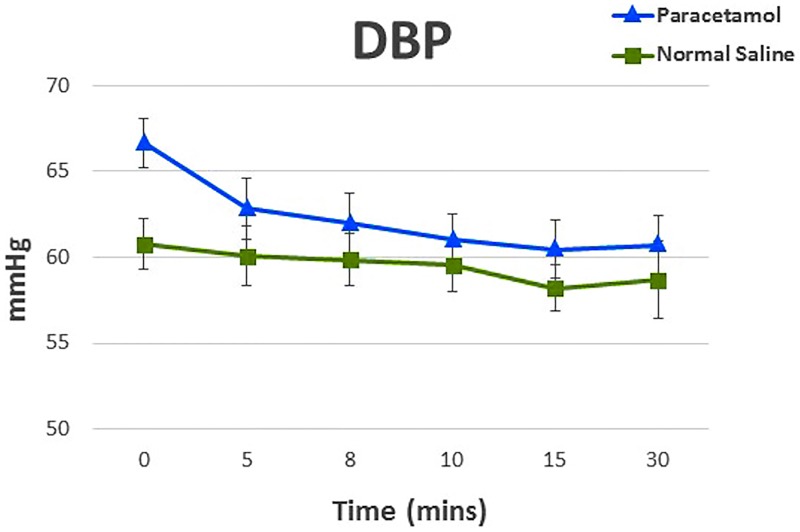
The hemodynamic effects of intravenous (IV) paracetamol in patients undergoing cardiac surgery are unknown. We performed a prospective single center placebo controlled randomized study with parallel group design in adult patients undergoing elective cardiac surgery. Participants received paracetamol (1 gram) IV or placebo (an equal volume of 0.9% saline) preoperatively followed by two postoperative doses 6 hours apart. The primary endpoint was the absolute change in systolic (SBP) 30 minutes after the preoperative infusion, analysed using an ANCOVA model. Secondary endpoints included absolute changes in mean arterial pressure (MAP) and diastolic blood pressure (DPB), and other key hemodynamic variables after each infusion. All other endpoints were analysed using random-effect generalized least squares regression modelling with individual patients treated as random effects. Fifty participants were randomly assigned to receive paracetamol (n = 25) or placebo (n = 25). Post preoperative infusion, paracetamol decreased SBP by a mean (SD) of 13 (18) mmHg, p = 0.02, compared to a mean (SD) of 1 (11) mmHg with saline. Paracetamol decreased MAP and DBP by a mean (SD) of 9 (12) mmHg and 8 (9) mmHg (p = 0.01 and 0.02), respectively, compared to a mean (SD) of 1 (8) mmHg and 0 (6) mmHg with placebo. Postoperatively, there were no significant differences in pressure or flow based hemodynamic parameters in both groups. This study provides high quality evidence that the administration of IV paracetamol in patients undergoing cardiac surgery causes a transient decrease in preoperative blood pressure when administered before surgery but no adverse hemodynamic effects when administered in the postoperative setting.
静脉注射(IV)扑热息痛对心脏手术患者的血流动力学影响尚不清楚。我们在择期心脏手术的成年患者中进行了一项前瞻性、单中心、安慰剂对照、随机平行组设计的研究。参与者在术前接受扑热息痛(1 克)IV 或安慰剂(等体积的 0.9%生理盐水)输注,然后在术后 6 小时给予两次剂量。主要终点是术前输注后 30 分钟收缩压(SBP)的绝对变化,使用协方差分析(ANCOVA)模型进行分析。次要终点包括平均动脉压(MAP)和舒张压(DBP)的绝对变化,以及每次输注后的其他关键血流动力学变量。所有其他终点均使用个体患者作为随机效应的随机效应广义最小二乘回归模型进行分析。50 名参与者被随机分配接受扑热息痛(n = 25)或安慰剂(n = 25)。与生理盐水相比,术前输注扑热息痛后 SBP 平均(SD)降低 13(18)mmHg,p = 0.02,扑热息痛平均(SD)降低 9(12)mmHg 和 8(9)mmHg,MAP 和 DBP 分别为 1(8)mmHg 和 0(6)mmHg 与安慰剂相比,p = 0.01 和 0.02。术后,两组在压力或流量相关血流动力学参数方面均无显著差异。本研究提供了高质量的证据,表明在心脏手术患者中,术前给予 IV 扑热息痛可导致血压短暂下降,但在术后给予时无不良血流动力学影响。