Correa-Galeote David, Bedmar Eulogio J, Arone Gregorio J
Department of Soil Microbiology and Symbiotic Systems, Estación Experimental del Zaidín, Agencia Estatal Consejo Superior de Investigaciones Científicas, Granada, Spain.
Department of Agricultural Sciences, National University of Huancavelica, Huancavelica, Peru.
Front Microbiol. 2018 Mar 16;9:484. doi: 10.3389/fmicb.2018.00484. eCollection 2018.
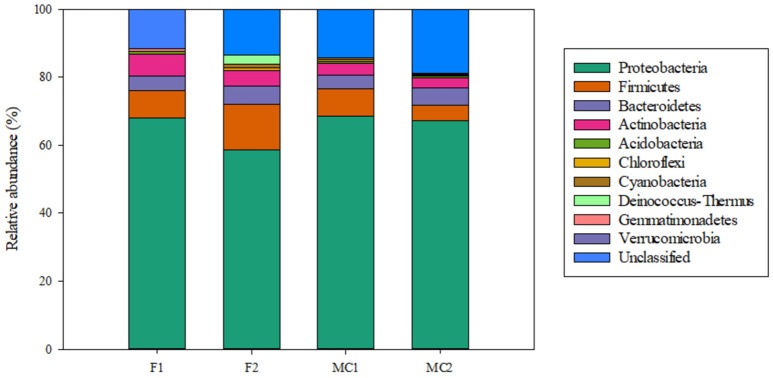
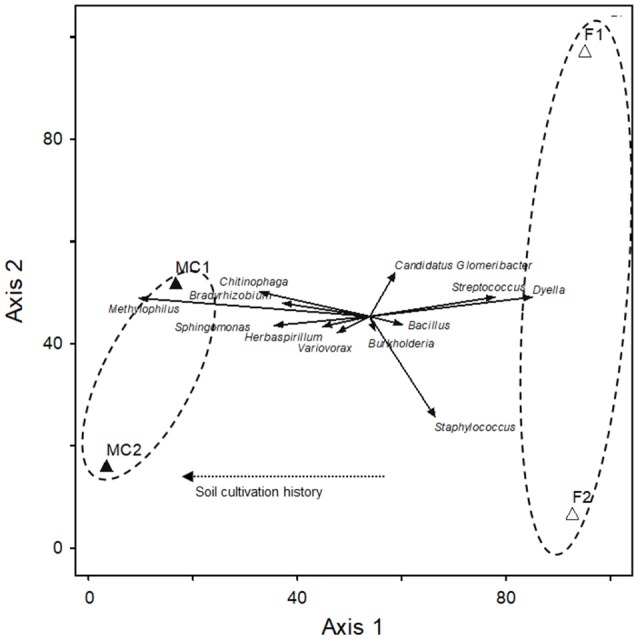
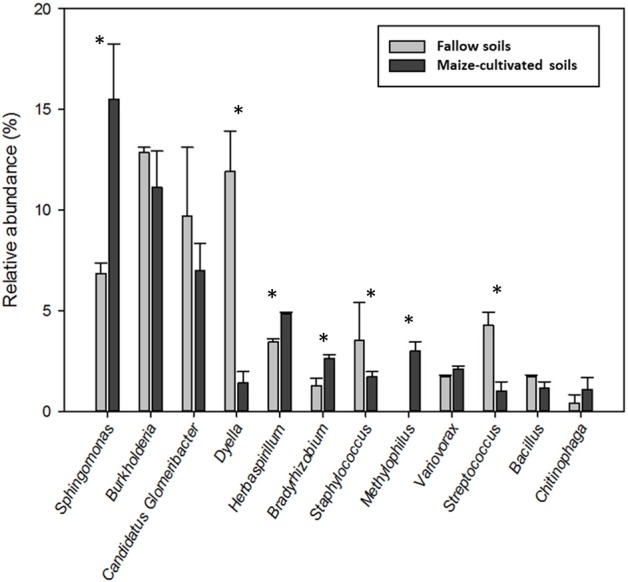
The bacterial endophytic communities residing within roots of maize ( L.) plants cultivated by a sustainable management in soils from the Quechua maize belt (Peruvian Andes) were examined using tags pyrosequencing spanning the V4 and V5 hypervariable regions of the 16S rRNA. Across four replicate libraries, two corresponding to sequences of endophytic bacteria from long time maize-cultivated soils and the other two obtained from fallow soils, 793 bacterial sequences were found that grouped into 188 bacterial operational taxonomic units (OTUs, 97% genetic similarity). The numbers of OTUs in the libraries from the maize-cultivated soils were significantly higher than those found in the libraries from fallow soils. A mean of 30 genera were found in the fallow soil libraries and 47 were in those from the maize-cultivated soils. Both alpha and beta diversity indexes showed clear differences between bacterial endophytic populations from plants with different soil cultivation history and that the soils cultivated for long time requires a higher diversity of endophytes. The number of sequences corresponding to main genera and in the maize-cultivated libraries were statistically more abundant than those from the fallow soils. Sequences of genera and were significantly more abundant in the libraries from the fallow soils. Relative abundance of genera Glomeribacter, and were similar among libraries. A canonical correspondence analysis of the relative abundance of the main genera showed that the four libraries distributed in two clearly separated groups. Our results suggest that cultivation history is an important driver of endophytic colonization of maize and that after a long time of cultivation of the soil the maize plants need to increase the richness of the bacterial endophytes communities.
利用跨越16S rRNA的V4和V5高变区的标签焦磷酸测序技术,对秘鲁安第斯科恰玉米带土壤中通过可持续管理种植的玉米(L.)植株根系内的细菌内生群落进行了研究。在四个重复文库中,两个对应于长期种植玉米土壤中的内生细菌序列,另外两个来自休耕土壤,共发现793个细菌序列,这些序列被归为188个细菌操作分类单元(OTU,97%基因相似性)。来自种植玉米土壤的文库中的OTU数量显著高于来自休耕土壤的文库。休耕土壤文库中平均发现30个属,而种植玉米土壤的文库中有47个属。α和β多样性指数均显示,来自不同土壤种植历史的植物的细菌内生种群之间存在明显差异,且长期耕种的土壤需要更高的内生菌多样性。种植玉米文库中对应主要属和的序列在统计学上比来自休耕土壤的序列更丰富。属和的序列在休耕土壤文库中显著更丰富。属Glomeribacter、和的相对丰度在各文库中相似。对主要属的相对丰度进行的典范对应分析表明,四个文库分为两个明显分开的组。我们的结果表明,种植历史是玉米内生定殖的重要驱动因素,并且在土壤长期耕种后,玉米植株需要增加细菌内生群落的丰富度。