Department of Respiration, The First Hospital of Jilin University, Changchun, China.
Front Immunol. 2018 Mar 20;9:563. doi: 10.3389/fimmu.2018.00563. eCollection 2018.
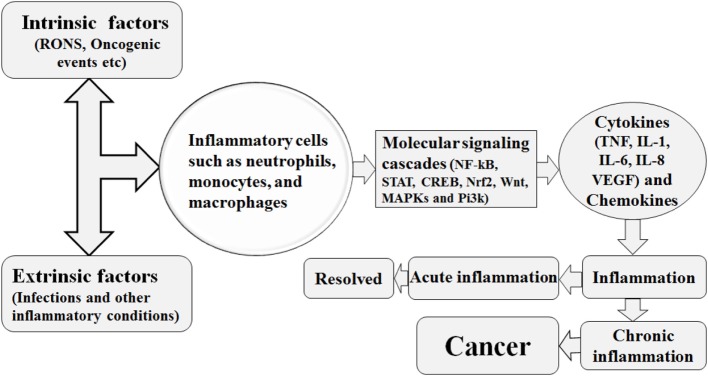
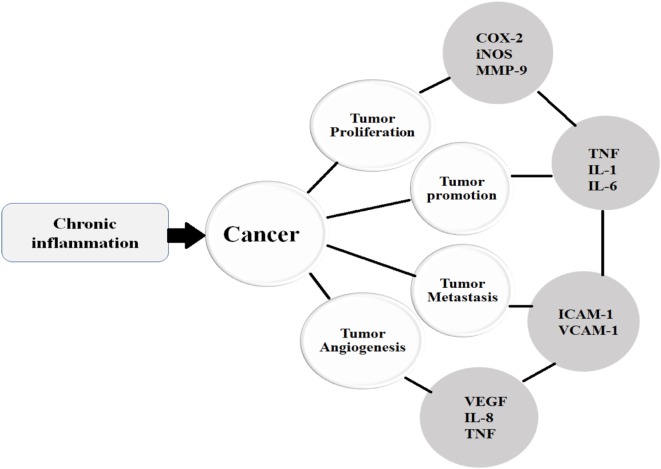
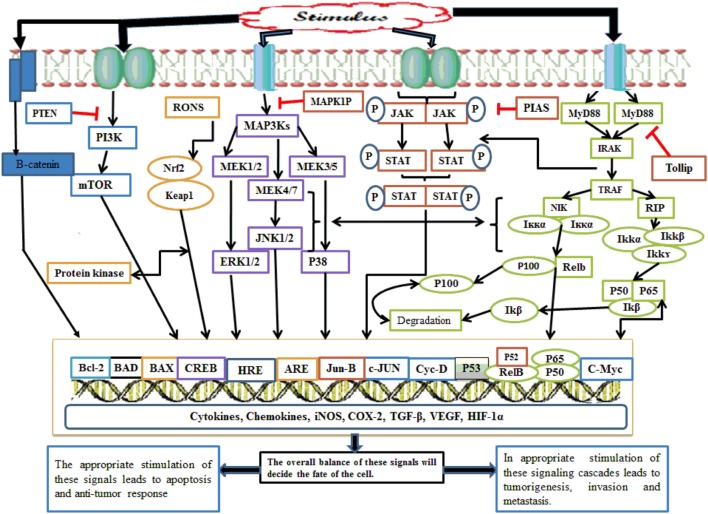
The inflammation is the protective response of the body against various harmful stimuli; however, the aberrant and inappropriate activation tends to become harmful. The acute inflammatory response tends to resolved once the offending agent is subside but this acute response becomes chronic in nature when the body is unable to successfully neutralized the noxious stimuli. This chronic inflammatory microenvironment is associated with the release of various pro-inflammatory and oncogenic mediators such as nitric oxide (NO), cytokines [IL-1β, IL-2, interleukin-6 (IL-6), and tumor necrosis factor-α (TNF-α)], growth factor, and chemokines. These mediators make the inflammatory microenvironment more vulnerable toward tumorigenesis. The pro-inflammatory mediators released during the chronic inflammation tends to induce several molecular signaling cascades such as nuclear factor kappa B, MAPKinase, nuclear factor erythroid 2-related factor 2, phosphoinositide-3-kinase, Janus kinases/STAT, Wnt/B-catenin, and cyclic AMP response element binding protein. The immune system and its components have a pleiotropic effect on inflammation and cancer progression. Immune components such as T cells, natural killer cells, macrophages, and neutrophils either inhibit or enhance tumor initiation depending on the type of tumor and immune cells involved. Tumor-associated macrophages and tumor-associated neutrophils are pro-tumorigenic cells highly prevalent in inflammation-mediated tumors. Similarly, presence of T regulatory (Treg) cells in an inflammatory and tumor setting suppresses the immune system, thus paving the way for oncogenesis. However, Treg cells also inhibit autoimmune inflammation. By contrast, cytotoxic T cells and T helper cells confer antitumor immunity and are associated with better prognosis in patients with cancer. Cytotoxic T cells inflict a direct cytotoxic effect on cells expressing oncogenic markers. Currently, several anti-inflammatory and antitumor therapies are under trials in which these immune cells are exploited. Adoptive cell transfer composed of tumor-infiltrating lymphocytes has been tried for the treatment of tumors after their expansion. Mediators released by cells in a tumorigenic and inflammatory microenvironment cross talk with nearby cells, either promoting or inhibiting inflammation and cancer. Recently, several cytokine-based therapies are either being developed or are under trial to treat such types of manifestations. Monoclonal antibodies directed against TNF-α, VEGF, and IL-6 has shown promising results to ameliorate inflammation and cancer, while direct administration of IL-2 has been shown to cause tumor regression.
炎症是机体对各种有害刺激的保护反应;然而,异常和不适当的激活往往会变得有害。一旦致病因子消退,急性炎症反应往往会得到解决,但当机体无法成功中和有害刺激时,这种急性反应就会变成慢性。这种慢性炎症微环境与各种促炎和致癌介质的释放有关,如一氧化氮(NO)、细胞因子[白细胞介素-1β(IL-1β)、白细胞介素-2(IL-2)、白细胞介素-6(IL-6)和肿瘤坏死因子-α(TNF-α)]、生长因子和趋化因子。这些介质使炎症微环境更容易发生肿瘤发生。慢性炎症期间释放的促炎介质往往会诱导几种分子信号级联反应,如核因子 kappa B、MAPKinase、核因子红细胞 2 相关因子 2、磷酸肌醇-3-激酶、Janus 激酶/STAT、Wnt/B-连环蛋白和环磷酸腺苷反应元件结合蛋白。免疫系统及其成分对炎症和癌症进展有多种影响。免疫成分,如 T 细胞、自然杀伤细胞、巨噬细胞和中性粒细胞,根据涉及的肿瘤类型和免疫细胞的类型,要么抑制要么促进肿瘤的起始。肿瘤相关巨噬细胞和肿瘤相关中性粒细胞是高度存在于炎症介导的肿瘤中的促肿瘤细胞。同样,炎症和肿瘤环境中存在调节性 T 细胞(Treg)会抑制免疫系统,从而为致癌作用铺平道路。然而,Treg 细胞也抑制自身免疫性炎症。相比之下,细胞毒性 T 细胞和辅助性 T 细胞赋予抗肿瘤免疫,并与癌症患者的更好预后相关。细胞毒性 T 细胞对表达致癌标记物的细胞施加直接细胞毒性作用。目前,正在临床试验中尝试几种抗炎和抗肿瘤疗法,这些免疫细胞正在被利用。肿瘤浸润淋巴细胞组成的过继细胞转移已被尝试用于治疗肿瘤,在其扩增后。肿瘤发生和炎症微环境中细胞释放的介质与附近细胞相互交流,促进或抑制炎症和癌症。最近,几种基于细胞因子的疗法正在开发或临床试验中,以治疗此类表现。针对 TNF-α、VEGF 和 IL-6 的单克隆抗体已显示出改善炎症和癌症的有希望的结果,而直接给予 IL-2 已显示出引起肿瘤消退的效果。