Institute for Molecular Biotechnology, RWTH Aachen University, Worringerweg 1, 52072 Aachen, Germany.
Biomed Res Int. 2018 Feb 13;2018:9328671. doi: 10.1155/2018/9328671. eCollection 2018.
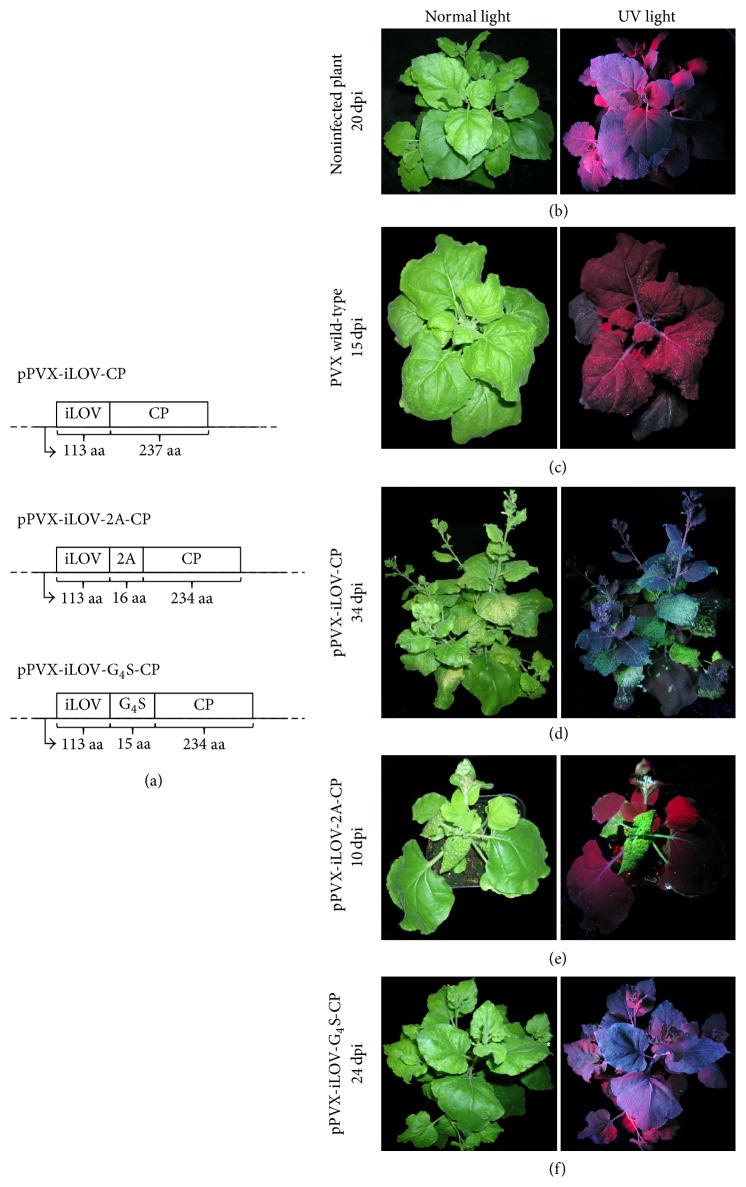
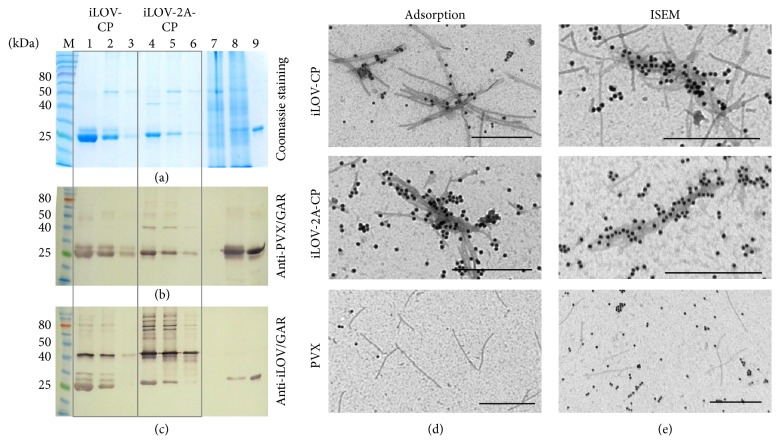
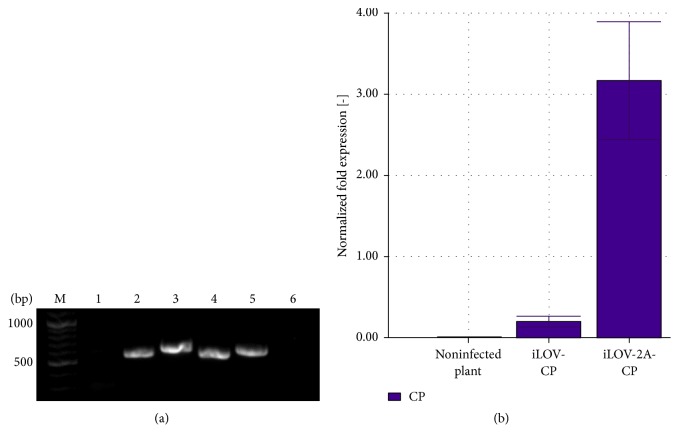
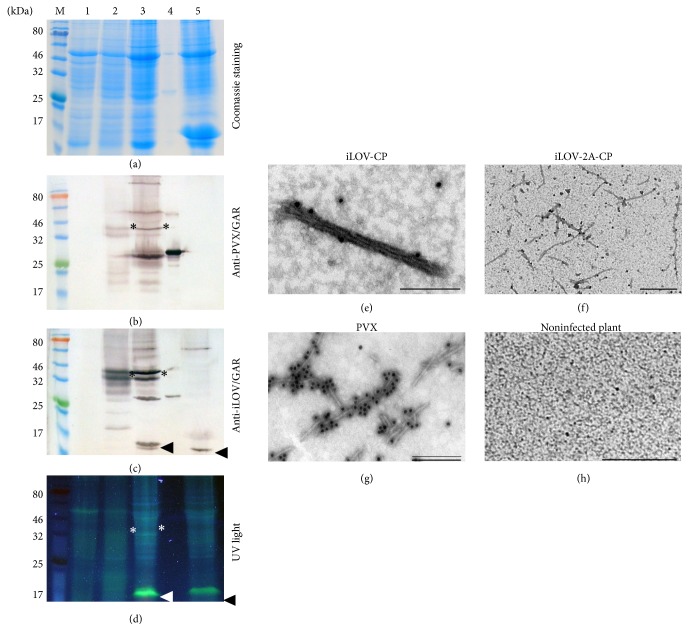
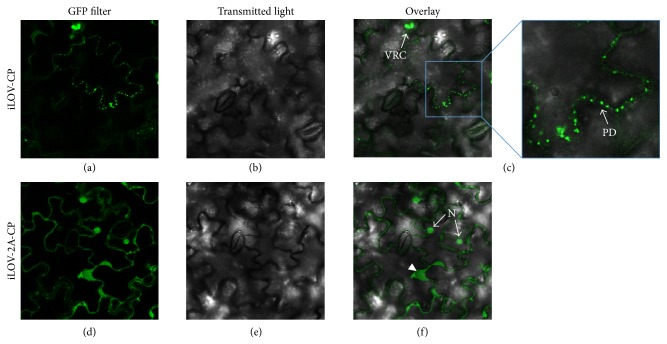
Plant virus-based nanoparticles can be produced in plants on a large scale and are easily modified to introduce new functions, making them suitable for applications such as vaccination and drug delivery, tissue engineering, and imaging. The latter is often achieved using green fluorescent protein and its derivatives, but the monovalent fluorescent protein iLOV is smaller and more robust. Here, we fused the iLOV polypeptide to the N-terminus of the (PVX) coat protein, directly or via the 2A sequence, for expression in . Direct fusion of the iLOV polypeptide did not prevent the assembly or systemic spread of the virus and we verified the presence of fusion proteins and iLOV hybrid virus particles in leaf extracts. Compared to wild-type PVX virions, the PVX particles displaying the iLOV peptide showed an atypical, intertwined morphology. Our results confirm that a direct fusion of the iLOV fluorescent protein to filamentous PVX nanoparticles offers a promising tool for imaging applications.
基于植物病毒的纳米颗粒可以在植物中大规模生产,并且易于修饰以引入新的功能,使其适用于疫苗接种和药物输送、组织工程和成像等应用。后一种方法通常使用绿色荧光蛋白及其衍生物,但单价荧光蛋白 iLOV 更小、更稳定。在这里,我们将 iLOV 多肽融合到 (PVX)外壳蛋白的 N 端,直接或通过 2A 序列进行融合,用于在 中表达。iLOV 多肽的直接融合并没有阻止病毒的组装或系统传播,我们在叶片提取物中验证了融合蛋白和 iLOV 杂合病毒颗粒的存在。与野生型 PVX 病毒粒子相比,显示 iLOV 肽的 PVX 颗粒表现出非典型的交织形态。我们的结果证实,将 iLOV 荧光蛋白直接融合到丝状 PVX 纳米颗粒上为成像应用提供了一种很有前途的工具。