Department of Neurology and Suzhou Clinical Research Center of Neurological Disease, The Second Affiliated Hospital of Soochow University, Suzhou, Jiangsu 215004, China.
Jiangsu Key Laboratory of Neuropsychiatric Diseases and Institute of Neuroscience, Soochow University, Suzhou, Jiangsu 215123, China.
Chin Med J (Engl). 2018 Apr 20;131(8):899-906. doi: 10.4103/0366-6999.229888.
Rapid eye movement (REM) sleep behavior disorder (RBD) and obstructive sleep apnea (OSA) are the most common sleep disorders in Parkinson's disease (PD). The aim of this study was to identify whether RBD could alleviate OSA severity in PD patients and its effect on cognitive impairment.
From February 2014 to May 2017, we recruited 174 PD patients from the Second Affiliated Hospital of Soochow University, all of whom underwent polysomnography (PSG). We collected clinical data, PSG results, and compared information between patients with and without RBD or OSA by analysis of covariance. We also investigated the effect of these sleep disorders on cognitive impairment using linear regression.
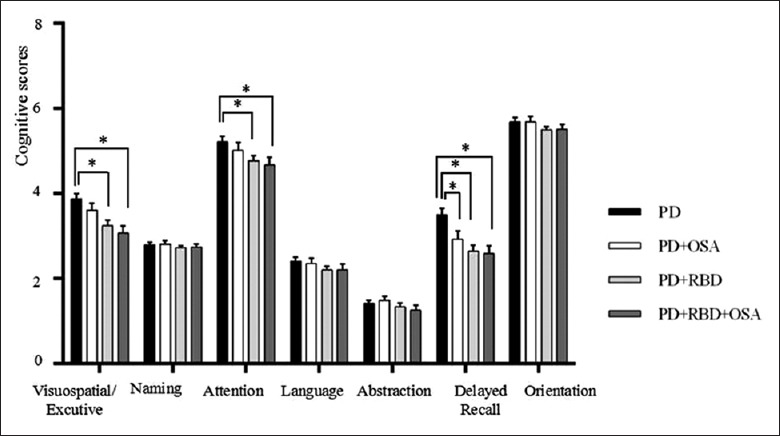
We grouped participants as follows: PD only (n = 53), PD + OSA (n = 29), PD + RBD (n = 61), and PD + RBD + OSA (n = 31). Minimum oxygen saturation (SaO) during whole sleep and in REM sleep was higher in PD + RBD + OSA patients than that in PD + OSA patients. PD + RBD patients had worse Mini-Mental Status Examination and Montreal Cognitive Assessment (MoCA) scores than those in the PD group (P < 0.001), especially in visuospatial/executive, attention, and memory functions. The PD + OSA group performed worse than the PD group in the delayed recall domain. After adjusting for age, sex, body mass index, education, disease severity, and other sleep disorders, MoCA was negatively associated with OSA (β = -0.736, P = 0.043) and RBD (β = -2.575,P < 0.001). The severity of RBD (tonic/phasic electromyography activity) and OSA (apnea-hypopnea index/oxygen desaturation index/minimum SaO) were also associated with MoCA. The adjusted β values of RBD-related parameters were higher than that for OSA.
We found that RBD alleviated OSA severity; however, RBD and OSA together exacerbated PD cognitive impairment. Further studies are needed to evaluate whether OSA treatment can improve cognition in PD.
快速眼动(REM)睡眠行为障碍(RBD)和阻塞性睡眠呼吸暂停(OSA)是帕金森病(PD)中最常见的睡眠障碍。本研究旨在确定 RBD 是否可以减轻 PD 患者的 OSA 严重程度及其对认知障碍的影响。
从 2014 年 2 月至 2017 年 5 月,我们从苏州大学第二附属医院招募了 174 名 PD 患者,所有患者均接受了多导睡眠图(PSG)检查。我们收集了临床数据和 PSG 结果,并通过协方差分析比较了有和无 RBD 或 OSA 的患者之间的信息。我们还使用线性回归研究了这些睡眠障碍对认知障碍的影响。
我们将参与者分为以下几组:PD 组(n = 53)、PD + OSA 组(n = 29)、PD + RBD 组(n = 61)和 PD + RBD + OSA 组(n = 31)。与 PD + OSA 组相比,PD + RBD + OSA 患者的整个睡眠和 REM 睡眠期间的最低血氧饱和度(SaO)更高。PD + RBD 患者的简易精神状态检查和蒙特利尔认知评估(MoCA)评分比 PD 组更差(P < 0.001),尤其是在视空间/执行、注意力和记忆力方面。PD + OSA 组在延迟回忆域的表现不如 PD 组。在调整年龄、性别、体重指数、教育程度、疾病严重程度和其他睡眠障碍后,MoCA 与 OSA(β = -0.736,P = 0.043)和 RBD(β = -2.575,P < 0.001)呈负相关。RBD(紧张/松弛肌电图活动)和 OSA(呼吸暂停-低通气指数/氧减指数/最低 SaO)的严重程度也与 MoCA 相关。RBD 相关参数的调整β值高于 OSA。
我们发现 RBD 减轻了 OSA 的严重程度;然而,RBD 和 OSA 共同加重了 PD 的认知障碍。需要进一步研究评估 OSA 治疗是否可以改善 PD 患者的认知能力。