Levieux Karine, Patural Hugues, Harrewijn Inge, Briand Huchet Elisabeth, de Visme Sophie, Gallot Géraldine, Chalumeau Martin, Gras Le Guen Christèle, Hanf Matthieu
Pediatric Emergency Care Unit, Nantes University Hospital, Nantes, France.
Inserm CIC 1413, Nantes University Hospital, Nantes, France.
BMJ Open. 2018 Apr 17;8(4):e020883. doi: 10.1136/bmjopen-2017-020883.
Even after 'back-to-sleep' campaigns, sudden unexpected infant death (SUID) continues to be the leading cause of death for infants 1 month to 1 year old in developed countries, with devastating social, psychological and legal implications for families. To sustainably tackle this problem and decrease the number of SUIDs, a French SUID registry was initiated in 2015 to (1) inform prevention with standardised data, (2) understand the mechanisms leading to SUID and the contribution of the already known or newly suggested risk factors and (3) gather a multidisciplinary group of experts to coordinate and develop innovative and urgent research in the SUID area.
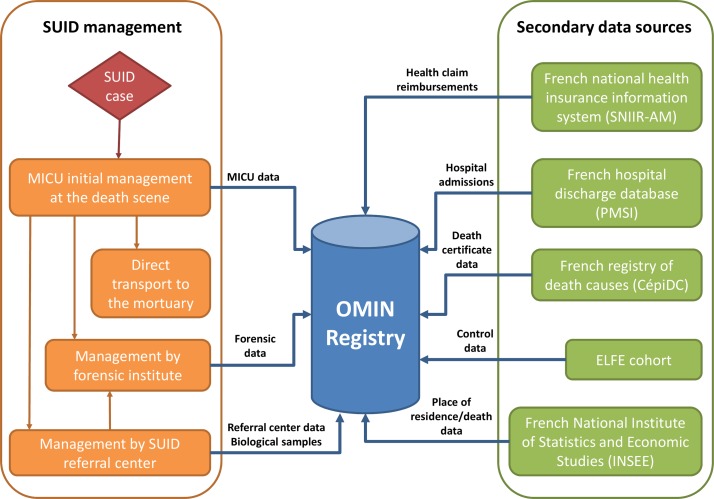
This observational multisite prospective observatory includes all cases of sudden unexpected deaths in children younger than 2 years occurring in the French territory covered by the 35 participating French referral centres. From these cases, various data concerning sociodemographic conditions, death scene, personal and family medical history, parental behaviours, sleep environment, clinical examinations, biological and imagery investigations and autopsy are systematically collected. These data will be complemented as of 2018 with a biobank of diverse biological samples (blood, hair, urine, faeces and cerebrospinal fluid), with other administrative health-related data (health claim reimbursements and hospital admissions) and socioenvironmental data. Insights from exploratory descriptive statistics and thematic analysis will be combined for the design of targeted strategies to effectively reduce preventable infant deaths.
The French sudden unexpected infant death registry (Observatoire National des Morts Inattendues du Nourrisson registry;OMIN) was approved in 2015 by the French Data Protection Authority in clinical research (Commission Nationale de l'Informatique et des Libertés: number 915273) and by an independent ethics committee (Groupe Nantais d'Ethique dans le Domaine de la Santé: number 2015-01-27). Results will be discussed with associations of families affected by SUID, caregivers, funders of the registry, medical societies and researchers and will be submitted to international peer-reviewed journals and presented at international conferences.
即使在开展“仰卧睡眠”运动之后,婴儿猝死综合征(SUID)仍是发达国家1个月至1岁婴儿的主要死因,给家庭带来了毁灭性的社会、心理和法律影响。为了可持续地解决这一问题并减少SUID的数量,法国于2015年启动了一个SUID登记处,以(1)利用标准化数据为预防工作提供信息,(2)了解导致SUID的机制以及已知或新提出的风险因素的作用,(3)召集多学科专家小组,协调并开展SUID领域的创新和紧急研究。
这个观察性多中心前瞻性观察站涵盖了35个参与研究的法国转诊中心所覆盖的法国领土内发生的所有2岁以下儿童意外猝死病例。从这些病例中,系统收集有关社会人口状况、死亡现场、个人和家族病史、父母行为、睡眠环境、临床检查、生物学和影像学检查以及尸检的各种数据。从2018年起,这些数据将得到补充,包括一个包含多种生物样本(血液、头发、尿液、粪便和脑脊液)的生物样本库,以及其他与健康相关的行政数据(健康索赔报销和住院情况)和社会环境数据。探索性描述性统计和主题分析的见解将结合起来,用于设计有针对性的策略,以有效减少可预防的婴儿死亡。
法国婴儿猝死登记处(法国国家婴儿意外死亡观察站登记处;OMIN)于2015年获得法国数据保护局在临床研究方面的批准(国家信息与自由委员会:编号915273),并获得独立伦理委员会(南特健康领域伦理小组:编号2015-01-27)的批准。研究结果将与受SUID影响的家庭协会、护理人员、登记处资助者、医学协会和研究人员进行讨论,并提交给国际同行评审期刊,并在国际会议上发表。