Department of Land, Air, and Water Resources, University of California, Davis, CA 95616.
Environmental Studies Program, Department of Geography, Institute of Ecology and Evolution, University of Oregon, Eugene, OR 97403
Proc Natl Acad Sci U S A. 2018 May 1;115(18):E4219-E4226. doi: 10.1073/pnas.1718864115. Epub 2018 Apr 16.
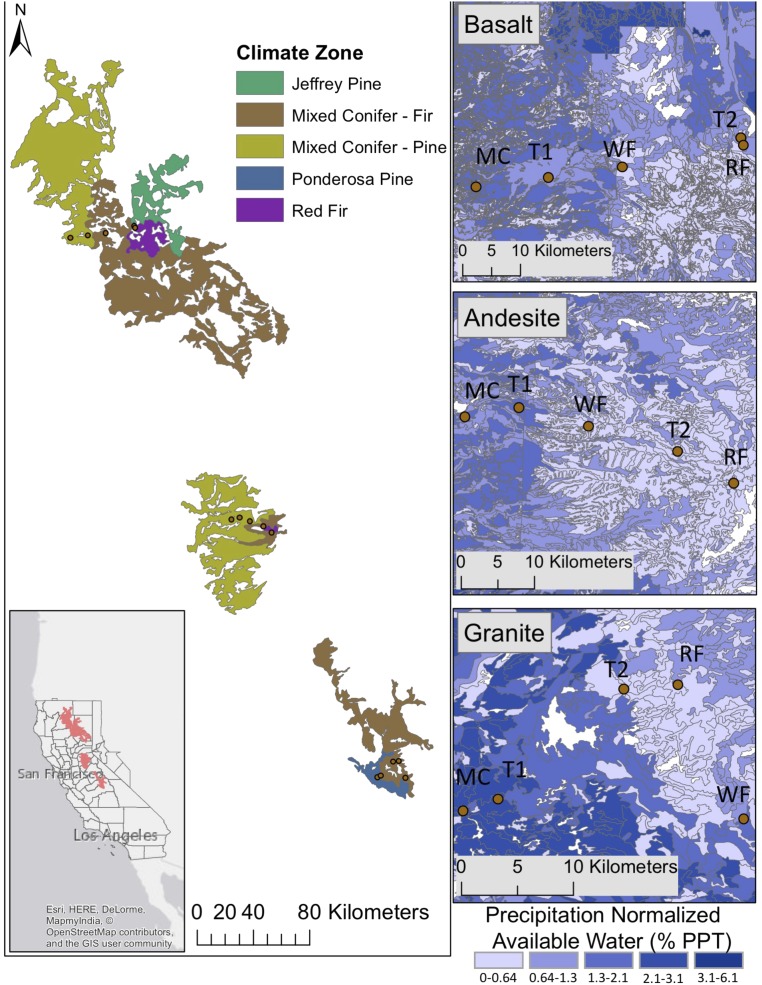
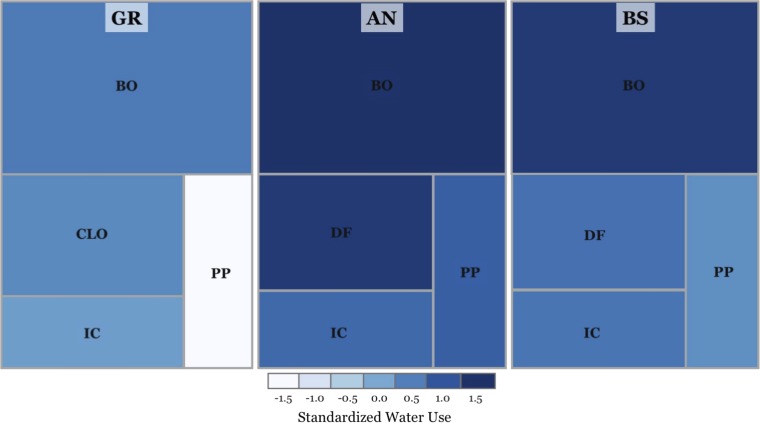
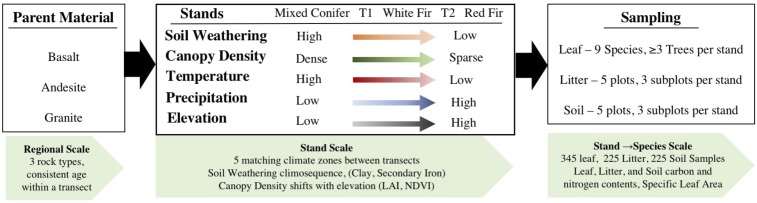
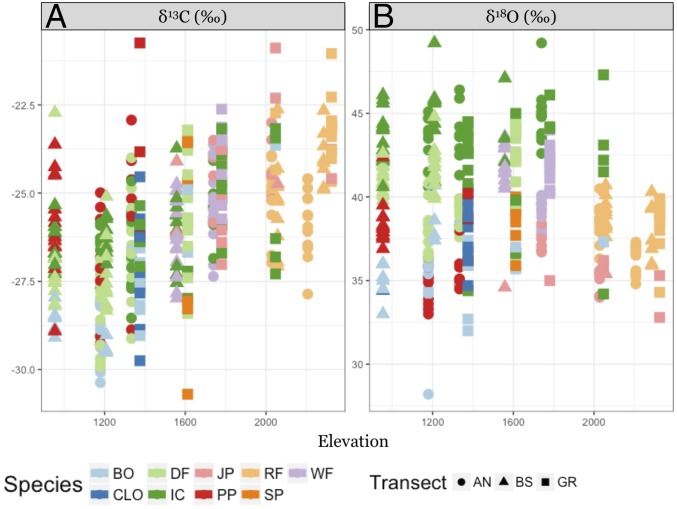
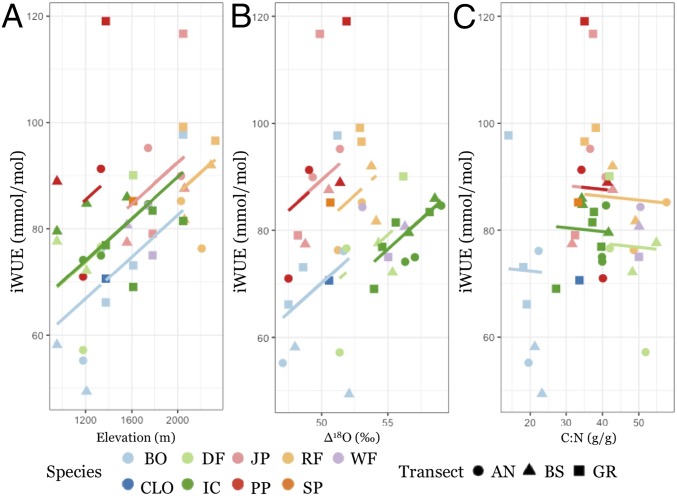
This study was designed to address a major source of uncertainty pertaining to coupled carbon-water cycles in montane forest ecosystems. The Sierra Nevada of California was used as a model system to investigate connections between the physiological performance of trees and landscape patterns of forest carbon and water use. The intrinsic water-use efficiency (iWUE)-an index of CO fixed per unit of potential water lost via transpiration-of nine dominant species was determined in replicated transects along an ∼1,500-m elevation gradient, spanning a broad range of climatic conditions and soils derived from three different parent materials. Stable isotope ratios of carbon and oxygen measured at the leaf level were combined with field-based and remotely sensed metrics of stand productivity, revealing that variation in iWUE depends primarily on leaf traits (∼24% of the variability), followed by stand productivity (∼16% of the variability), climatic regime (∼13% of the variability), and soil development (∼12% of the variability). Significant interactions between species composition and soil properties proved useful to predict changes in forest carbon-water relations. On the basis of observed shifts in tree species composition, ongoing since the 1950s and intensified in recent years, an increase in water loss through transpiration (ranging from 10 to 60% depending on parent material) is now expected in mixed conifer forests throughout the region.
本研究旨在解决与山地森林生态系统中碳-水耦合循环相关的一个主要不确定性来源。加利福尼亚州的内华达山脉被用作模型系统,以调查树木生理表现与森林碳和水分利用的景观格局之间的联系。在跨越三种不同母质来源的广泛气候条件和土壤的约 1500 米海拔梯度上,沿重复样带确定了 9 个主要物种的内在水分利用效率(iWUE)——每单位通过蒸腾作用损失的潜在水分固定的 CO2 量的指标。在叶片水平上测量的碳和氧稳定同位素比率与基于现场和遥感的林分生产力指标相结合,表明 iWUE 的变化主要取决于叶片特性(约 24%的变异),其次是林分生产力(约 16%的变异)、气候模式(约 13%的变异)和土壤发育(约 12%的变异)。物种组成和土壤特性之间的显著相互作用有助于预测森林碳-水关系的变化。基于自 20 世纪 50 年代以来观察到的树种组成变化,并在近年来加剧,预计整个地区的混交针叶林的蒸腾水分损失将增加(取决于母质,范围为 10%至 60%)。