Key Laboratory of Mesoscale Severe Weather/Ministry of Education and School of Atmospheric Sciences, Nanjing University, Nanjing, 210023, China.
Nat Commun. 2018 Apr 17;9(1):1507. doi: 10.1038/s41467-018-03945-y.
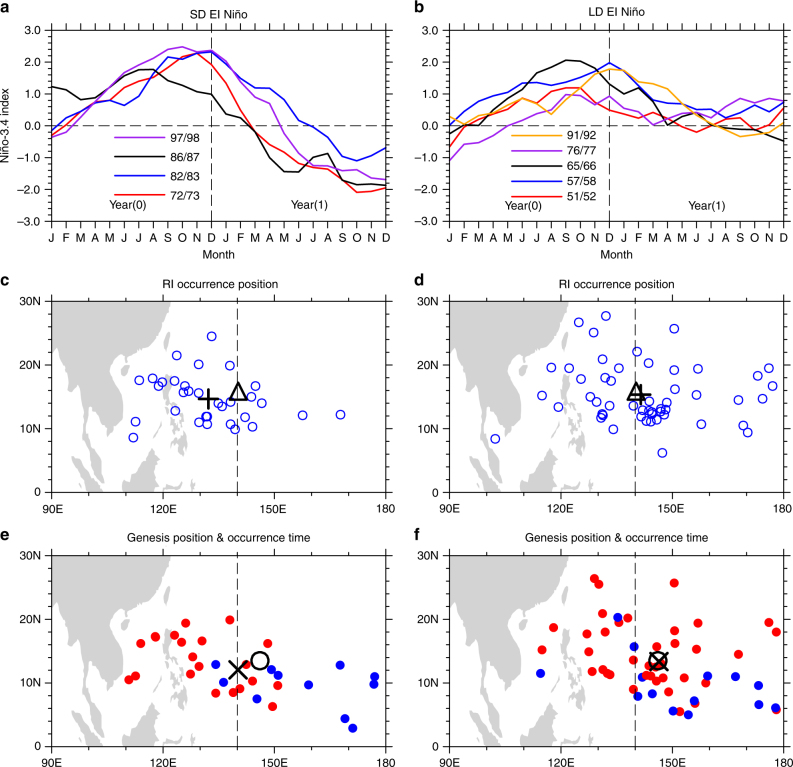
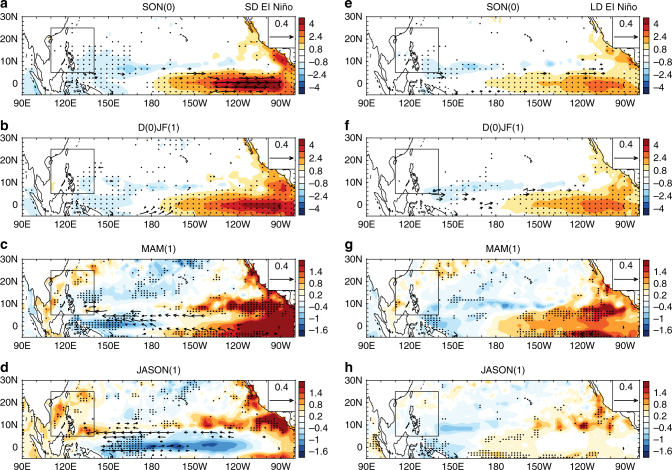
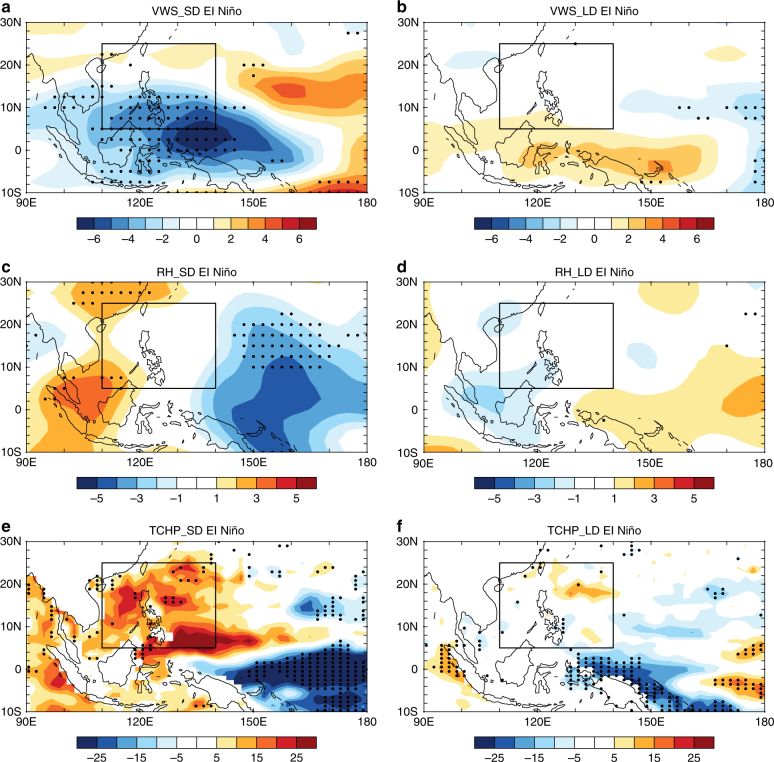
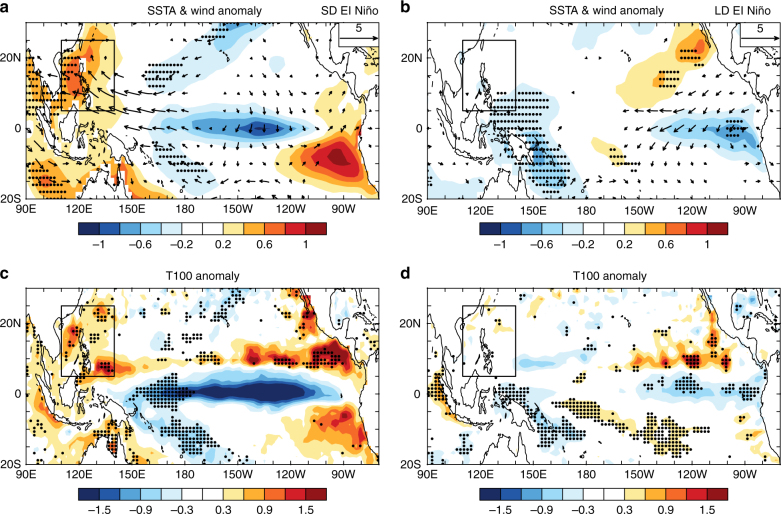
The El Niño-Southern Oscillation (ENSO) can significantly affect the rapid intensification of tropical cyclones over the western North Pacific (WNP). However, ENSO events have various durations, which can lead to different atmospheric and oceanic conditions. Here we show that during short duration El Niño events, the WNP tropical cyclone rapid-intensification mean occurrence position migrates westward by ~8.0° longitude, which is caused by reduced vertical wind shear, increased mid-tropospheric humidity, and enhanced tropical cyclone heat potential over the westernmost WNP. The changes in these factors are caused by westward advected upper ocean heat during the decaying phase of a short duration El Niño. As super El Niño events tend to have short durations and their frequency is projected to increase under global warming, our findings have important implications for future projections of WNP tropical cyclone activity.
厄尔尼诺-南方涛动(ENSO)会显著影响西北太平洋(WNP)上热带气旋的快速增强。然而,ENSO 事件具有不同的持续时间,这会导致不同的大气和海洋条件。在这里,我们表明在短时间厄尔尼诺事件期间,WNP 热带气旋快速增强的平均发生位置向西迁移了约 8.0°经度,这是由于垂直风切变减少、中对流层湿度增加以及西 WNP 上热带气旋热潜能增强所致。这些因素的变化是由短时间厄尔尼诺事件衰减阶段向西平流的上层海洋热量引起的。由于超级厄尔尼诺事件往往持续时间较短,而且预计在全球变暖下其频率会增加,因此我们的发现对未来 WNP 热带气旋活动的预测具有重要意义。