Department of Materials and Production, Aalborg University, Aalborg, Denmark.
Department of Health Science and Technology, Aalborg University, Aalborg, Denmark.
Sci Rep. 2018 Apr 17;8(1):6094. doi: 10.1038/s41598-018-24346-7.
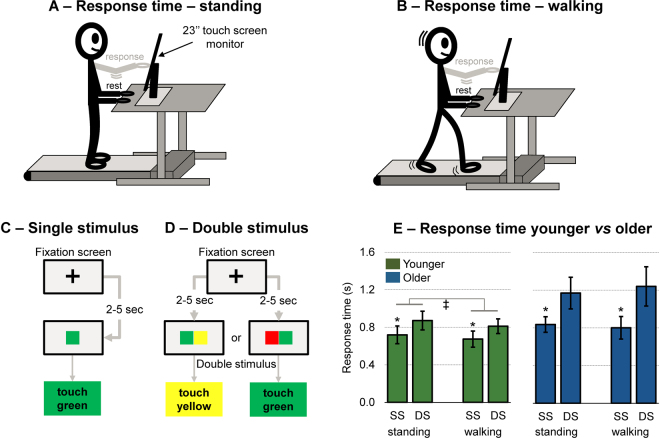
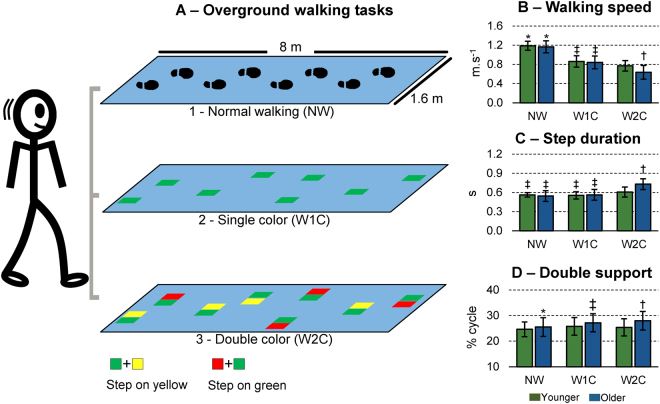
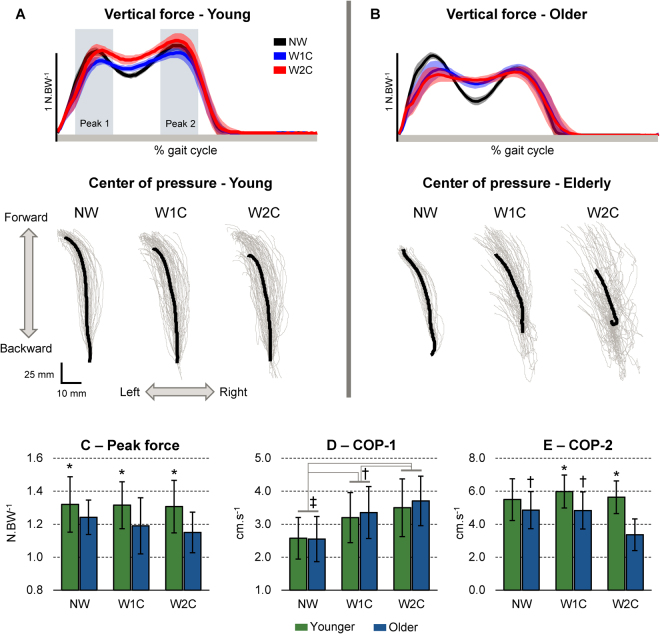
Aging reduces cognitive functions, and such impairments have implications in mental and motor performance. Cognitive function has been recently linked to the risk of falls in older adults. Physical activities have been used to attenuate the declines in cognitive functions and reduce fall incidence, but little is known whether a physically active lifestyle can maintain physical performance under cognitively demanding conditions. The aim of this study was to verify whether physically active older adults present similar performance deficits during upper limb response time and precision stepping walking tasks when compared to younger adults. Both upper limb and walking tasks involved simple and complex cognitive demands through decision-making. For both tasks, decision-making was assessed by including a distracting factor to the execution. The results showed that older adults were substantially slower than younger individuals in the response time tasks involving decision-making. Similarly, older adults walked slower and extended the double support periods when precision stepping involved decision-making. These results suggest that physically active older adults present greater influence of cognitive demanding contexts to perform a motor task when compared to younger adults. These results underpin the need to develop interventions combining cognitive and motor contexts.
衰老会降低认知功能,而这些认知功能的损害会对精神和运动表现产生影响。最近有研究表明,认知功能与老年人跌倒的风险有关。身体活动被用来减轻认知功能的下降和减少跌倒的发生率,但对于积极运动的生活方式是否能在认知要求高的情况下保持身体表现,知之甚少。本研究旨在验证与年轻人相比,积极运动的老年人在上肢反应时间和精确踏步行走任务中是否表现出相似的表现缺陷。上肢和行走任务都通过决策来涉及简单和复杂的认知需求。对于这两个任务,通过向执行过程中添加分散因素来评估决策。结果表明,在涉及决策的反应时间任务中,老年人的反应速度明显慢于年轻人。同样,当精确踏步涉及决策时,老年人的步行速度较慢,并且双支撑期延长。这些结果表明,与年轻人相比,积极运动的老年人在执行运动任务时受到认知要求环境的影响更大。这些结果支持了需要结合认知和运动环境来制定干预措施的必要性。