Looman Wilhelmina Mijntje, Huijsman Robbert, Fabbricotti Isabelle Natalina
Department Health Services Management & Organisation, Erasmus School of Health Policy & Management, Erasmus University, Rotterdam, The Netherlands.
Health Soc Care Community. 2019 Jan;27(1):1-30. doi: 10.1111/hsc.12571. Epub 2018 Apr 17.
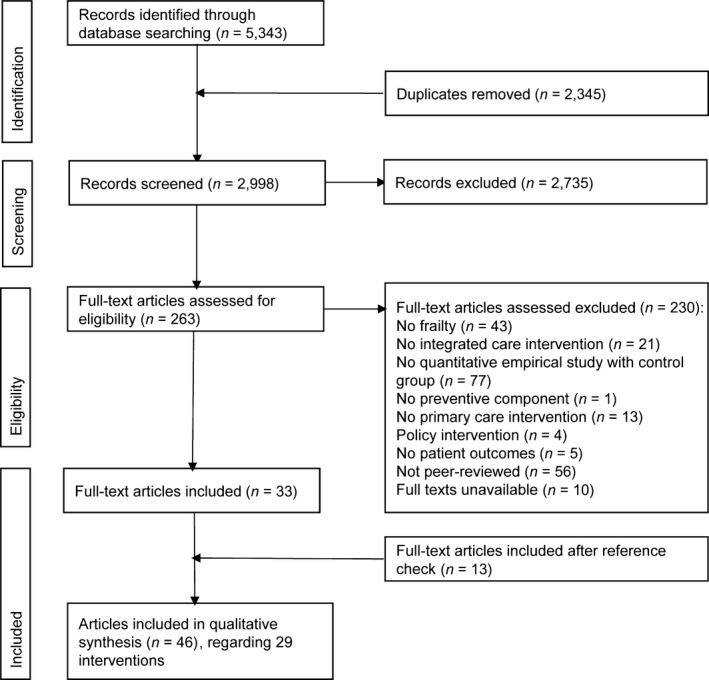
Integrated care is increasingly promoted as an effective and cost-effective way to organise care for community-dwelling frail older people with complex problems but the question remains whether high expectations are justified. Our study aims to systematically review the empirical evidence for the effectiveness and cost-effectiveness of preventive, integrated care for community-dwelling frail older people and close attention is paid to the elements and levels of integration of the interventions. We searched nine databases for eligible studies until May 2016 with a comparison group and reporting at least one outcome regarding effectiveness or cost-effectiveness. We identified 2,998 unique records and, after exclusions, selected 46 studies on 29 interventions. We assessed the quality of the included studies with the Effective Practice and Organization of Care risk-of-bias tool. The interventions were described following Rainbow Model of Integrated Care framework by Valentijn. Our systematic review reveals that the majority of the reported outcomes in the studies on preventive, integrated care show no effects. In terms of health outcomes, effectiveness is demonstrated most often for seldom-reported outcomes such as well-being. Outcomes regarding informal caregivers and professionals are rarely considered and negligible. Most promising are the care process outcomes that did improve for preventive, integrated care interventions as compared to usual care. Healthcare utilisation was the most reported outcome but we found mixed results. Evidence for cost-effectiveness is limited. High expectations should be tempered given this limited and fragmented evidence for the effectiveness and cost-effectiveness of preventive, integrated care for frail older people. Future research should focus on unravelling the heterogeneity of frailty and on exploring what outcomes among frail older people may realistically be expected.
整合照护作为一种为社区中患有复杂问题的体弱老年人组织照护的有效且具成本效益的方式,正得到越来越多的推广,但人们仍质疑这些过高的期望是否合理。我们的研究旨在系统回顾针对社区体弱老年人的预防性整合照护的有效性和成本效益的实证证据,并密切关注干预措施的整合要素和水平。我们检索了九个数据库,以查找截至2016年5月的符合条件的研究,这些研究要有一个对照组,并报告至少一项关于有效性或成本效益的结果。我们识别出2998条独特记录,经过排除后,选择了46项关于29种干预措施的研究。我们使用“有效照护实践与组织”偏倚风险工具评估了纳入研究的质量。这些干预措施是按照瓦伦丁的整合照护彩虹模型框架进行描述的。我们的系统综述显示,在预防性整合照护研究中,所报告的大多数结果都没有效果。在健康结果方面,有效性最常体现在很少报告的结果上,如幸福感。关于非正式照护者和专业人员的结果很少被考虑且微不足道。最有前景的是与常规照护相比,预防性整合照护干预措施在照护过程结果方面有所改善。医疗保健利用率是报告最多的结果,但我们发现结果不一。成本效益的证据有限。鉴于针对体弱老年人的预防性整合照护的有效性和成本效益的证据有限且零散,过高的期望应有所收敛。未来的研究应侧重于揭示衰弱的异质性,并探索体弱老年人实际可能期望的结果。