Li Yan, Zhu Ming-Xi, Qi Si-Hua
Department of Anesthesia, The 4th Affiliated Hospital of Harbin Medical University Key Laboratory of Hepatosplenic Surgery, Ministry of Education, Department of General Surgery, The First Affiliated Hospital of Harbin Medical University, Harbin, China.
Medicine (Baltimore). 2018 Apr;97(16):e0385. doi: 10.1097/MD.0000000000010385.
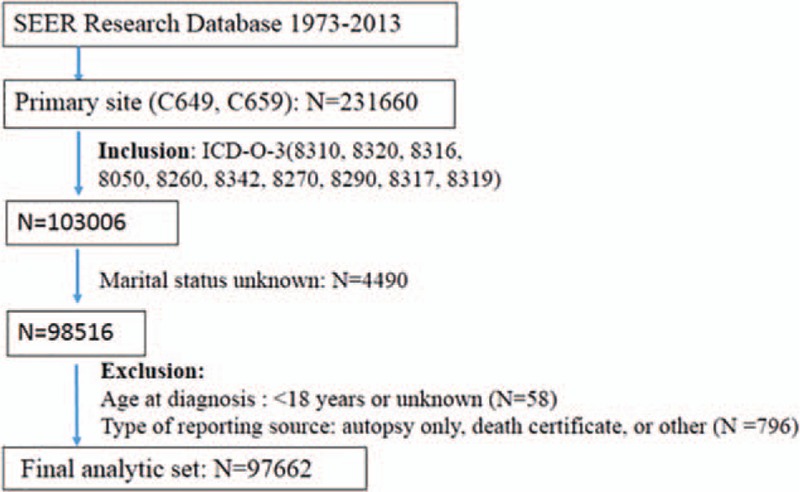
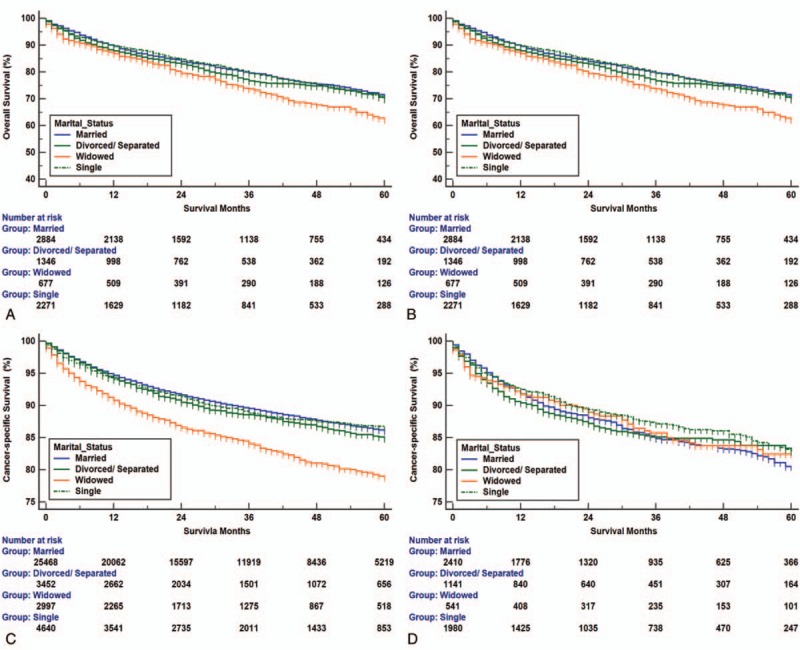
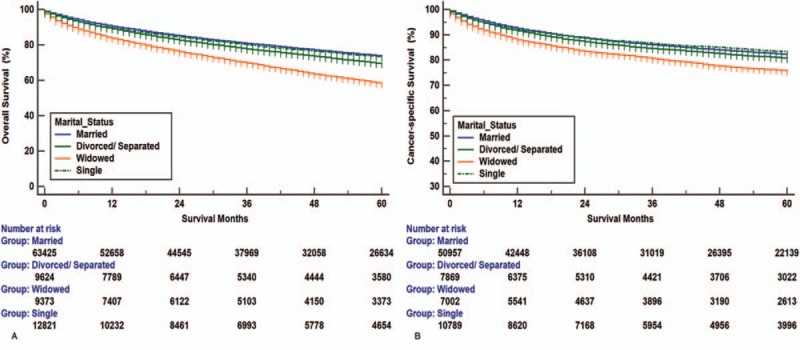
Previous studies have shown that marital status is an independent prognostic factor for survival in several types of cancer. In this study, we investigated the effects of marital status on survival outcomes among renal cell carcinoma (RCC) patients.We identified patients diagnosed with RCC between 1973 and 2013 from the Surveillance, Epidemiology and End Results (SEER) database. Kaplan-Meier analysis and Cox regression were used to identify the effects of marital status on overall survival (OS) and cancer-specific survival (CSS).We enrolled 97,662 eligible RCC patients, including 64,884 married patients, and 32,778 unmarried (9831 divorced/separated, 9692 widowed, and 13,255 single) patients at diagnosis. The 5-year OS and CSS rates of the married, separated/divorced, widowed, and single patients were 73.7%, 69.5%, 58.3%, and 73.2% (OS), and 82.2%, 80.7%, 75.7%, and 83.3% (CSS), respectively. Multivariate Cox regression showed that, compared with married patients, widowed individuals showed poorer OS (hazard ratio, 1.419; 95% confidence interval, 1.370-1.469) and CSS (hazard ratio, 1.210; 95% confidence interval, 1.144-1.279). Stratified analyses and multivariate Cox regression showed that, in the insured and uninsured groups, married patients had better survival outcomes while widowed patients suffered worse OS outcomes; however, this trend was not significant for CSS.In RCC patients, married patients had better survival outcomes while widowed patients tended to suffer worse survival outcomes in terms of both OS and CSS.
以往研究表明,婚姻状况是多种癌症患者生存的独立预后因素。在本研究中,我们调查了婚姻状况对肾细胞癌(RCC)患者生存结局的影响。我们从监测、流行病学和最终结果(SEER)数据库中确定了1973年至2013年间被诊断为RCC的患者。采用Kaplan-Meier分析和Cox回归来确定婚姻状况对总生存期(OS)和癌症特异性生存期(CSS)的影响。我们纳入了97662例符合条件的RCC患者,其中包括64884例已婚患者和32778例未婚(9831例离婚/分居、9692例丧偶和13255例单身)患者。已婚、分居/离婚、丧偶和单身患者的5年OS率和CSS率分别为73.7%、69.5%、58.3%和73.2%(OS),以及82.2%、80.7%、75.7%和83.3%(CSS)。多变量Cox回归显示,与已婚患者相比,丧偶个体的OS(风险比,1.419;95%置信区间,1.370-1.469)和CSS(风险比,1.210;95%置信区间,1.144-1.279)较差。分层分析和多变量Cox回归显示,在参保和未参保组中,已婚患者的生存结局较好,而丧偶患者的OS结局较差;然而,这种趋势在CSS方面并不显著。在RCC患者中,已婚患者的生存结局较好,而丧偶患者在OS和CSS方面的生存结局往往较差。