Department of Orthopaedics, The First Hospital of China Medical University, Shenyang, Liaoning, China (mainland).
Department of Orthopedics, The First Hospital of China Medical University, Shenyang, Liaoning, China (mainland).
Med Sci Monit. 2019 Nov 1;25:8190-8203. doi: 10.12659/MSM.918048.
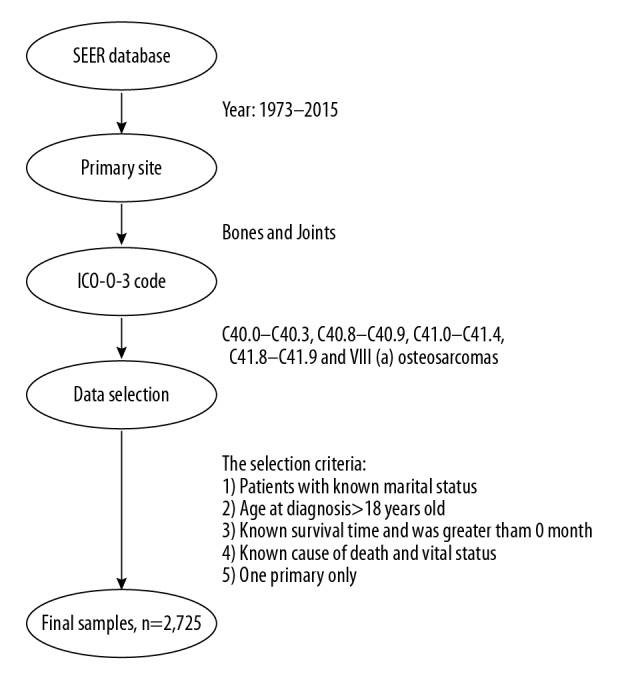
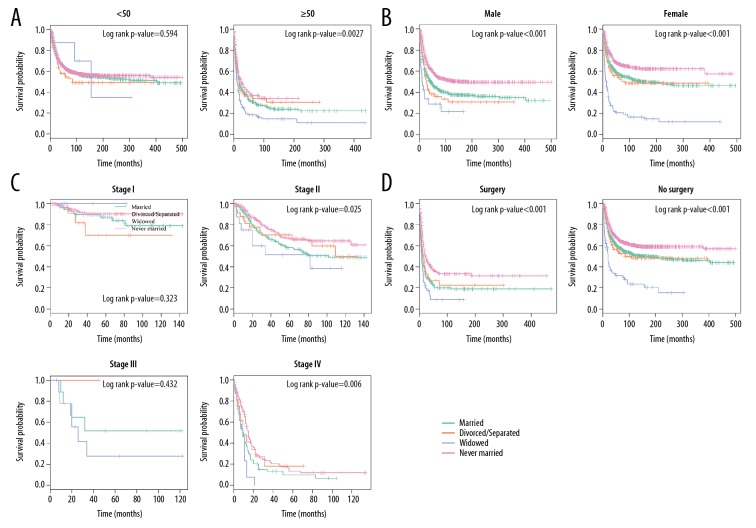
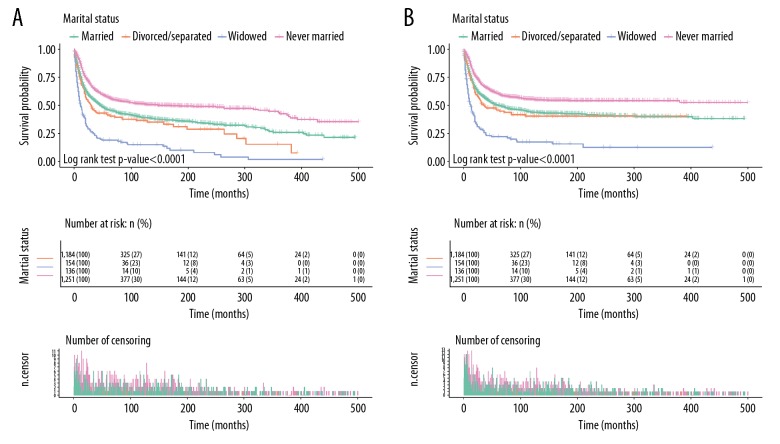
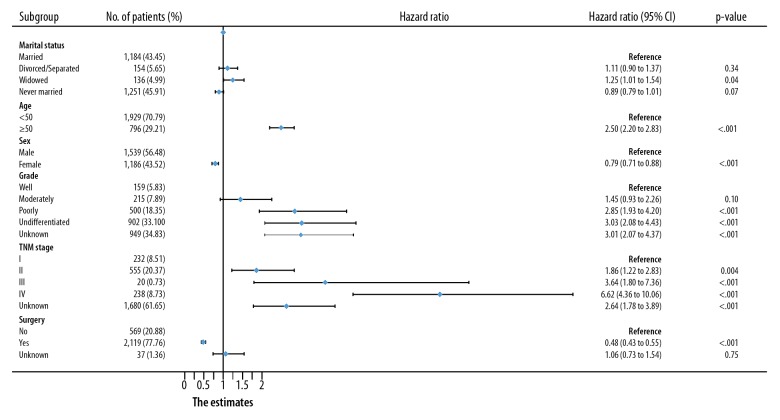
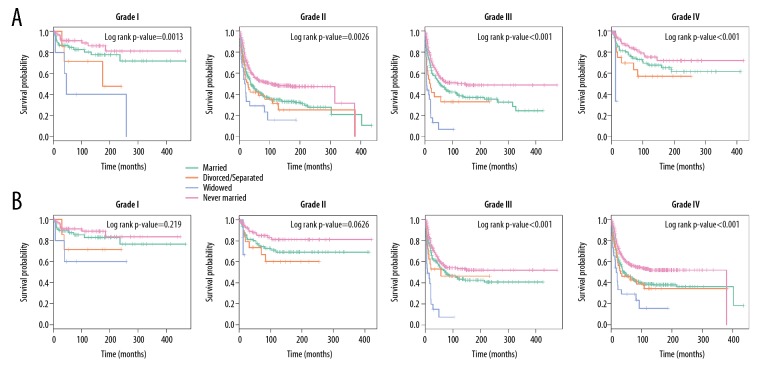
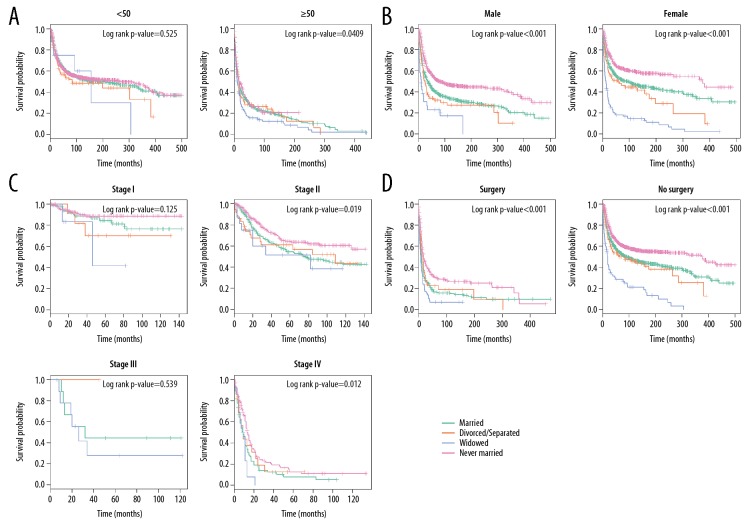
BACKGROUND As the most malignant bone tumor globally, osteosarcoma has drawn increased attention. However, no studies have focused on the association between marital status and survival rate. The objectives of this study were to determine the association between marital and survival rate of osteosarcoma patients based on the SEER database. MATERIAL AND METHODS We enrolled a total of 2725 osteosarcoma patients between 1973 and 2015, including 1184 married, 154 divorced/separated, 136 widowed, and 1251 never-married patients. Survival rate was determined based on the Kaplan-Meier method in different marital subgroups. Multivariate Cox regression analysis was performed to explore independent prognostic factors. RESULTS The 5-year overall survival (OS) and cancer-specific survival (CSS) rates of the married, separated/divorced, widowed, and never-married subjects were 45.93%, 41.39%, 19.08%, and 57.21% (OS), and 49.97%, 45.85%, 22.14%, and 60.69% (CSS), respectively. The survival outcome among subgroups exhibited a clear difference, with a log-rank test p-value <0.0001. Multivariate Cox regression showed that widowhood served as the independent prognostic factor for decreased OS rather than marriage (HR, 1.246; 95% CI, 1.011-1.536; p-value=0.039) and CSS (HR, 1.34; 95% CI, 1.07-1.68; p-value=0.01). Moreover, the OS and CSS in widowed patients were lower. Additionally, based on the propensity score matching (PSM) method, the prognosis of married patients was better than that of unmarried subjects. CONCLUSIONS Marital status was correlated with the survival rate, meaning that married patients had higher survival than widowed subjects, who had worse prognoses of osteosarcoma.
骨肉瘤作为全球最恶性的骨肿瘤,受到了越来越多的关注。然而,目前尚无研究关注婚姻状况与生存率之间的关系。本研究旨在基于 SEER 数据库,探讨婚姻状况与骨肉瘤患者生存率之间的关系。
我们共纳入了 1973 年至 2015 年间的 2725 名骨肉瘤患者,其中 1184 名已婚,154 名离婚/分居,136 名丧偶,1251 名未婚。通过 Kaplan-Meier 法确定不同婚姻亚组的生存率。采用多因素 Cox 回归分析探讨独立的预后因素。
已婚、离婚/分居、丧偶和未婚患者的 5 年总生存率(OS)和癌症特异性生存率(CSS)分别为 45.93%、41.39%、19.08%和 57.21%(OS)和 49.97%、45.85%、22.14%和 60.69%(CSS)。亚组之间的生存结果差异明显,对数秩检验 p 值<0.0001。多因素 Cox 回归显示,丧偶是 OS 和 CSS 降低的独立预后因素,而不是婚姻(HR,1.246;95%CI,1.011-1.536;p 值=0.039)和 CSS(HR,1.34;95%CI,1.07-1.68;p 值=0.01)。此外,丧偶患者的 OS 和 CSS 更低。此外,基于倾向评分匹配(PSM)方法,已婚患者的预后优于未婚患者。
婚姻状况与生存率相关,即已婚患者的生存率高于丧偶患者,而丧偶患者的骨肉瘤预后较差。