Department of Biochemistry, University of Washington, Seattle, WA 98195, USA.
Vaccine and Infectious Disease Division, Fred Hutchinson Cancer Research Center, 1100 Fairview Ave. N. PO Box 19024, Seattle, WA 98109, USA.
Immunity. 2018 Apr 17;48(4):799-811.e9. doi: 10.1016/j.immuni.2018.03.026.
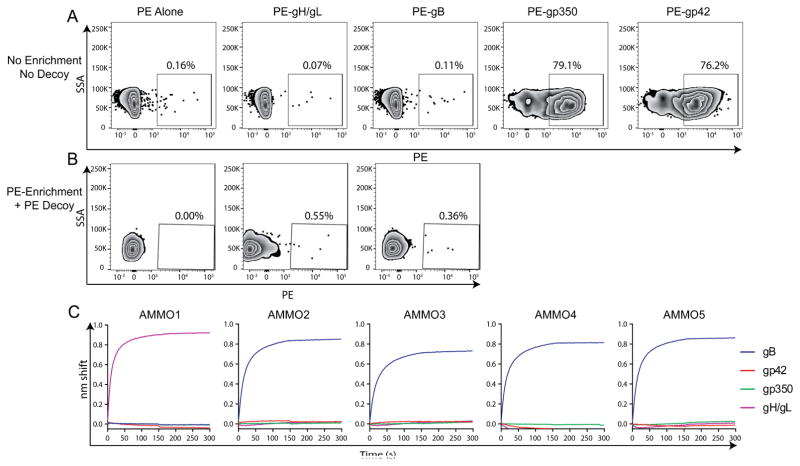
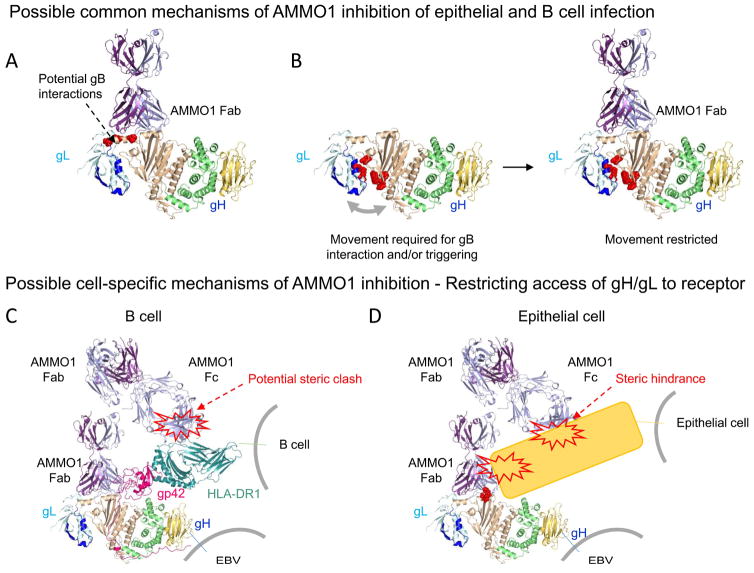
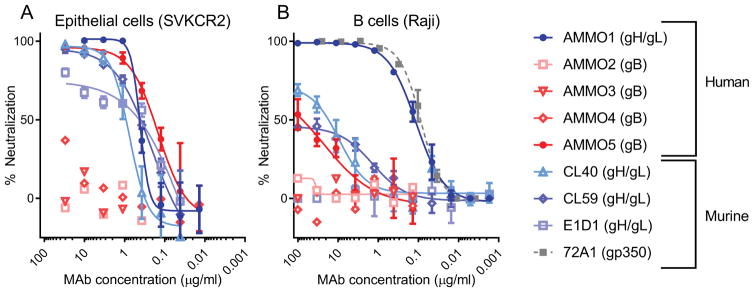
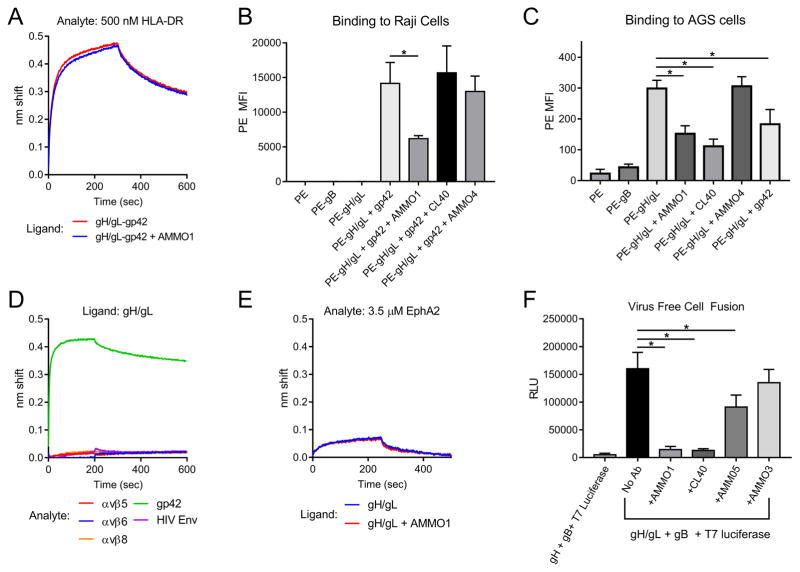
Epstein-Barr virus (EBV) is a causative agent of infectious mononucleosis and is associated with 200,000 new cases of cancer and 140,000 deaths annually. Subunit vaccines against this pathogen have focused on the gp350 glycoprotein and remain unsuccessful. We isolated human antibodies recognizing the EBV fusion machinery (gH/gL and gB) from rare memory B cells. One anti-gH/gL antibody, AMMO1, potently neutralized infection of B cells and epithelial cells, the two major cell types targeted by EBV. We determined a cryo-electron microscopy reconstruction of the gH/gL-gp42-AMMO1 complex and demonstrated that AMMO1 bound to a discontinuous epitope formed by both gH and gL at the Domain-I/Domain-II interface. Integrating structural, biochemical, and infectivity data, we propose that AMMO1 inhibits fusion of the viral and cellular membranes. This work identifies a crucial epitope that may aid in the design of next-generation subunit vaccines against this major public health burden.
EB 病毒(EBV)是传染性单核细胞增多症的病原体,每年导致 20 万例新癌症病例和 14 万人死亡。针对这种病原体的亚单位疫苗主要针对 gp350 糖蛋白,但仍未成功。我们从罕见的记忆 B 细胞中分离出了识别 EBV 融合机制(gH/gL 和 gB)的人源抗体。一种抗 gH/gL 抗体 AMMO1 能够有效中和 B 细胞和上皮细胞的感染,这两种细胞是 EBV 的主要靶细胞类型。我们确定了 gH/gL-gp42-AMMO1 复合物的低温电子显微镜重建结构,并证明 AMMO1 结合在 gH 和 gL 于域 I/域 II 界面形成的不连续表位上。综合结构、生化和感染性数据,我们提出 AMMO1 抑制病毒和细胞膜的融合。这项工作鉴定了一个关键表位,可能有助于设计针对这种主要公共卫生负担的下一代亚单位疫苗。