National Center for Environmental Assessment, Office of Research and Development (ORD), U.S. Environmental Protection Agency (EPA), Research Triangle Park, North Carolina, USA.
University of California Los Angeles Institute for Society and Genetics, Los Angeles, California, USA.
Environ Health Perspect. 2018 Apr 12;126(4):045001. doi: 10.1289/EHP2322.
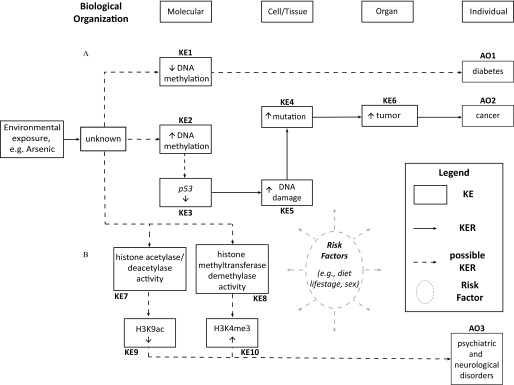
The epigenome may be an important interface between environmental chemical exposures and human health. However, the links between epigenetic modifications and health outcomes are often correlative and do not distinguish between cause and effect or common-cause relationships. The Adverse Outcome Pathway (AOP) framework has the potential to demonstrate, by way of an inference- and science-based analysis, the causal relationship between chemical exposures, epigenome, and adverse health outcomes.
The objective of this work is to discuss the epigenome as a modifier of exposure effects and risk, perspectives for integrating toxicoepigenetic data into an AOP framework, tools for the exploration of epigenetic toxicity, and integration of AOP-guided epigenetic information into science and risk-assessment processes.
Organizing epigenetic information into the topology of a qualitative AOP network may help describe how a system will respond to epigenetic modifications caused by environmental chemical exposures. However, understanding the biological plausibility, linking epigenetic effects to short- and long-term health outcomes, and including epigenetic studies in the risk assessment process is met by substantive challenges. These obstacles include understanding the complex range of epigenetic modifications and their combinatorial effects, the large number of environmental chemicals to be tested, and the lack of data that quantitatively evaluate the epigenetic effects of environmental exposure.
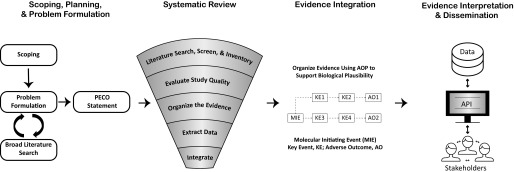
We anticipate that epigenetic information organized into AOP frameworks can be consistently used to support biological plausibility and to identify data gaps that will accelerate the pace at which epigenetic information is applied in chemical evaluation and risk-assessment paradigms. https://doi.org/10.1289/EHP2322.
表观基因组可能是环境化学暴露与人类健康之间的重要接口。然而,表观遗传修饰与健康结果之间的联系通常是相关的,无法区分因果关系或共同原因关系。通过推理和基于科学的分析,不良结局途径 (AOP) 框架有可能证明化学暴露、表观基因组和不良健康结果之间的因果关系。
本工作旨在讨论表观基因组作为暴露效应和风险的修饰物,将毒代遗传学数据纳入 AOP 框架的观点,探索表观遗传毒性的工具,以及将 AOP 指导的表观遗传信息整合到科学和风险评估过程中。
将表观遗传信息组织到定性 AOP 网络的拓扑结构中,可能有助于描述系统将如何对环境化学暴露引起的表观遗传修饰做出反应。然而,理解生物学合理性、将表观遗传效应与短期和长期健康结果联系起来,以及将表观遗传研究纳入风险评估过程,都面临实质性的挑战。这些障碍包括理解复杂的表观遗传修饰范围及其组合效应、要测试的大量环境化学物质,以及缺乏定量评估环境暴露的表观遗传效应的数据。
我们预计,组织到 AOP 框架中的表观遗传信息可以一致地用于支持生物学合理性,并确定数据差距,这将加速将表观遗传信息应用于化学评估和风险评估范式的速度。https://doi.org/10.1289/EHP2322.