Inoshita Masatoshi, Umehara Hidehiro, Watanabe Shin-Ya, Nakataki Masahito, Kinoshita Makoto, Tomioka Yukiko, Tajima Atsushi, Numata Shusuke, Ohmori Tetsuro
Department of Psychiatry, Graduate School of Biomedical Sciences, Tokushima University, Tokushima, Japan.
Department of Bioinformatics and Genomics, Graduate School of Advanced Preventive Medical Sciences, Kanazawa University, Ishikawa, Japan.
Neuropsychiatr Dis Treat. 2018 Apr 6;14:945-953. doi: 10.2147/NDT.S159855. eCollection 2018.
There is growing evidence that glutamatergic signaling may be involved in major depressive disorder (MDD). In regard to peripheral blood glutamate changes in MDD, inconsistent findings have been reported. The purpose of the present study was to evaluate whether blood glutamate levels differed between MDD patients and control participants.
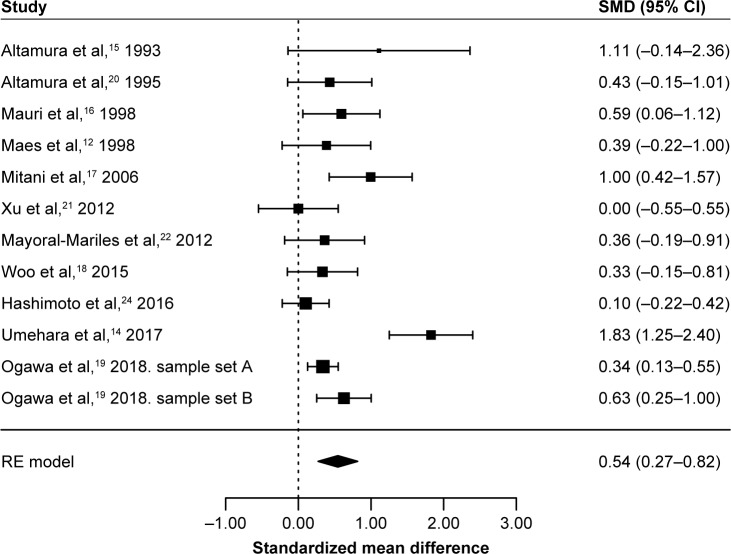
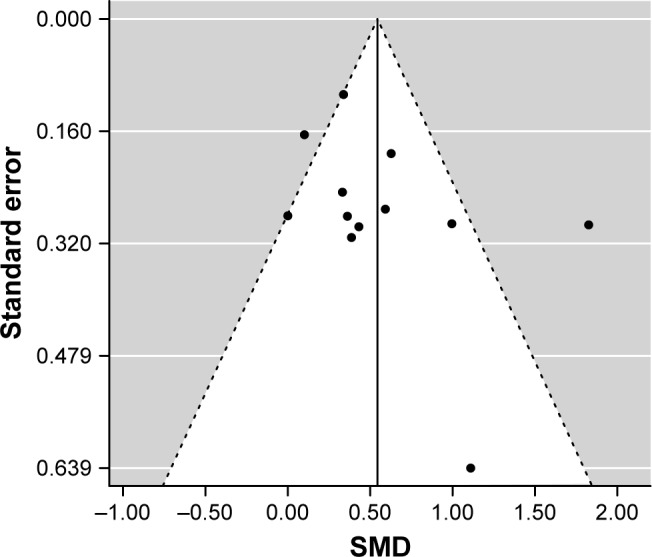
We conducted a systematic review and meta-analysis of 12 association studies between blood glutamate levels and MDD in a total of 529 MDD patients and 590 controls. Subsequently, we conducted subgroup analyses and a meta-regression analysis to examine the sources of potential heterogeneity.
A random effects model showed that blood glutamate levels were significantly higher in MDD patients than in controls (standardized mean difference=0.54, 95% CI=0.27-0.82, =8.5×10) with high heterogeneity (=75.0%, <0.05). Subgroup analyses showed elevated glutamate levels in MDD patients compared with controls in plasma, but not serum studies, and in studies using high-performance liquid chromatography but not with mass spectrometry for glutamate assay. A meta-regression analysis showed no effects of age, gender, medication use, sample size, and published year on blood glutamate levels.
Our findings suggest that altered glutamate levels may be implicated in MDD, which provides further evidence of glutamatergic dysfunction in MDD.
越来越多的证据表明,谷氨酸能信号传导可能与重度抑郁症(MDD)有关。关于MDD患者外周血谷氨酸的变化,已有不一致的研究结果报道。本研究的目的是评估MDD患者与对照参与者之间的血谷氨酸水平是否存在差异。
我们对12项关于血谷氨酸水平与MDD的关联研究进行了系统评价和荟萃分析,这些研究共纳入了529例MDD患者和590例对照。随后,我们进行了亚组分析和荟萃回归分析,以检验潜在异质性的来源。
随机效应模型显示,MDD患者的血谷氨酸水平显著高于对照组(标准化均差=0.54,95%CI=0.27 - 0.82,P = 8.5×10⁻¹⁰),异质性较高(I² = 75.0%,P < 0.05)。亚组分析显示,与对照组相比,MDD患者血浆中的谷氨酸水平升高,但血清研究中未发现此现象;在使用高效液相色谱法检测谷氨酸的研究中发现了升高,但使用质谱法检测的研究中未发现。荟萃回归分析显示,年龄、性别、用药情况、样本量和发表年份对血谷氨酸水平均无影响。
我们的研究结果表明,谷氨酸水平的改变可能与MDD有关,这为MDD中谷氨酸能功能障碍提供了进一步的证据。