Zhou Lei, Du Yanyan, Kong Lingqun, Zhang Xingyuan, Chen Qiangpu
Department of Hepatobiliary Surgery, The Affiliated Hospital of Binzhou Medical University, Binzhou, China.
Onco Targets Ther. 2018 Apr 4;11:1861-1869. doi: 10.2147/OTT.S156737. eCollection 2018.
Hepatocellular carcinoma (HCC) is a major cause of cancer mortality and is increasing incidence worldwide. The aim of this study was to identify the key genes and microRNAs in HCC and explore their potential mechanisms.
The gene expression profiles of GSE76427, GSE64041, GSE57957, and the microRNA dataset GSE67882 were downloaded from the Gene Expression Omnibus database. The online tool GEO2R was used to obtain differentially expressed genes (DEGs) and miRNAs (DEMs). The gene ontology and the Kyoto Encyclopedia of Genes and Genomes pathway enrichment analysis were performed for DEGs using the Database for Annotation, Visualization, and Integrated Discovery. A protein-protein interaction (PPI) network of the DEGs was constructed by Search Tool for the Retrieval of Interacting Genes and visualized by Cytoscape. Moreover, miRecords was used to predict the target genes of DEMs.
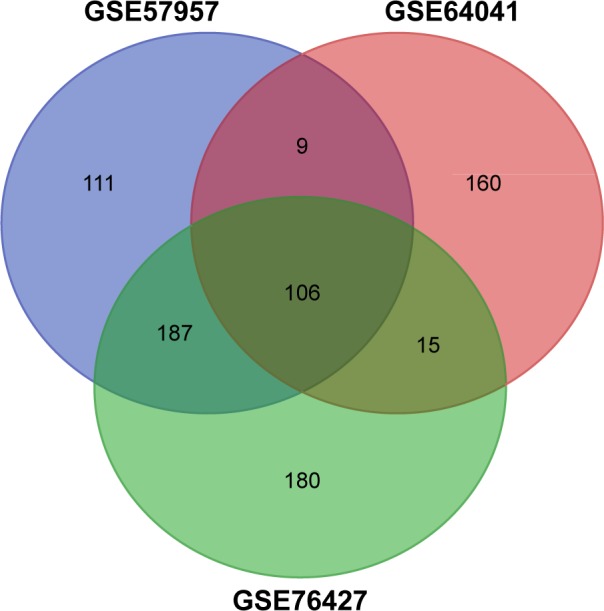
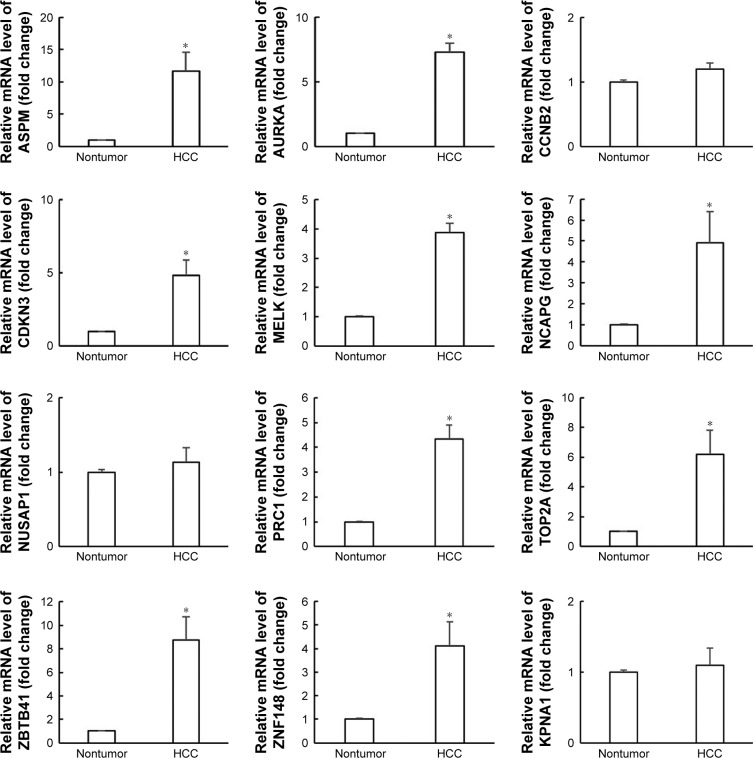
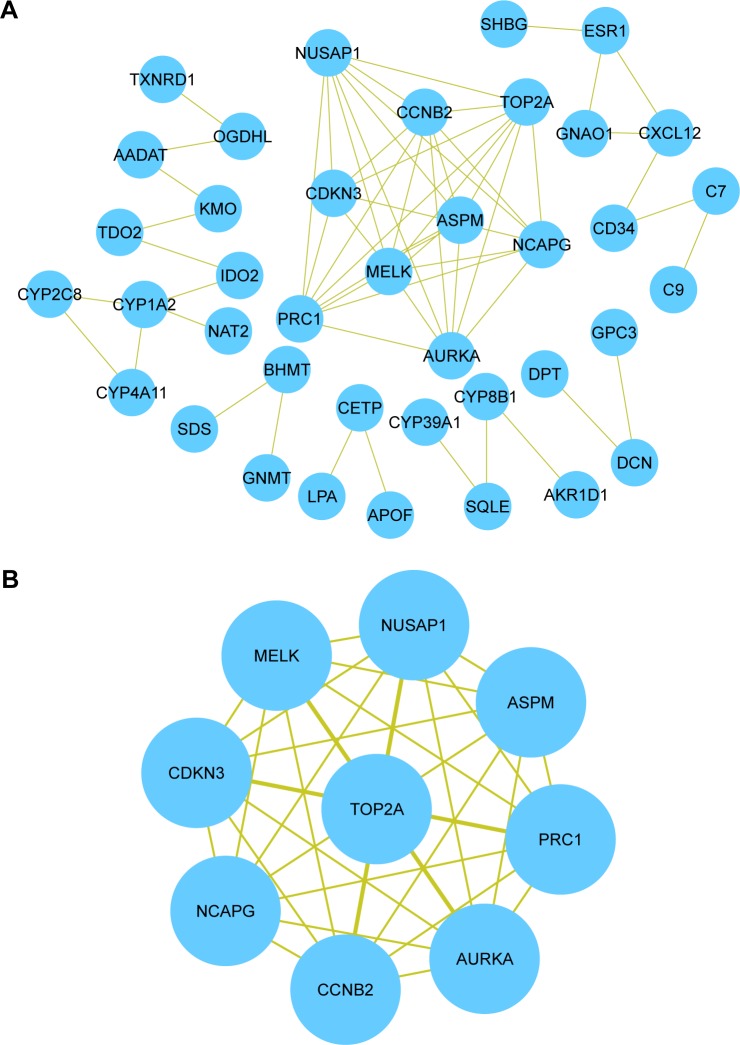
In total, 106 DEGs were screened out in HCC, consisting of 89 upregulated genes and 17 downregulated genes, which were mainly enriched in biological processes associated with oxidation-reduction process. Besides, the Kyoto Encyclopedia of Genes and Genomes pathways including chemical carcinogenesis, drug metabolism-cytochrome P450, tryptophan metabolism, and retinol metabolism were involved. A PPI network was constructed consisting of 105 nodes and 66 edges. A significant module including nine hub genes, ASPM, AURKA, CCNB2, CDKN3, MELK, NCAPG, NUSAP1, PRC1, and TOP2A, was detected from the PPI network by Molecular Complex Detection. The enriched functions were mainly associated with the mitotic cell cycle process, cell division, and mitotic cell cycle. In addition, a total of 21 DEMs were identified, including 9 upregulated and 12 downregulated miRNAs. Interestingly, ZBTB41 was the potential target of seven miRNAs. Finally, the nine hub genes and three miRNA-target genes expression levels were validated by reverse transcription-polymerase chain reaction. The relative expression levels of nine genes (ASPM, AURKA, CDKN3, MELK, NCAPG, PRC1, TOP2A, ZBTB41, and ZNF148) were significantly upregulated in cancer tissues.
This study identified the key genes and potential molecular mechanisms underlying the development of HCC, which could provide new insight for HCC interventional strategies.
肝细胞癌(HCC)是癌症死亡的主要原因,且在全球范围内发病率呈上升趋势。本研究旨在鉴定HCC中的关键基因和微小RNA,并探索其潜在机制。
从基因表达综合数据库下载GSE76427、GSE64041、GSE57957基因表达谱以及微小RNA数据集GSE67882。使用在线工具GEO2R获取差异表达基因(DEGs)和微小RNA(DEMs)。使用注释、可视化和综合发现数据库对DEGs进行基因本体和京都基因与基因组百科全书通路富集分析。通过检索相互作用基因的搜索工具构建DEGs的蛋白质-蛋白质相互作用(PPI)网络,并使用Cytoscape进行可视化。此外,使用miRecords预测DEMs的靶基因。
共筛选出106个HCC中的DEGs,其中包括89个上调基因和17个下调基因,主要富集在与氧化还原过程相关的生物学过程中。此外,还涉及京都基因与基因组百科全书通路,包括化学致癌作用、药物代谢-细胞色素P450、色氨酸代谢和视黄醇代谢。构建了一个由105个节点和66条边组成的PPI网络。通过分子复合物检测从PPI网络中检测到一个包含9个枢纽基因(ASPM、AURKA、CCNB2、CDKN3、MELK、NCAPG、NUSAP1、PRC1和TOP2A)的显著模块。富集的功能主要与有丝分裂细胞周期过程、细胞分裂和有丝分裂细胞周期相关。此外,共鉴定出21个DEMs,包括9个上调和12个下调的微小RNA。有趣的是,ZBTB41是7个微小RNA的潜在靶标。最后,通过逆转录-聚合酶链反应验证了9个枢纽基因和3个微小RNA靶基因的表达水平。9个基因(ASPM、AURKA、CDKN3、MELK、NCAPG、PRC1、TOP2A、ZBTB41和ZNF148)在癌组织中的相对表达水平显著上调。
本研究鉴定了HCC发生发展的关键基因和潜在分子机制,可为HCC的干预策略提供新的见解。