You Haisheng, Yang Jin, Liu Qingqing, Tang Lina, Bu Qingting, Pan Zhenyu, Lyu Jun
Department of Pharmacy, The First Affiliated Hospital of Xi'an Jiaotong University, Xi'an, Shaanxi, People's Republic of China.
Clinical Research Center, The First Affiliated Hospital of Xi'an Jiaotong University, Xi'an, Shaanxi, People's Republic of China.
Cancer Manag Res. 2018 Apr 6;10:671-677. doi: 10.2147/CMAR.S163514. eCollection 2018.
The objective of this study was to determine the impact of the lymph node density (LND) on overall survival of patients with Wilms' tumor (WT) using the Surveillance, Epidemiology, and End Results (SEER) database.
Data from the SEER database were extracted from patients with WT in whom the LND could be obtained. Patients were divided into a low LND group and high LND group. Survival curves based on the LND stratification were plotted using the Kaplan-Meier method and compared with the log-rank test. The impact of prognostic factors on overall survival was analyzed using Cox regression models.
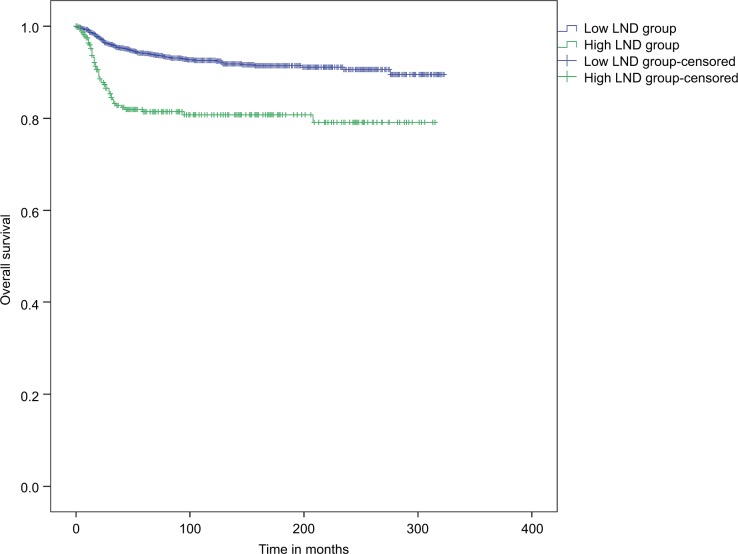
A total of 1,924 patients were identified from the database. Overall survival for the low LND group at 5, 10, and 20 years was significantly better than the high LND group (5-year survival: 94.1% vs 81.4%; 10-year survival: 92.6% vs 80.8%; 20-year survival: 90.6% vs 79.1%; <0.001). In multivariate analysis, LND was a significant predictor of overall survival, regardless of whether it was a categorical variable or a continuous variable. Other significant predictors included age, race, SEER stage, and tumor laterality.
LND was a significant risk factor for overall survival of patients with WT. LND may provide a better prediction of the prognosis of WT patients and may be helpful for designing better treatments.
本研究的目的是使用监测、流行病学和最终结果(SEER)数据库来确定淋巴结密度(LND)对肾母细胞瘤(WT)患者总生存期的影响。
从SEER数据库中提取可获得LND的WT患者的数据。将患者分为低LND组和高LND组。使用Kaplan-Meier方法绘制基于LND分层的生存曲线,并通过对数秩检验进行比较。使用Cox回归模型分析预后因素对总生存期的影响。
从数据库中识别出总共1924例患者。低LND组5年、10年和20年的总生存期明显优于高LND组(5年生存率:94.1%对81.4%;10年生存率:92.6%对80.8%;20年生存率:90.6%对79.1%;P<0.001)。在多变量分析中,LND是总生存期的显著预测因素,无论它是分类变量还是连续变量。其他显著的预测因素包括年龄、种族、SEER分期和肿瘤侧别。
LND是WT患者总生存期的显著危险因素。LND可能为WT患者的预后提供更好的预测,并且可能有助于设计更好的治疗方案。