Zhang Dandan, Xie Hui, He Zhenhong, Wei Zhaoguo, Gu Ruolei
CAS Key Laboratory of Behavioral Science, Institute of Psychology, Beijing, China.
Shenzhen Key Laboratory of Affective and Social Cognitive Science, Shenzhen University, Shenzhen, China.
Front Behav Neurosci. 2018 Apr 4;12:65. doi: 10.3389/fnbeh.2018.00065. eCollection 2018.
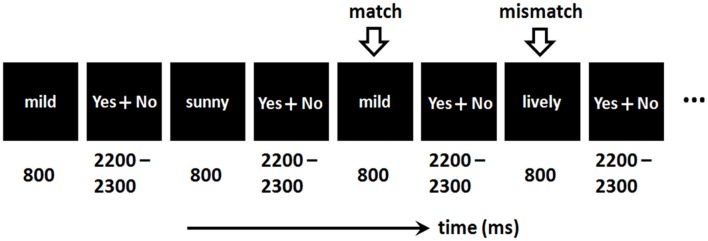
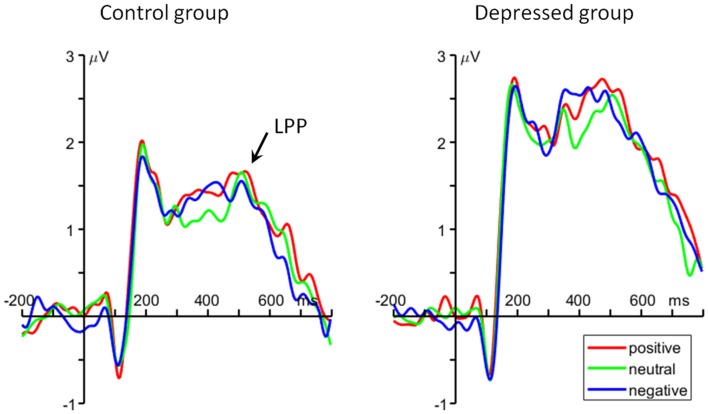
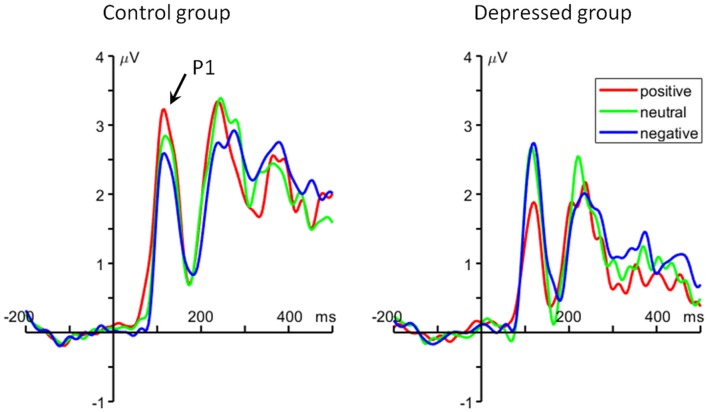
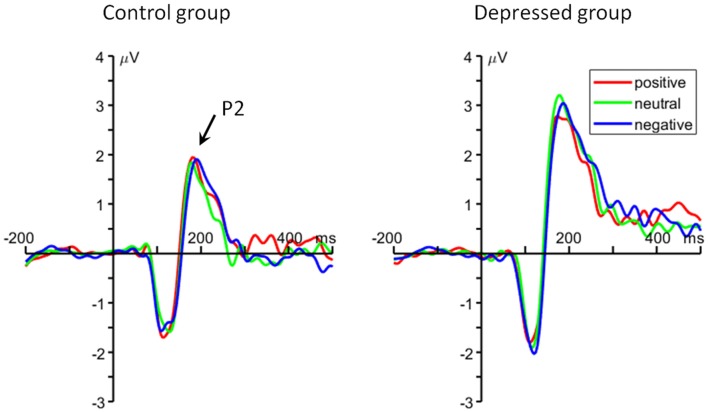
Although two previous studies have demonstrated that depressed individuals showed deficits in working memory (WM) updating of both negative and positive contents, the effects were confounded by shifting dysfunctions and the detailed neural mechanism associated with the failure in N-back task is not clear. Using a 2-back task, the current study examined the WM updating of positive, negative and neutral contents in depressed patients. It is found that depressed patients performed poorer than healthy controls only when updating positive material. Using event-related potential (ERP) technique, the current study also investigated the neural correlates of updating deficits in depression. According to previous studies, the n-back task was divided into three sub-processes, i.e., encoding, matching and maintaining. Our ERP results showed that depressed patients had smaller occipital P1 for positive material compared to healthy controls, indicating their insensitivity to positive items on early encoding stage. Besides, depressed patients had larger frontal P2 and parietal late positive potential (LPP) than healthy controls irrespective of the valence of the words, reflecting that patients are inefficient during matching (P2) and maintaining (LPP) processes. These two mechanisms (insufficient attention to positive stimuli and low efficiency in matching and maintaining) together lead to the deficits of WM updating in depression.
尽管之前的两项研究表明,抑郁个体在对负面和正面内容的工作记忆(WM)更新方面存在缺陷,但这些影响被转换功能障碍所混淆,并且与N-back任务失败相关的详细神经机制尚不清楚。本研究采用2-back任务,考察了抑郁症患者对正面、负面和中性内容的WM更新情况。研究发现,抑郁症患者仅在更新正面材料时表现比健康对照组差。本研究还使用事件相关电位(ERP)技术,调查了抑郁症中更新缺陷的神经关联。根据之前的研究,n-back任务分为三个子过程,即编码、匹配和维持。我们的ERP结果显示,与健康对照组相比,抑郁症患者对正面材料的枕叶P1较小,表明他们在早期编码阶段对正面项目不敏感。此外,无论单词的效价如何,抑郁症患者的额叶P2和顶叶晚期正电位(LPP)均大于健康对照组,这反映出患者在匹配(P2)和维持(LPP)过程中效率低下。这两种机制(对正面刺激的注意力不足以及匹配和维持效率低下)共同导致了抑郁症患者WM更新的缺陷。