Jocz Paulina, Stolarski Maciej, Jankowski Konrad S
Faculty of Psychology, University of Warsaw, Warsaw, Poland.
Front Psychol. 2018 Apr 4;9:443. doi: 10.3389/fpsyg.2018.00443. eCollection 2018.
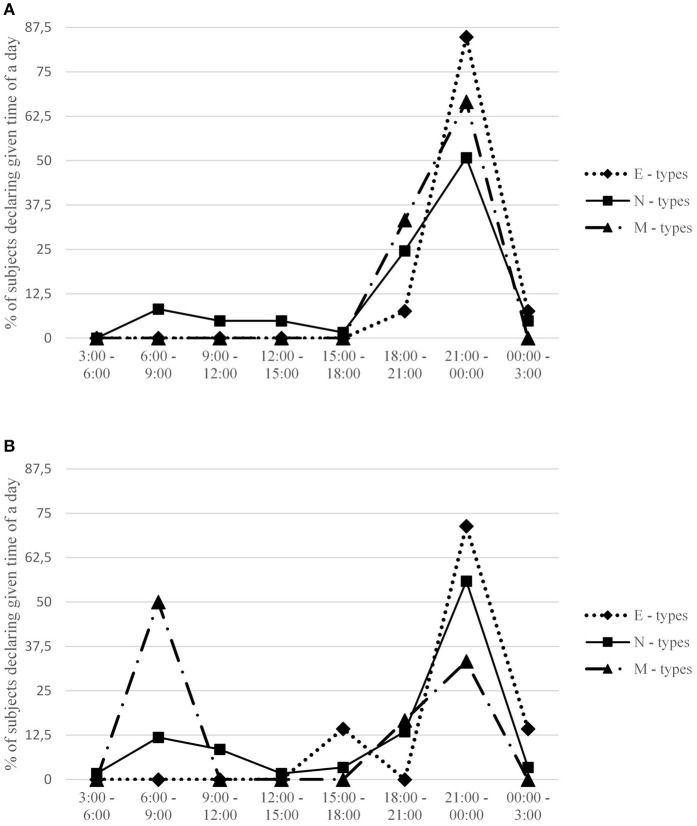
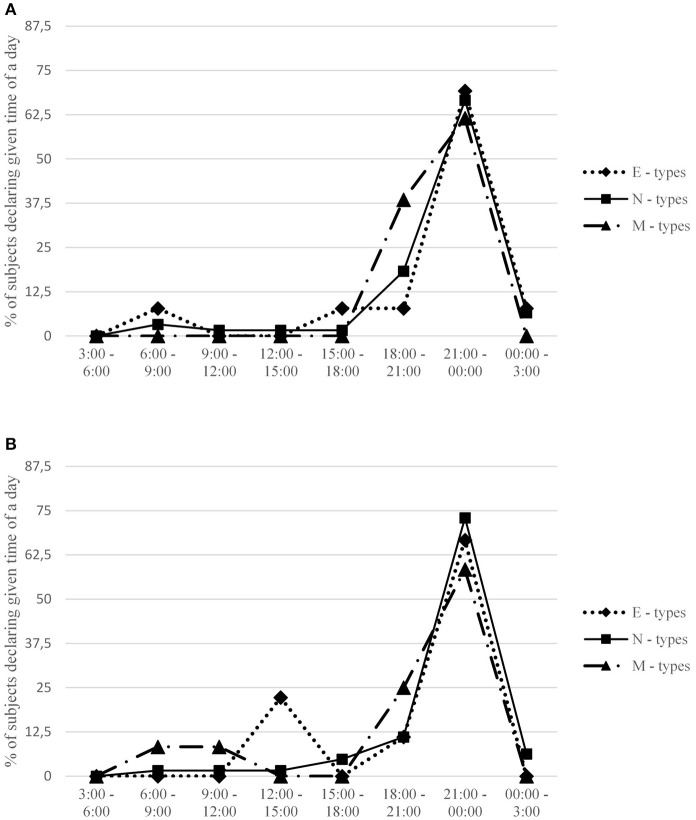
Recently, the issue of diurnal preferences has been increasingly studied within the context of romantic relationships and sexual functioning. In the present paper we apply a dyadic design to investigate the role of romantic partners' diurnal preferences in determining a variety of relationship outcomes. A sample of 91 heterosexual couples completed a set of questionnaires measuring relationship satisfaction, sexual satisfaction, and morningness-eveningness, and answered questions regarding their actual and preferred time for sexual activity. Conducted analyses revealed that similarity in chronotype between partners and female morningness fostered relationship satisfaction in females, but not in males. Furthermore, morningness-eveningness was associated with preferred time for sex in males, but not in females, who in principle preferred evening hours. Although actual time for sex was up to the female preference, sexual satisfaction in both genders was associated with lower discrepancy in their preferred time for sex and greater frequency of intercourse. In sum, these results indicate that chronotype and time for sex are important factors affecting sexual and relationships satisfaction in heterosexual couples.
最近,在浪漫关系和性功能的背景下,昼夜偏好问题受到了越来越多的研究。在本文中,我们采用二元设计来研究浪漫伴侣的昼夜偏好在决定各种关系结果中的作用。91对异性恋夫妇组成的样本完成了一组测量关系满意度、性满意度和晨型-夜型的问卷,并回答了关于他们实际和偏好的性行为时间的问题。进行的分析表明,伴侣之间的生物钟类型相似性以及女性的晨型特质促进了女性的关系满意度,但对男性没有影响。此外,晨型-夜型与男性偏好的性行为时间相关,但与女性无关,女性原则上更喜欢晚上的时间。尽管实际的性行为时间取决于女性的偏好,但两性的性满意度都与他们偏好的性行为时间差异较小以及性交频率较高有关。总之,这些结果表明生物钟类型和性行为时间是影响异性恋夫妇性满意度和关系满意度的重要因素。