Memarpour Mahtab, Shafiei Fereshteh, Zarean Mehran, Razmjoei Faranak
DMD, MScD, Professor, Oral and Dental Disease Research Center, Department of Pediatric Dentistry, School of Dentistry, Shiraz University of Medical Sciences, Shiraz, Iran.
DMD, MScD, Professor, Oral and Dental Disease Research Center, Department of Operative Dentistry, School of Dentistry, Shiraz University of Medical Sciences, Shiraz, Iran.
J Clin Exp Dent. 2018 Jan 1;10(1):e1-e6. doi: 10.4317/jced.54471. eCollection 2018 Jan.
The effectiveness of sealants is dependent upon their adhesion to enamel surface. The aim of the study was to evaluate the sealing ability of a pit and fissure sealant used with a universal adhesive (etch-and-rinse vs. self-etch modes) when the site is contaminated with saliva. Adhesive properties were evaluated as microleakage and scanning electron microscopic (SEM) characteristics.
A total of 72 mandibular third molars were randomly divided into 6 groups (n=12). Occlusal pits and fissures were sealed with an unfilled resin fissure sealant (FS) material with or without saliva contamination. The groups included: 1) phosphoric acid etching + FS (control), 2) phosphoric acid etching + Scotchbond Universal (etch-and-rinse) + FS, 3) phosphoric acid etching + saliva + Scotchbond Universal (etch-and-rinse) + FS, 4) Scotchbond Universal (self-etching) + FS,5) Scotchbond Universal (self-etching) + saliva + FS, and 6) Scotchbond Universal (self-etching) + saliva + Scotchbond Universal + FS. After thermocycling, the teeth were placed in 0.5% fuchsin, sectioned, and evaluated by digital microscopy. Two samples from each group were also observed by SEM. The data were analyzed with Kruskal-Wallis and Mann-Whitney tests for a significance of <0.05.
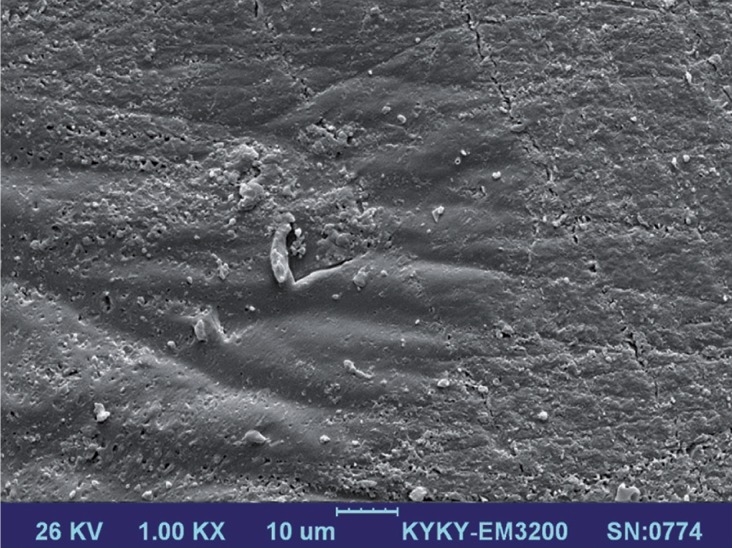
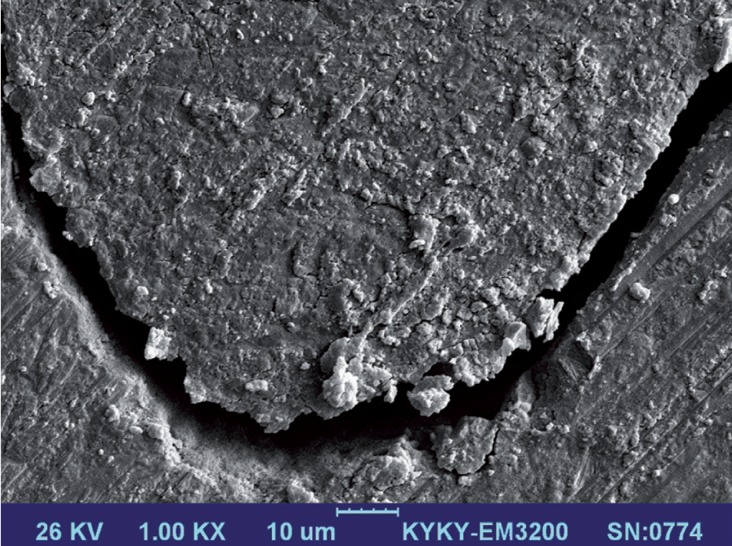
There were significant differences among groups. Groups 1,2 and 4 showed the least microleakage, with no significant differences among groups. Saliva contamination led to increased microleakage and gap formation in SEM images in groups 3, 5 and 6.
The fissure sealing ability of the universal adhesive in etch-and-rinse or self-etch modes was similar to that of conventional acid etching. Saliva contamination had a negative effect on sealant adhesion to pretreated enamel. Pit and fissure sealant, Universal adhesive, Saliva.
窝沟封闭剂的有效性取决于其对牙釉质表面的附着力。本研究的目的是评估在窝沟被唾液污染的情况下,通用型粘结剂(酸蚀冲洗型与自酸蚀型)与窝沟封闭剂联合使用时的封闭能力。通过微渗漏和扫描电子显微镜(SEM)特征评估粘结性能。
将72颗下颌第三磨牙随机分为6组(每组n = 12)。用未填充树脂窝沟封闭剂(FS)材料对咬合面窝沟进行封闭,分为有或无唾液污染两种情况。分组如下:1)磷酸酸蚀 + FS(对照组),2)磷酸酸蚀 + 3M Scotchbond Universal通用型粘结剂(酸蚀冲洗型)+ FS,3)磷酸酸蚀 + 唾液 + 3M Scotchbond Universal通用型粘结剂(酸蚀冲洗型)+ FS,4)3M Scotchbond Universal通用型粘结剂(自酸蚀型)+ FS,5)3M Scotchbond Universal通用型粘结剂(自酸蚀型)+ 唾液 + FS,6)3M Scotchbond Universal通用型粘结剂(自酸蚀型)+ 唾液 + 3M Scotchbond Universal通用型粘结剂 + FS。经过热循环后,将牙齿置于0.5%的品红溶液中,切片,并通过数码显微镜进行评估。每组还选取两个样本进行SEM观察。采用Kruskal-Wallis检验和Mann-Whitney检验对数据进行分析,显著性水平设定为<0.05。
各组之间存在显著差异。第1、2和4组微渗漏最少,各组间无显著差异。唾液污染导致第3、5和6组在SEM图像中微渗漏增加和间隙形成。
通用型粘结剂在酸蚀冲洗或自酸蚀模式下的窝沟封闭能力与传统酸蚀相似。唾液污染对封闭剂与预处理牙釉质的粘结有负面影响。窝沟封闭剂,通用型粘结剂,唾液