Department of Neonatologe The Second Affiliated Hospital of Jiaxing University Jiaxing China.
Brain Behav. 2018 Mar 25;8(4):e00948. doi: 10.1002/brb3.948. eCollection 2018 Apr.
To detect the expression of high-mobility group box protein 1 (HMGB1) and toll-like receptor 4 (TLR4) and their downstream signaling factors-myeloid differentiation factor 88 (MyD88), nuclear factor kappa B (NF-κB), and tumor necrosis factor alpha (TNF-α)-in the sera of patients with Parkinson's disease (PD) in order to evaluate the relationship of the HMGB1-TLR4 axis with PD development and progression.
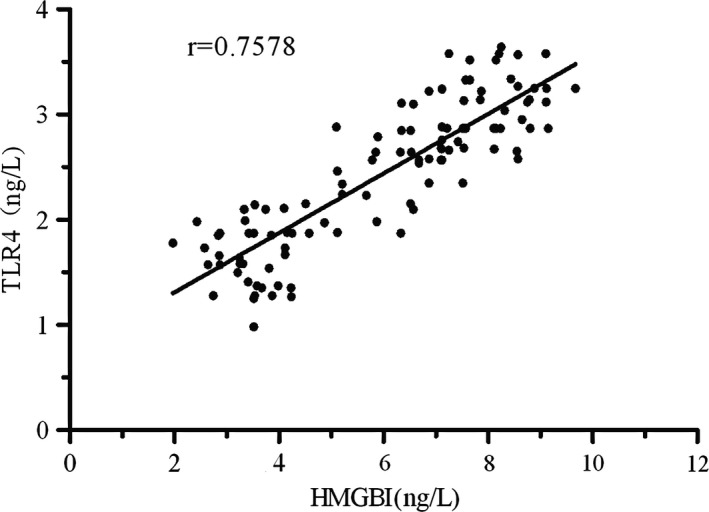
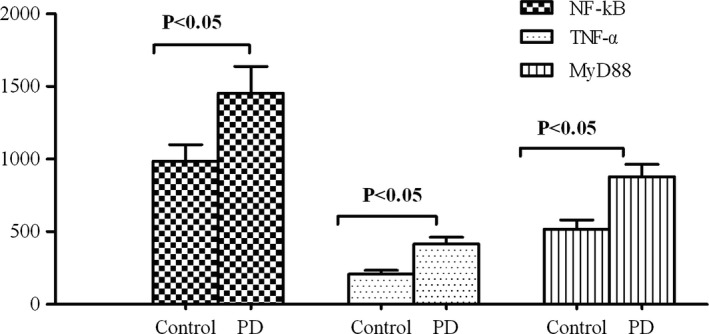
The serum HMGB1 and TLR4 protein levels of 120 patients with PD and 100 healthy volunteers were measured using double-antibody sandwich ELISA, and their correlations with PD staging, disease duration, drug treatment effectiveness, and clinical classification were analyzed. In addition, their correlations with the key downstream factors of the HMGB1-TLR4 axis (MyD88, NF-κB, and TNF-α) were analyzed.
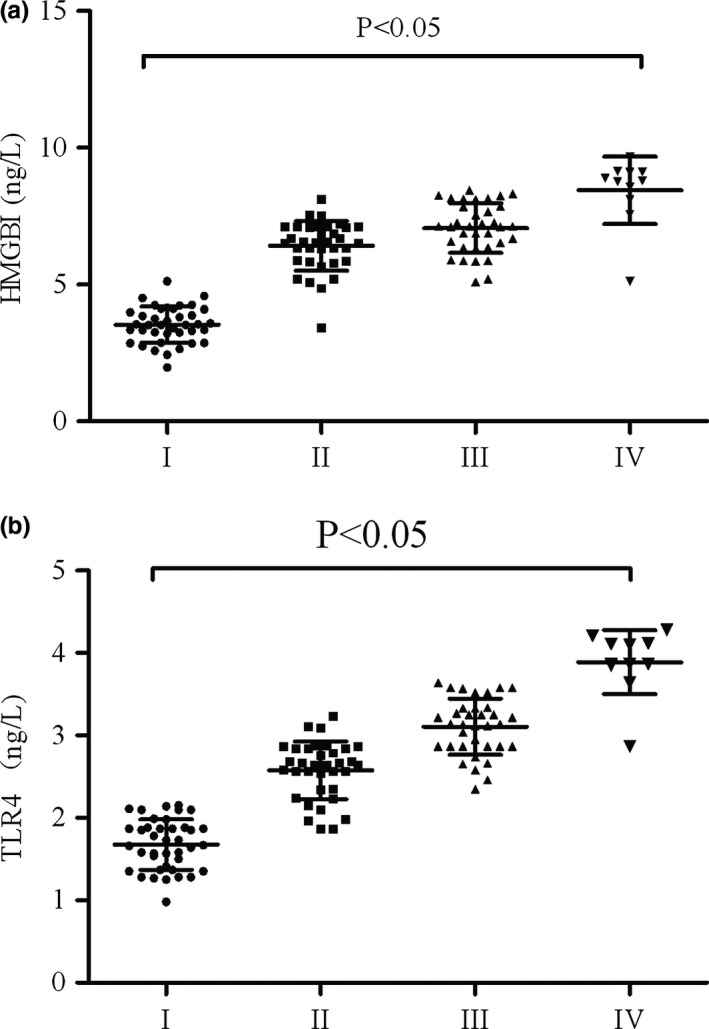
HMGB1 and TLR4 expressions were higher in the peripheral blood of patients with PD than in healthy volunteers. PD patients with poor drug treatment outcomes had significantly higher HMGB1 and TLR4 expressions than PD patients with stable drug treatment outcomes. Higher HMGB1 and TLR4 expressions were found in patients at higher PD stages, and patients with >4-year disease duration had significantly higher HMGB1 and TLR4 expressions than patients with <4-year disease duration. No significant difference in HMGB1 and TLR4 expressions was found among patients with tremor-dominant, akinetic-rigid, and mixed subtypes of PD. NF-κB and TNF-α expressions were positively correlated with high expression of the HMGB1-TLR4 axis.
High expression of the HMGB1-TLR4 axis is closely associated with PD development, progression, drug treatment effectiveness, staging, and disease duration and has great significance for PD diagnosis and treatment.
检测高迁移率族蛋白 B1(HMGB1)和 Toll 样受体 4(TLR4)及其下游信号因子髓样分化因子 88(MyD88)、核因子 κB(NF-κB)和肿瘤坏死因子-α(TNF-α)在帕金森病(PD)患者血清中的表达,以评估 HMGB1-TLR4 轴与 PD 发生和发展的关系。
采用双抗体夹心 ELISA 法检测 120 例 PD 患者和 100 例健康志愿者血清 HMGB1 和 TLR4 蛋白水平,分析其与 PD 分期、病程、药物治疗效果及临床分型的关系。此外,还分析了它们与 HMGB1-TLR4 轴下游关键因子(MyD88、NF-κB 和 TNF-α)的相关性。
PD 患者外周血中 HMGB1 和 TLR4 表达高于健康志愿者。药物治疗效果不佳的 PD 患者 HMGB1 和 TLR4 表达明显高于药物治疗效果稳定的 PD 患者。HMGB1 和 TLR4 表达随 PD 分期升高而升高,病程>4 年的患者明显高于病程<4 年的患者。震颤为主型、无动僵直型和混合型 PD 患者 HMGB1 和 TLR4 表达无明显差异。NF-κB 和 TNF-α 的表达与 HMGB1-TLR4 轴的高表达呈正相关。
HMGB1-TLR4 轴的高表达与 PD 的发生、发展、药物治疗效果、分期及病程密切相关,对 PD 的诊断和治疗具有重要意义。