Faculty of Health, Zuyd University of Applied Sciences, Heerlen, The Netherlands.
Department of Family Medicine, CAPHRI School for Public Health and Primary Care, Maastricht University, Maastricht, The Netherlands.
Health Expect. 2018 Oct;21(5):848-857. doi: 10.1111/hex.12679. Epub 2018 Apr 19.
To gain insight into how communication vulnerable people and health-care professionals experience the communication in dialogue conversations, and how they adjust their conversation using augmentative and alternative communication (AAC) or other communication strategies.
Communication vulnerable clients and health-care professionals in a long-term care institution were observed during a dialogue conversation (n = 11) and subsequently interviewed (n = 22) about their experiences with the conversation. The clients had various communication difficulties due to different underlying aetiologies, such as acquired brain injury or learning disorder. Results from the observations and interviews were analysed using conventional content analysis.
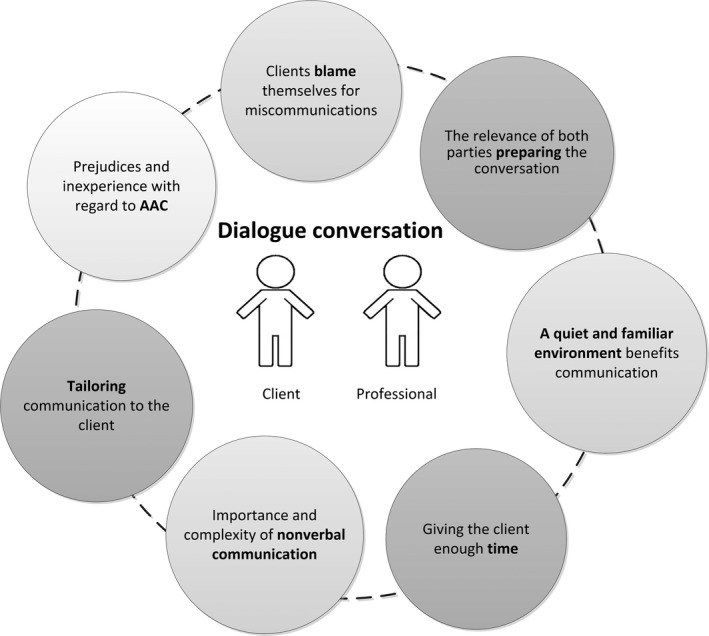
Seven key themes emerged regarding the experiences of clients and professionals: clients blame themselves for miscommunications; the relevance of both parties preparing the conversation; a quiet and familiar environment benefitting communication; giving clients enough time; the importance and complexity of nonverbal communication; the need to tailor communication to the client; prejudices and inexperience regarding AAC. The observations showed that some professionals had difficulties using appropriate communication strategies and all professionals relied mostly on verbal or nonverbal communication strategies.
Professionals were aware of the importance of preparation, sufficient time, a suitable environment and considering nonverbal communication in dialogue conversations. However, they struggled with adequate use of communication strategies, such as verbal communication and AAC. There is a lack of knowledge about AAC, and professionals and clients need to be informed about the potential of AAC and how this can help them achieve equal participation in dialogue conversations in addition to other communication strategies.
深入了解沟通弱势群体和医疗保健专业人员在对话交流中体验到的沟通方式,以及他们如何通过使用增强和替代沟通(AAC)或其他沟通策略来调整对话。
在长期护理机构中,观察沟通弱势群体的客户和医疗保健专业人员在对话交流(n=11)期间的情况,并随后对他们(n=22)进行关于对话体验的访谈。这些客户由于不同的潜在病因,如获得性脑损伤或学习障碍,存在各种沟通困难。观察结果和访谈结果采用常规内容分析进行分析。
关于客户和专业人员的体验,出现了七个关键主题:客户将沟通不畅归咎于自己;双方准备对话的重要性;安静熟悉的环境有利于沟通;给予客户足够的时间;非言语沟通的重要性和复杂性;根据客户的需求调整沟通的必要性;对 AAC 的偏见和缺乏经验。观察结果表明,一些专业人员在使用适当的沟通策略方面存在困难,所有专业人员主要依赖言语或非言语沟通策略。
专业人员意识到在对话交流中准备、足够的时间、合适的环境和考虑非言语沟通的重要性。然而,他们在使用沟通策略方面存在困难,例如言语沟通和 AAC。他们对 AAC 的了解不足,专业人员和客户需要了解 AAC 的潜力以及如何通过这种方式帮助他们除了其他沟通策略外,还能在对话交流中实现平等参与。