Kaltschmidt Barbara, Greiner Johannes F W, Kadhim Hussamadin M, Kaltschmidt Christian
AG Molecular Neurobiology, University of Bielefeld, 33615 Bielefeld, Germany.
Department of Cell Biology, University of Bielefeld, 33615 Bielefeld, Germany.
Biomedicines. 2018 Apr 17;6(2):44. doi: 10.3390/biomedicines6020044.
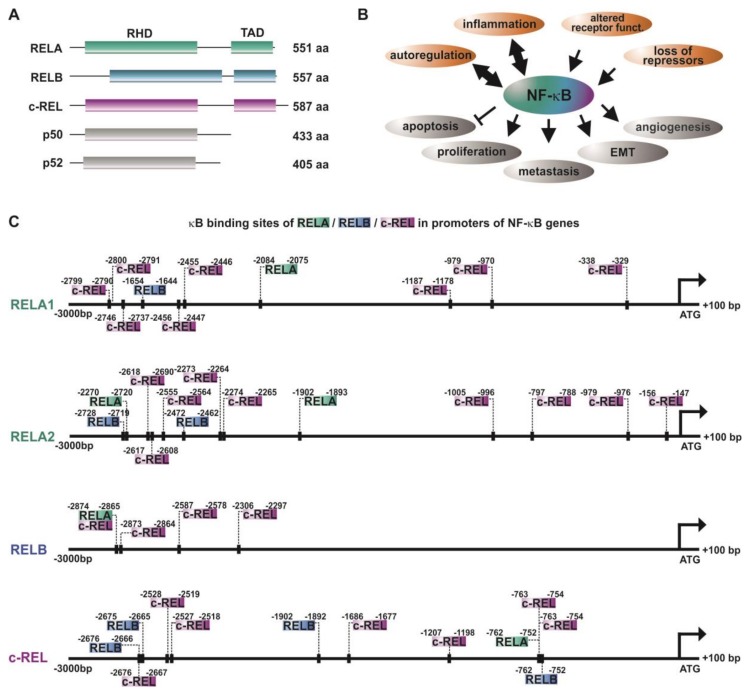
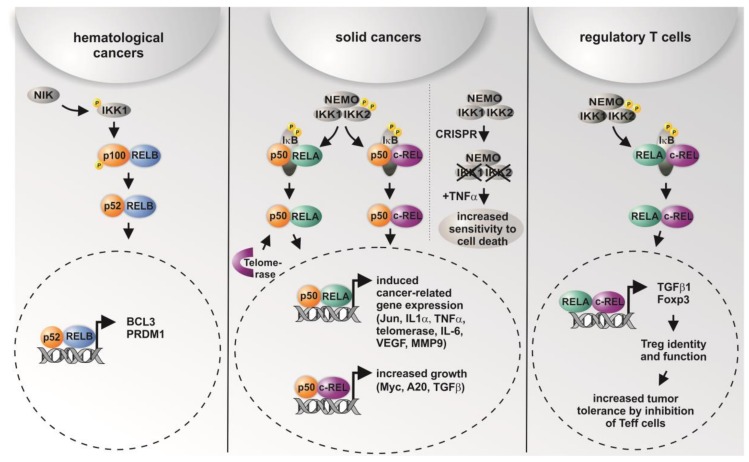
The transcription factor NF-κB is a key player in inflammation, cancer development, and progression. NF-κB stimulates cell proliferation, prevents apoptosis, and could promote tumor angiogenesis as well as metastasis. Extending the commonly accepted role of NF-κB in cancer formation and progression, different NF-κB subunits have been shown to be active and of particular importance in distinct types of cancer. Here, we summarize overexpression data of the NF-κB subunits RELA, RELB, and c-REL (referring to the v-REL, which is the oncogene of Reticuloendotheliosis virus strain T) as well as of their upstream kinase inhibitor, namely inhibitor of κB kinases (IKK), in different human cancers, assessed by database mining. These data argue against a universal mechanism of cancer-mediated activation of NF-κB, and suggest a much more elaborated mode of NF-κB regulation, indicating a tumor type-specific upregulation of the NF-κB subunits. We further discuss recent findings showing the diverse roles of NF-κB signaling in cancer development and metastasis in a subunit-specific manner, emphasizing their specific transcriptional activity and the role of autoregulation. While non-canonical NF-κB RELB signaling is described to be mostly present in hematological cancers, solid cancers reveal constitutive canonical NF-κB RELA or c-REL activity. Providing a linkage to cancer therapy, we discuss the recently described pivotal role of NF-κB c-REL in regulating cancer-targeting immune responses. In addition, current strategies and ongoing clinical trials are summarized, which utilize genome editing or drugs to inhibit the NF-κB subunits for cancer treatment.
转录因子核因子-κB(NF-κB)在炎症、癌症发生和发展过程中起着关键作用。NF-κB可刺激细胞增殖、防止细胞凋亡,还可能促进肿瘤血管生成和转移。除了在癌症形成和发展中发挥普遍公认的作用外,不同的NF-κB亚基在不同类型的癌症中也表现出活性且尤为重要。在此,我们通过数据库挖掘总结了NF-κB亚基RELA、RELB和c-REL(参考v-REL,即网状内皮增生症病毒T株的癌基因)及其上游激酶抑制剂,即κB激酶抑制剂(IKK)在不同人类癌症中的过表达数据。这些数据反驳了癌症介导的NF-κB激活的普遍机制,并提示了一种更为精细的NF-κB调节模式,表明NF-κB亚基存在肿瘤类型特异性上调。我们还进一步讨论了最近的研究结果,这些结果以亚基特异性方式展示了NF-κB信号在癌症发生和转移中的多种作用,强调了它们的特定转录活性和自调节作用。虽然非经典NF-κB RELB信号大多存在于血液系统癌症中,但实体癌显示出组成型经典NF-κB RELA或c-REL活性。在与癌症治疗的联系方面,我们讨论了最近描述的NF-κB c-REL在调节癌症靶向免疫反应中的关键作用。此外,还总结了目前利用基因组编辑或药物抑制NF-κB亚基进行癌症治疗的策略和正在进行的临床试验。