Emery Joanne L, Coleman Tim, Sutton Stephen, Cooper Sue, Leonardi-Bee Jo, Jones Matthew, Naughton Felix
Behavioral Science Group, Institute of Public Health, University of Cambridge, Cambridge, United Kingdom.
Division of Primary Care, School of Medicine, University of Nottingham, Nottingham, United Kingdom.
J Med Internet Res. 2018 Apr 19;20(4):e146. doi: 10.2196/jmir.8525.
Smoking in pregnancy is a major public health concern. Pregnant smokers are particularly difficult to reach, with low uptake of support options and few effective interventions. Text message-based self-help is a promising, low-cost intervention for this population, but its real-world uptake is largely unknown.
The objective of this study was to explore the uptake and cost-effectiveness of a tailored, theory-guided, text message intervention for pregnant smokers ("MiQuit") when advertised on the internet.
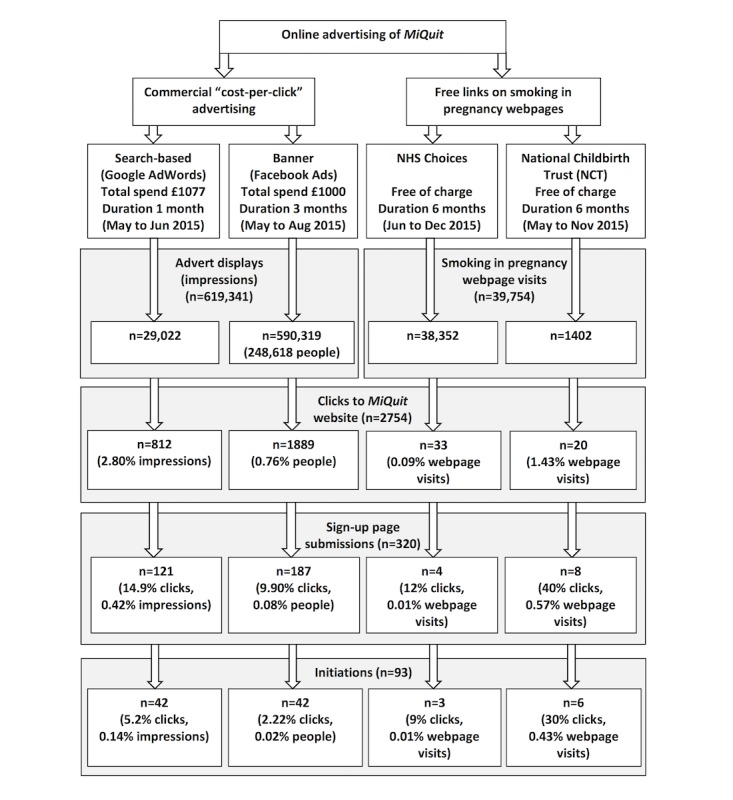
Links to a website providing MiQuit initiation information (texting a short code) were advertised on a cost-per-click basis on 2 websites (Google Search and Facebook; £1000 budget each) and free of charge within smoking-in-pregnancy webpages on 2 noncommercial websites (National Childbirth Trust and NHS Choices). Daily budgets were capped to allow the Google and Facebook adverts to run for 1 and 3 months, respectively. We recorded the number of times adverts were shown and clicked on, the number of MiQuit initiations, the characteristics of those initiating MiQuit, and whether support was discontinued prematurely. For the commercial adverts, we calculated the cost per initiation and, using quit rates obtained from an earlier clinical trial, estimated the cost per additional quitter.
With equal capped budgets, there were 812 and 1889 advert clicks to the MiQuit website from Google (search-based) and Facebook (banner) adverts, respectively. MiQuit was initiated by 5.2% (42/812) of those clicking via Google (95% CI 3.9%-6.9%) and 2.22% (42/1889) of those clicking via Facebook (95% CI 1.65%-2.99%). Adverts on noncommercial webpages generated 53 clicks over 6 months, with 9 initiations (9/53, 17%; 95% CI 9%-30%). For the commercial websites combined, mean cost per initiation was £24.73; estimated cost per additional quitter, including text delivery costs, was £735.86 (95% CI £227.66-£5223.93). Those initiating MiQuit via Google were typically very early in pregnancy (median gestation 5 weeks, interquartile range 10 weeks); those initiating via Facebook were distributed more evenly across pregnancy (median gestation 16 weeks, interquartile range 14 weeks).
Commercial online adverts are a feasible, likely cost-effective method for engaging pregnant smokers in digital cessation support and may generate uptake at a faster rate than noncommercial websites. As a strategy for implementing MiQuit, online advertising has large reach potential and can offer support to a hard-to-reach population of smokers.
孕期吸烟是一个重大的公共卫生问题。怀孕吸烟者尤其难以接触到,他们对支持选项的接受度较低,且有效的干预措施较少。基于短信的自助干预对于这一人群来说是一种有前景的低成本干预方式,但其在现实世界中的接受情况在很大程度上尚不清楚。
本研究的目的是探讨针对怀孕吸烟者的一种量身定制、理论指导的短信干预措施(“MiQuit”)在互联网上进行广告宣传时的接受情况和成本效益。
在两个网站(谷歌搜索和脸书;每个预算1000英镑)上以每次点击付费的方式宣传一个提供MiQuit启动信息(发送短代码短信)的网站链接,并在两个非商业网站(国家分娩信托和国民保健服务选择)的孕期吸烟网页上免费宣传。每日预算设限,以便谷歌和脸书的广告分别投放1个月和3个月。我们记录了广告展示和点击的次数、MiQuit的启动次数、启动MiQuit者的特征,以及支持是否过早中断。对于商业广告,我们计算了每次启动的成本,并使用从早期临床试验中获得的戒烟率,估计了每增加一名戒烟者的成本。
在预算相同的情况下,谷歌(基于搜索)和脸书(横幅)广告分别有812次和1889次点击进入MiQuit网站。通过谷歌点击的人中,有5.2%(42/812)启动了MiQuit(95%可信区间3.9%-6.9%),通过脸书点击的人中,有2.22%(42/1889)启动了MiQuit(95%可信区间1.65%-2.99%)。非商业网页上的广告在6个月内产生了53次点击,有9人启动(9/53,17%;95%可信区间9%-30%)。对于综合的商业网站,每次启动的平均成本为24.73英镑;包括短信发送成本在内,每增加一名戒烟者的估计成本为735.86英镑(95%可信区间227.66英镑-5223.93英镑)。通过谷歌启动MiQuit的人通常处于怀孕早期(妊娠中位数5周,四分位间距10周);通过脸书启动的人在孕期分布更均匀(妊娠中位数16周,四分位间距14周)。
商业在线广告是使怀孕吸烟者参与数字戒烟支持的一种可行且可能具有成本效益的方法,并且可能比非商业网站更快地产生接受度。作为实施MiQuit的一种策略,在线广告具有很大的覆盖潜力,可以为难以接触到的吸烟人群提供支持。