Zhang Shan-Shan, Feng Lei, Senanayake Ravithree D, Aikens Christine M, Wang Xing-Po, Zhao Quan-Qin, Tung Chen-Ho, Sun Di
Key Lab of Colloid and Interface Chemistry , Ministry of Education , School of Chemistry and Chemical Engineering , Shandong University , Jinan , 250100 , P. R. China . Email:
Department of Chemistry , Kansas State University , Manhattan , Kansas 66506 , USA.
Chem Sci. 2017 Dec 4;9(5):1251-1258. doi: 10.1039/c7sc03566g. eCollection 2018 Feb 7.
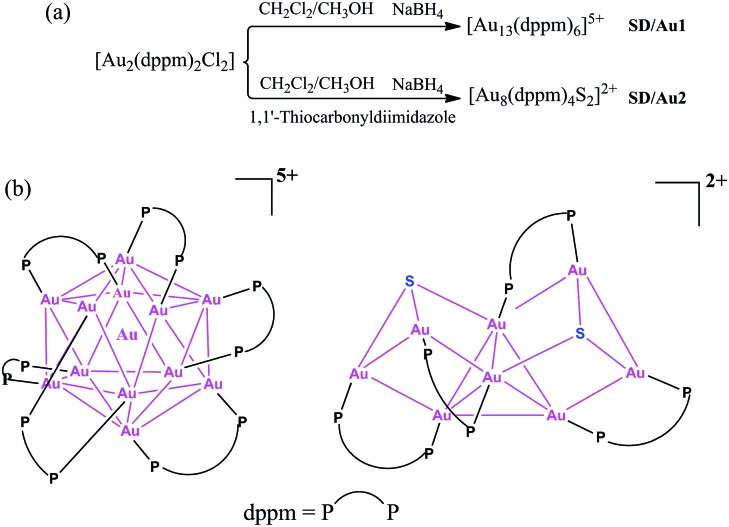
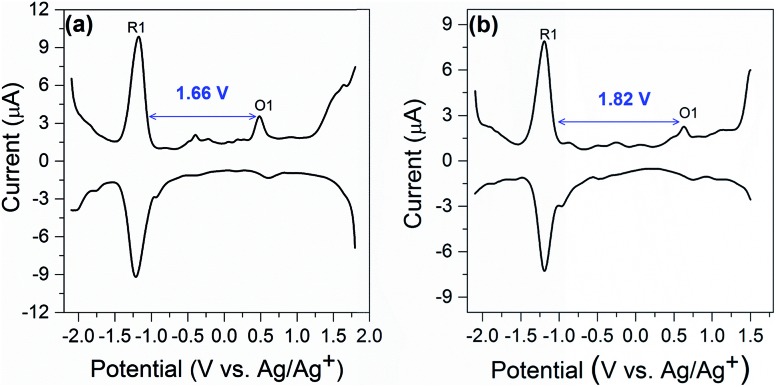
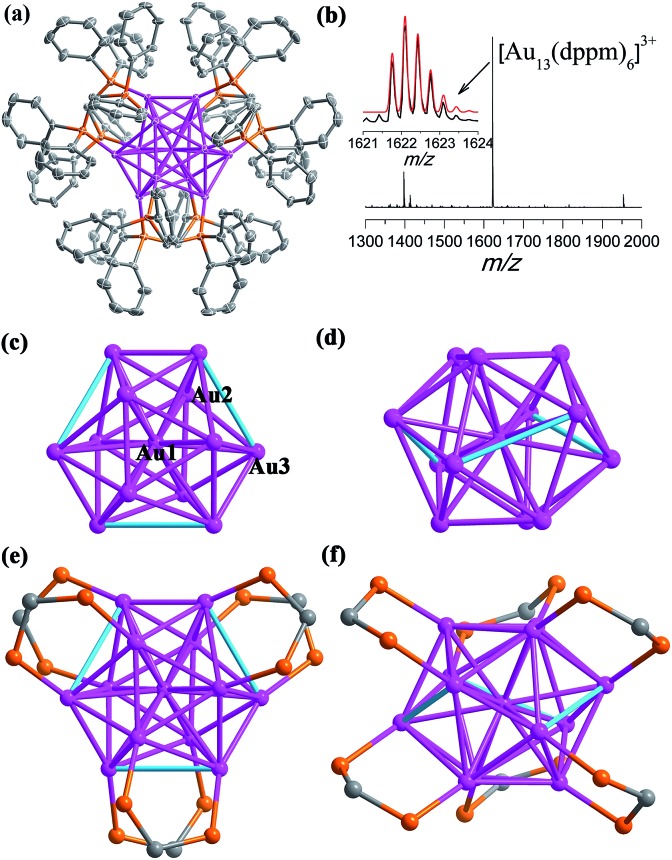
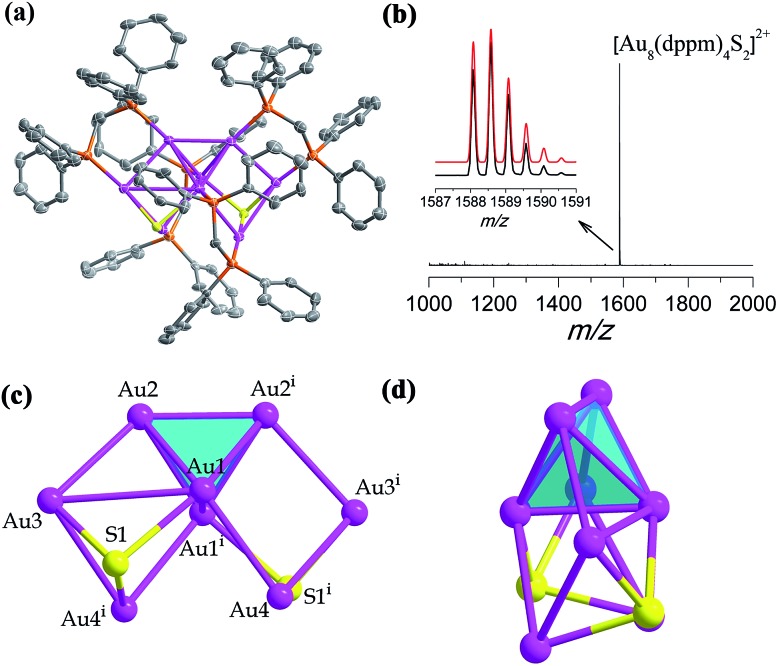
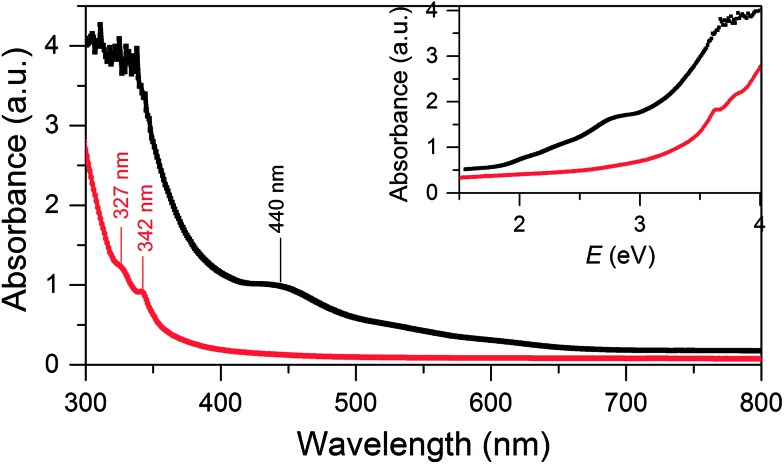
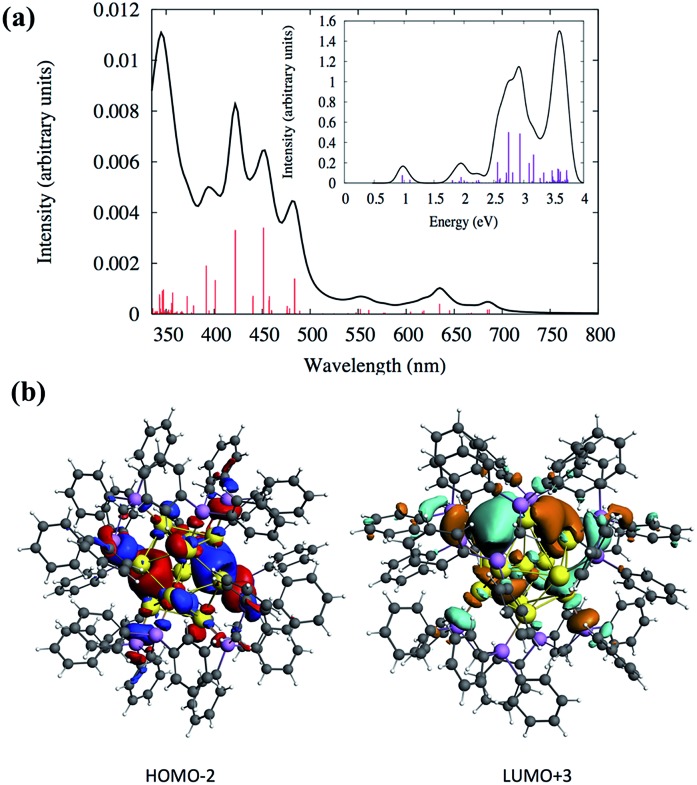
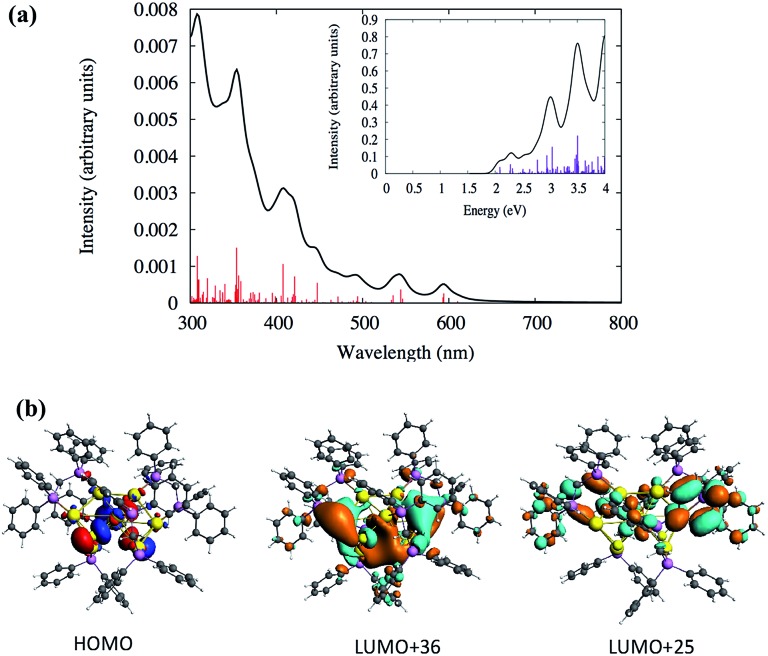
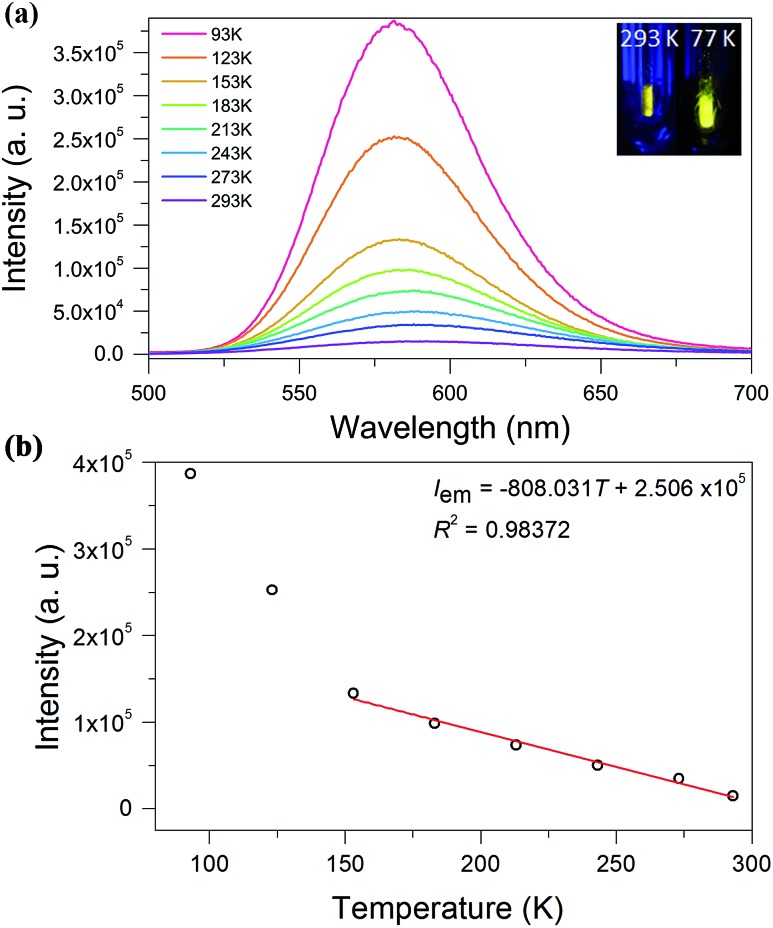
Due to distinctive quantum confinement effects, ultrasmall gold nanoparticles usually exhibit interesting electronic structure and molecular-like properties. However, the lack of atomically-precise structural information makes the understanding of them almost impossible, such as understanding the relationships between their compositions and unique properties. Herein, by reducing a diphosphine Au precursor (Au(dppm)Cl; dppm = PhPCHPPh) with or without a S releasing reagent, we enriched our knowledge of the members in the families of Au and Au by the structural determinations of two new dppm-protected gold nanoclusters, [Au(dppm)] () and [Au(dppm)S] (), respectively. Within , the Au kernel significantly deviates from the ideal icosahedron by the elongation of three surface Au-Au bonds to ∼3.5 Å, giving it symmetry, whereas has a novel heart-shaped symmetric AuS core (central Au tetrahedron + two AuS units) protected by four μ-dppm ligands in the outer shell. Of note, represents a rare Au nanocluster with an opened icosahedral geometry, and shows a new edge-shared "core + 4" structure type that has never been observed before. The electronic structures and optical absorption spectra of these systems are correlated with time-dependent density functional theory (TDDFT) calculations. Based on the spherical jellium model, the stability of the Au and Au nanoclusters can be ascribed to 8- and 2-electron superatoms with 1S1P and 1S configurations, respectively. Interestingly, the cluster exhibits bright yellow luminescence with an emission maximum at 591 nm that slightly hypsochromically shifts to 581 nm upon cooling to 93 K. Our findings not only enrich the family of diphosphine-protected ultrasmall gold nanoclusters, but also demonstrate the rich variations of gold kernels during the transformation from a simple Au precursor to Au nanoclusters.
由于独特的量子限域效应,超小金纳米颗粒通常表现出有趣的电子结构和类分子性质。然而,缺乏原子精确的结构信息使得几乎无法理解它们,比如理解它们的组成与独特性质之间的关系。在此,通过用或不用硫释放试剂还原二膦金前驱体(Au(dppm)Cl;dppm = PhPCHPPh),我们分别通过对两个新的二膦保护的金纳米团簇[Au(dppm)] () 和[Au(dppm)S] () 的结构测定,丰富了我们对金和金家族成员的认识。在 中,金核显著偏离理想的二十面体,三个表面金 - 金键伸长至约3.5 Å,使其具有 对称性,而 具有一个新颖的由四个μ - dppm配体在外层保护的心形 对称AuS核(中心金四面体 + 两个AuS单元)。值得注意的是, 代表一种罕见的具有开放二十面体几何结构的金纳米团簇,并且 展示了一种前所未有的新的边共享“核 + 4”结构类型。这些体系的电子结构和光吸收光谱与含时密度泛函理论(TDDFT)计算相关。基于球形电子气模型,金和金纳米团簇的稳定性可分别归因于具有1S1P和1S构型的8 - 和2 - 电子超原子。有趣的是,团簇 在591 nm处呈现亮黄色发光,在冷却至93 K时发射最大值略微蓝移至581 nm。我们的发现不仅丰富了二膦保护的超小金纳米团簇家族,还展示了从简单的金前驱体到金纳米团簇转变过程中金核的丰富变化。