Zhao Pei, Li Xuping, Baryshnikov Glib, Wu Bin, Ågren Hans, Zhang Junji, Zhu Liangliang
State Key Laboratory of Molecular Engineering of Polymers , Department of Macromolecular Science , Fudan University , Shanghai 200433 , China . Email:
Division of Theoretical Chemistry , Biology School of Biotechnology , KTH Royal Institute of Technology , SE-10691 Stockholm , Sweden.
Chem Sci. 2017 Dec 12;9(5):1323-1329. doi: 10.1039/c7sc04607c. eCollection 2018 Feb 7.
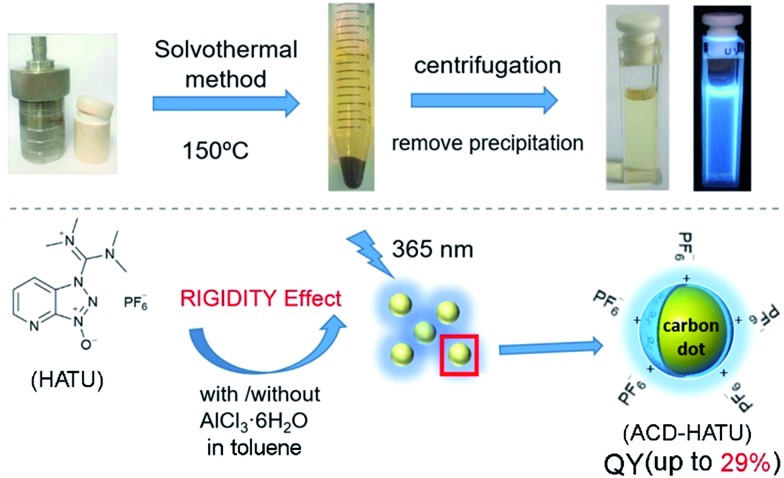
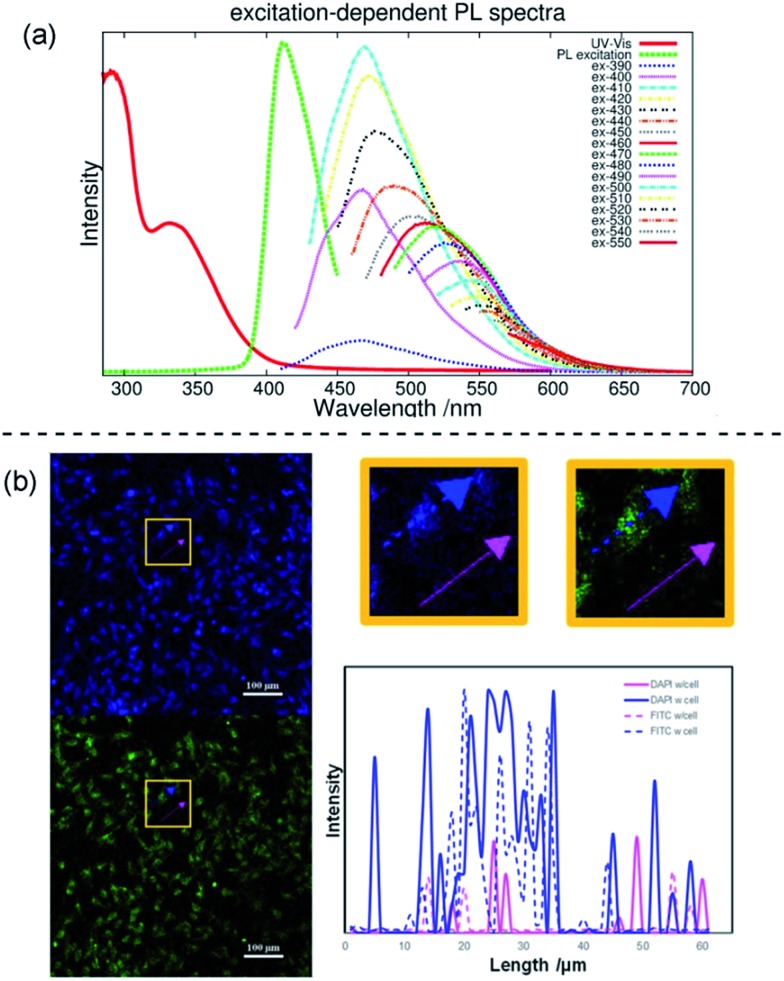
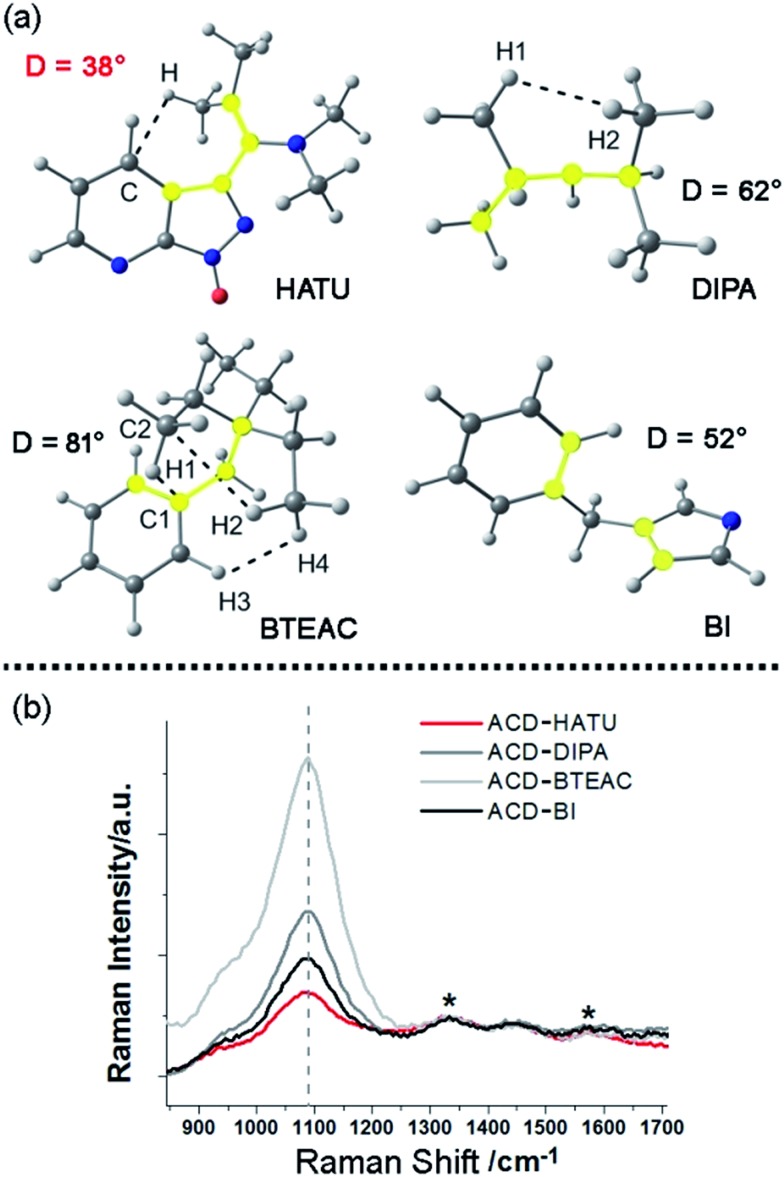
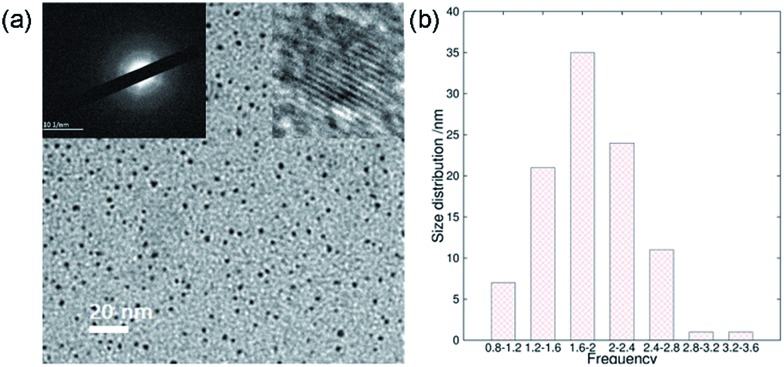
In nanoscience, amphiphilic carbon dots (ACDs) are of great importance due to their excellent transferability for application in biological sensing, imaging and labelling. However, facile synthetic strategies are still limited, especially for obtaining high-emissive ACDs. Since the development of a high-emissive feature is strongly desired for improving the practical resolution , here we report a chemical strategy that uses rigid molecules to straightforwardly construct amphiphilic carbon dots (ACDs) with high luminescence quantum yields (QYs). By using 1-[bis(dimethylamino)methylene]-1-1,2,3-triazolo[4,5-]pyridinium 3-oxide hexafluorophosphate (HATU), a typical coplanar compound, as the only precursor, well-defined ACDs were prepared a one-step solvothermal process which exhibited a superior QY of up to 29%, largely superior to those prepared from precursors with less rigid structures. The effect can be mainly attributed to a significant suppression of the competition of non-radiative decay through rigidity derivation. Metal ionic doping during the synthesis resulted in a further improvement of the crystallinity and monodispersity of the materials, with retention of the high-emissive ability. This high-emissive photoluminescence behavior of the ACDs is accompanied with an excitation-wavelength dependence, a high biocompatibility and a low toxicity, which together make the ACDs advantageous for application in multi-channel bioimaging.
在纳米科学领域,两亲性碳点(ACD)因其在生物传感、成像和标记应用中具有出色的转移性而具有重要意义。然而,简便的合成策略仍然有限,特别是在获得高发光的ACD方面。由于提高实际分辨率强烈需要开发高发光特性,因此我们在此报告一种化学策略,该策略使用刚性分子直接构建具有高发光量子产率(QY)的两亲性碳点(ACD)。通过使用典型的共平面化合物1-[双(二甲基氨基)亚甲基]-1,2,3-三唑并[4,5-b]吡啶鎓3-氧化物六氟磷酸盐(HATU)作为唯一前驱体,通过一步溶剂热法制备了定义明确的ACD,其QY高达29%,大大优于由结构刚性较小的前驱体制备的ACD。这种效果主要归因于通过刚性推导对非辐射衰减竞争的显著抑制。合成过程中的金属离子掺杂进一步提高了材料的结晶度和单分散性,同时保留了高发光能力。ACD的这种高发光光致发光行为伴随着激发波长依赖性、高生物相容性和低毒性,这些共同使ACD在多通道生物成像应用中具有优势。