Mellor Kate C, Meyer Anne, Elkholly Doaa A, Fournié Guillaume, Long Pham T, Inui Ken, Padungtod Pawin, Gilbert Marius, Newman Scott H, Vergne Timothée, Pfeiffer Dirk U, Stevens Kim B
Veterinary Epidemiology, Economics and Public Health Group, Department of Pathobiology and Population Sciences, Royal Veterinary College, Hatfield, United Kingdom.
Department of Animal Health, Ministry of Agriculture and Rural Development, Hanoi, Vietnam.
Front Vet Sci. 2018 Apr 5;5:51. doi: 10.3389/fvets.2018.00051. eCollection 2018.
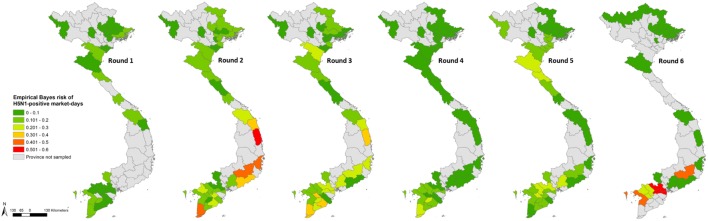
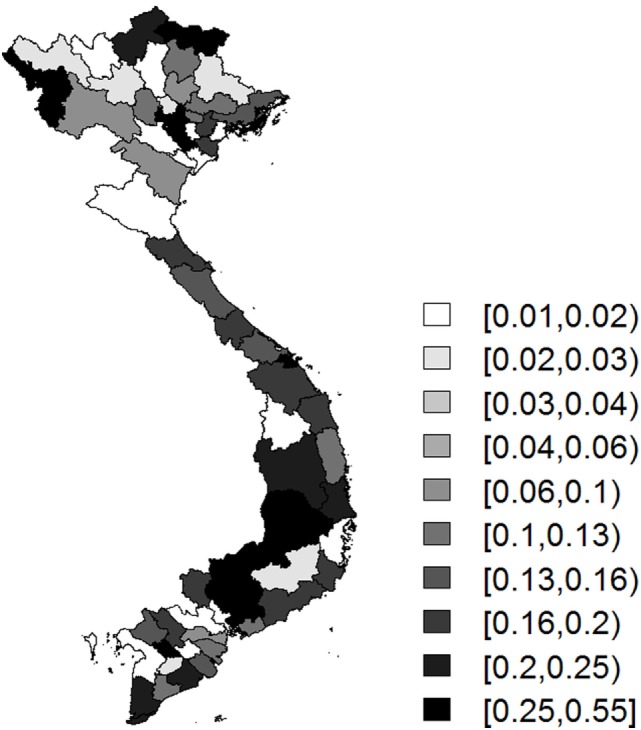
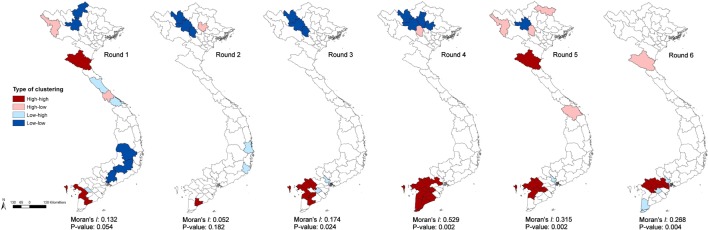
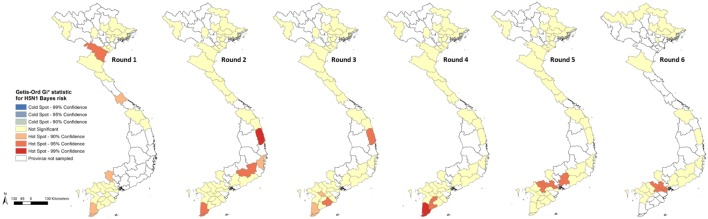
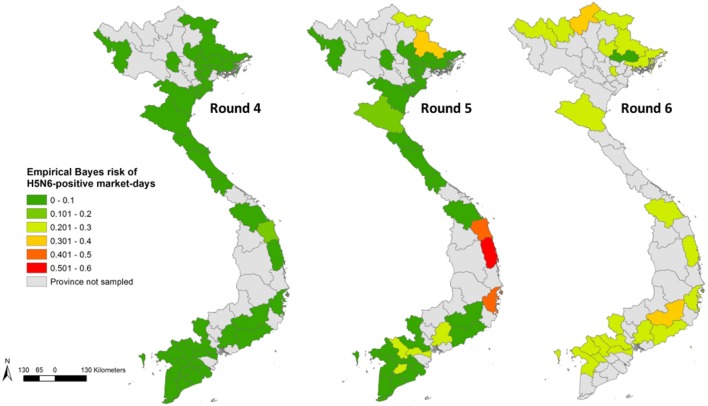
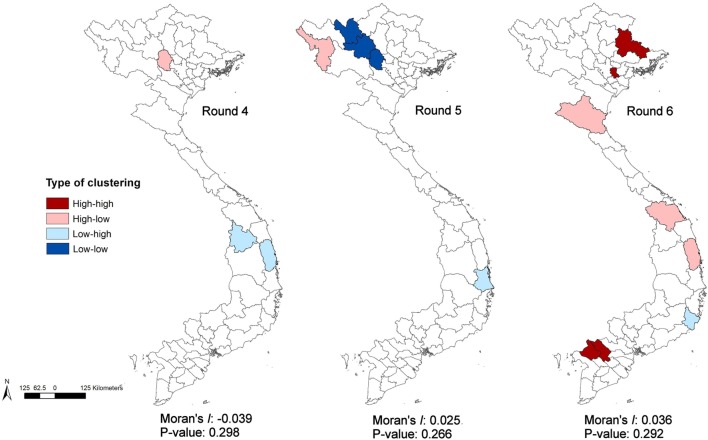
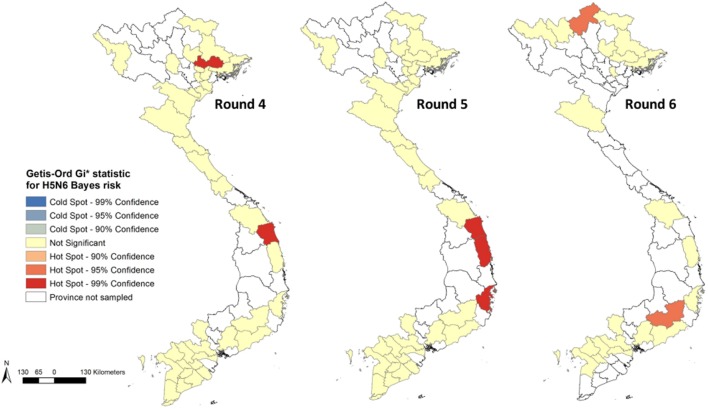
Highly pathogenic avian influenza (HPAI) H5N1 virus has been circulating in Vietnam since 2003, whilst outbreaks of HPAI H5N6 virus are more recent, having only been reported since 2014. Although the spatial distribution of H5N1 outbreaks and risk factors for virus occurrence has been extensively studied, there have been no comparative studies for H5N6. Data collected through active surveillance of Vietnamese live bird markets (LBMs) between 2011 and 2015 were used to explore and compare the spatiotemporal distributions of H5N1- and H5N6-positive LBMs. Conditional autoregressive models were developed to quantify spatiotemporal associations between agroecological factors and the two HPAI strains using the same set of predictor variables. Unlike H5N1, which exhibited a strong north-south divide, with repeated occurrence in the extreme south of a cluster of high-risk provinces, H5N6 was homogeneously distributed throughout Vietnam. Similarly, different agroecological factors were associated with each strain. Sample collection in the months of January and February and higher average maximum temperature were associated with higher likelihood of H5N1-positive market-day status. The likelihood of market days being positive for H5N6 increased with decreased river density, and with successive Rounds of data collection. This study highlights marked differences in spatial patterns and risk factors for H5N1 and H5N6 in Vietnam, suggesting the need for tailored surveillance and control approaches.
高致病性禽流感(HPAI)H5N1病毒自2003年以来一直在越南传播,而HPAI H5N6病毒的疫情则较为新近,自2014年才开始有报告。尽管对H5N1疫情的空间分布及病毒出现的风险因素已进行了广泛研究,但尚未有针对H5N6的比较研究。利用2011年至2015年间通过对越南活禽市场(LBM)进行主动监测收集的数据,来探索和比较H5N1和H5N6阳性活禽市场的时空分布。开发了条件自回归模型,以使用同一组预测变量来量化农业生态因素与这两种高致病性禽流感病毒株之间的时空关联。与H5N1不同,H5N1呈现出明显的南北差异,在一组高风险省份的最南部反复出现,而H5N6在越南各地分布均匀。同样,不同的农业生态因素与每种病毒株相关。在1月和2月采样以及较高的平均最高温度与H5N1阳性市场日状态的可能性较高相关。H5N6市场日呈阳性的可能性随着河流密度的降低以及连续几轮数据收集而增加。这项研究突出了越南H5N1和H5N6在空间模式和风险因素方面的显著差异,表明需要采取针对性的监测和控制方法。