Department of Biomedical Engineering and Mechanics, Virginia Tech, Blacksburg, VA 24061, USA.
Department of Chemical Engineering, Virginia Tech, Blacksburg, VA 24061, USA.
Sci Adv. 2018 Apr 18;4(4):eaar8187. doi: 10.1126/sciadv.aar8187. eCollection 2018 Apr.
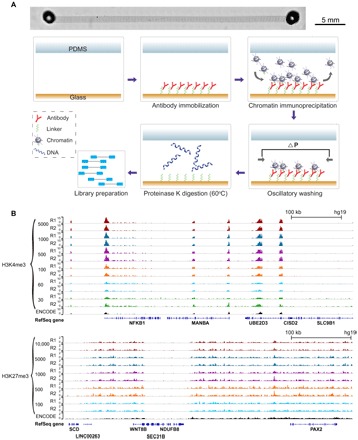
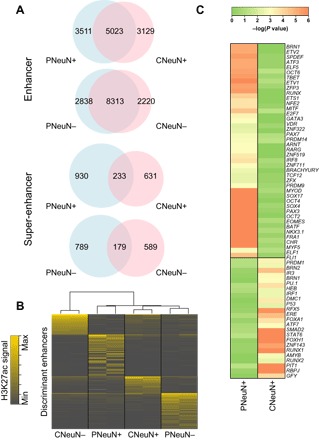
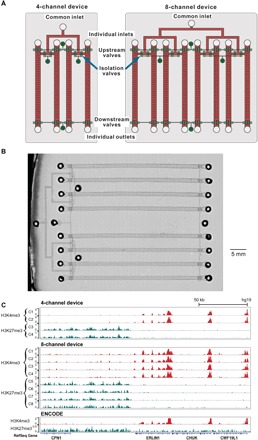
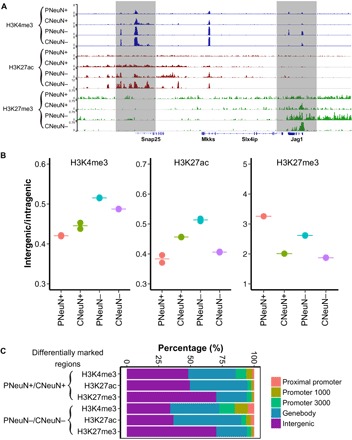
Extensive effort is under way to survey the epigenomic landscape of primary ex vivo tissues to establish normal reference data and to discern variation associated with disease. The low abundance of some tissue types and the isolation procedure required to generate a homogenous cell population often yield a small quantity of cells for examination. This difficulty is further compounded by the need to profile a myriad of epigenetic marks. Thus, technologies that permit both ultralow input and high throughput are desired. We demonstrate a simple microfluidic technology, SurfaceChIP-seq, for profiling genome-wide histone modifications using as few as 30 to 100 cells per assay and with up to eight assays running in parallel. We applied the technology to profile epigenomes using nuclei isolated from prefrontal cortex and cerebellum of mouse brain. Our cell type-specific data revealed that neuronal and glial fractions exhibited profound epigenomic differences across the two functionally distinct brain regions.
目前正在进行大量工作,以调查原发性离体组织的表观基因组景观,建立正常的参考数据,并辨别与疾病相关的变异。某些组织类型的丰度低,以及为生成同质细胞群体而进行的分离程序通常只能产生少量用于检查的细胞。由于需要分析大量的表观遗传标记,这种困难更加复杂。因此,人们希望拥有既能实现超低输入又能实现高通量的技术。我们展示了一种简单的微流控技术,SurfaceChIP-seq,可使用每个测定低至 30 到 100 个细胞,甚至多达 8 个测定同时运行,来对全基因组组蛋白修饰进行分析。我们应用该技术对从小鼠大脑的前额叶皮层和小脑中分离出的核进行表观基因组分析。我们的细胞类型特异性数据显示,神经元和神经胶质分数在两个功能上明显不同的大脑区域之间表现出深刻的表观基因组差异。