Faculty of Energy and Fuels, AGH University of Science and Technology, Krakow, Poland.
Faculty of Electrical Engineering, Automatics, Computer Science and Biomedical Engineering, AGH University of Science and Technology, Krakow, Poland.
Environ Sci Pollut Res Int. 2019 Mar;26(9):8402-8417. doi: 10.1007/s11356-018-1970-x. Epub 2018 Apr 20.
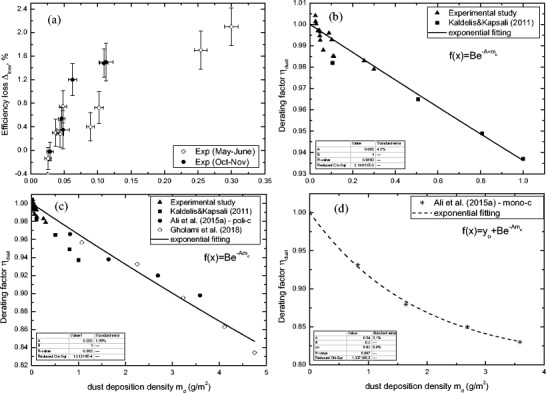
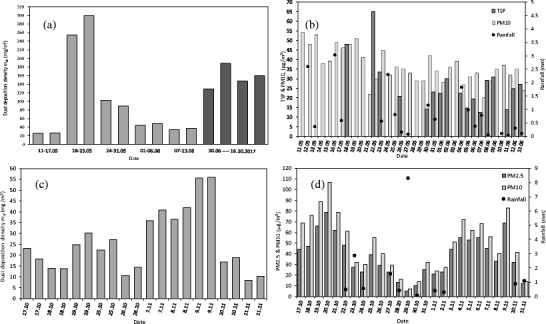
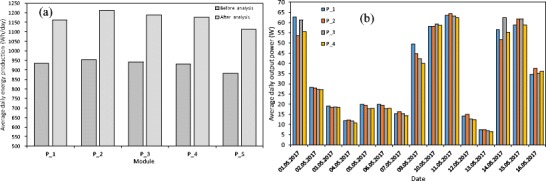
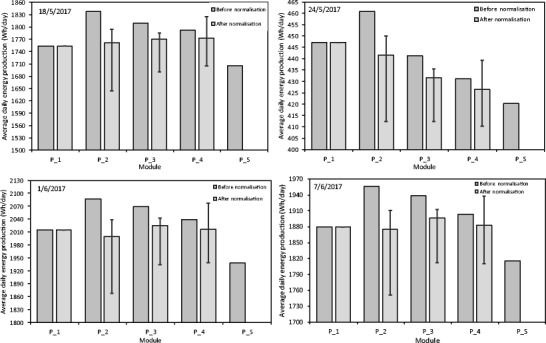
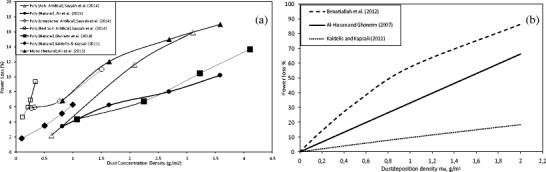
The maximisation of the efficiency of the photovoltaic system is crucial in order to increase the competitiveness of this technology. Unfortunately, several environmental factors in addition to many alterable and unalterable factors can significantly influence the performance of the PV system. Some of the environmental factors that depend on the site have to do with dust, soiling and pollutants. In this study conducted in the city centre of Kraków, Poland, characterised by high pollution and low wind speed, the focus is on the evaluation of the degradation of efficiency of polycrystalline photovoltaic modules due to natural dust deposition. The experimental results that were obtained demonstrated that deposited dust-related efficiency loss gradually increased with the mass and that it follows the exponential. The maximum dust deposition density observed for rainless exposure periods of 1 week exceeds 300 mg/m and the results in efficiency loss were about 2.1%. It was observed that efficiency loss is not only mass-dependent but that it also depends on the dust properties. The small positive effect of the tiny dust layer which slightly increases in surface roughness on the module performance was also observed. The results that were obtained enable the development of a reliable model for the degradation of the efficiency of the PV module caused by dust deposition. The novelty consists in the model, which is easy to apply and which is dependent on the dust mass, for low and moderate naturally deposited dust concentration (up to 1 and 5 g/m and representative for many geographical regions) and which is applicable to the majority of cases met in an urban and non-urban polluted area can be used to evaluate the dust deposition-related derating factor (efficiency loss), which is very much sought after by the system designers, and tools used for computer modelling and system malfunction detection.
为了提高光伏系统的竞争力,最大限度地提高光伏系统的效率至关重要。不幸的是,除了许多可改变和不可改变的因素外,许多环境因素也会显著影响光伏系统的性能。一些取决于地点的环境因素与灰尘、污垢和污染物有关。在这项在波兰克拉科夫市中心进行的研究中,由于污染严重且风速低,重点是评估由于自然灰尘沉积导致的多晶硅光伏组件效率下降。实验结果表明,由于灰尘导致的效率损失逐渐随质量增加而增加,并且符合指数关系。在无雨暴露期为 1 周的情况下,观察到的最大灰尘沉积密度超过 300mg/m,效率损失约为 2.1%。观察到效率损失不仅取决于质量,还取决于灰尘特性。还观察到灰尘层的微小正效应,灰尘层略微增加了表面粗糙度,从而略微提高了模块性能。获得的结果使开发一种可靠的模型成为可能,该模型用于预测由于灰尘沉积导致的光伏模块效率下降。该模型的新颖之处在于它易于应用,并且取决于灰尘质量,适用于低浓度和中等浓度的自然沉积灰尘(高达 1 和 5g/m,代表许多地理区域),并且适用于城市和非城市污染地区遇到的大多数情况,可用于评估灰尘沉积相关的降额系数(效率损失),这是系统设计者非常需要的,并且用于计算机建模和系统故障检测的工具。