Department of Electronic Engineering, Tsinghua University, Beijing, 100084, China.
Tsinghua National Laboratory of Information Science and Technology, Beijing, 100084, China.
Sci Rep. 2018 Apr 20;8(1):6329. doi: 10.1038/s41598-018-24389-w.
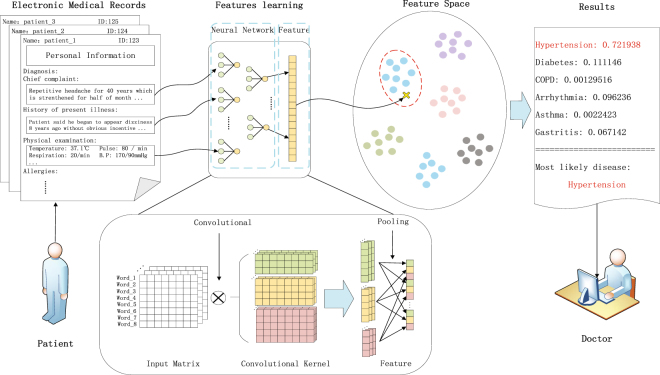
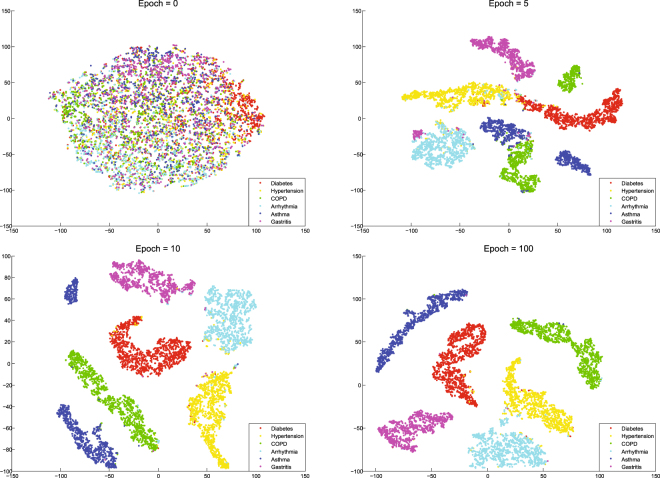
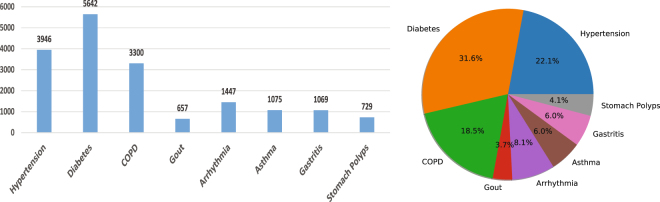
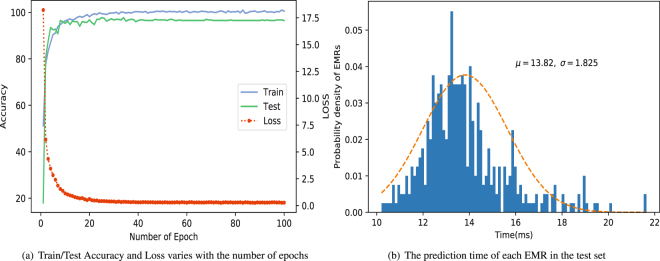
Automatically extracting useful information from electronic medical records along with conducting disease diagnoses is a promising task for both clinical decision support(CDS) and neural language processing(NLP). Most of the existing systems are based on artificially constructed knowledge bases, and then auxiliary diagnosis is done by rule matching. In this study, we present a clinical intelligent decision approach based on Convolutional Neural Networks(CNN), which can automatically extract high-level semantic information of electronic medical records and then perform automatic diagnosis without artificial construction of rules or knowledge bases. We use collected 18,590 copies of the real-world clinical electronic medical records to train and test the proposed model. Experimental results show that the proposed model can achieve 98.67% accuracy and 96.02% recall, which strongly supports that using convolutional neural network to automatically learn high-level semantic features of electronic medical records and then conduct assist diagnosis is feasible and effective.
从电子病历中自动提取有用信息并进行疾病诊断,这对于临床决策支持(CDS)和神经语言处理(NLP)来说都是一项很有前景的任务。大多数现有的系统都是基于人工构建的知识库,然后通过规则匹配来进行辅助诊断。在本研究中,我们提出了一种基于卷积神经网络(CNN)的临床智能决策方法,它可以自动提取电子病历的高级语义信息,然后无需人工构建规则或知识库即可进行自动诊断。我们使用收集到的 18590 份真实世界的临床电子病历来训练和测试所提出的模型。实验结果表明,所提出的模型可以达到 98.67%的准确率和 96.02%的召回率,这有力地支持了使用卷积神经网络自动学习电子病历的高级语义特征,然后进行辅助诊断是可行且有效的。