Phabphal Kanitpong, Chisurajinda Suparat, Somboon Thapanee, Unwongse Kanjana, Geater Alan
Neurology Unit, Department of Medicine, Faculty of Medicine, Prince of Songkla University, Hat Yai, Songkhla, 90110, Thailand.
Prasat Neurological Institute, Bangkok, 10400, Thailand.
BMC Neurol. 2018 Apr 21;18(1):46. doi: 10.1186/s12883-018-1050-3.
The general principles in the administration of anesthetic drugs entail not only the suppression of seizure activity but also the achievement of electroencephalography burst suppression (BS). However, previous studies have reported conflicting results, possibly owing to the inclusion of various anesthetic agents, not all patients undergoing continuous electroencephalography (cEEG), and the inclusion of anoxic encephalopathy. This study aimed to analyze the effects of midazolam-induced BS on the occurrence outcomes in refractory status epilepticus patients.
Based on a prospective database of patients who had been diagnosed with status epilepticus via cEEG, multivariate Poisson regression modules were used to estimate the effect of midazolam-induced BS on breakthrough seizure, withdrawal seizure, intra-hospital complications, functional outcome at 3 months, and mortality. Modules were based on a pre-compiled directed acyclic graph (DAG).
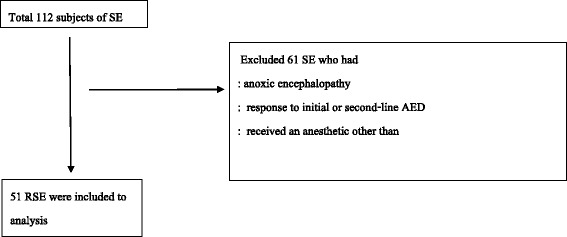
We included 51 non-anoxic encephalopathy, refractory status epilepticus patients. Burst suppression was achieved in 26 patients (51%); 25 patients (49%) had non-burst suppression on their cEEG. Breakthrough seizure was less often seen in the burst suppression group than in the non-burst suppression group. The incidence risk ratio [IRR] was 0.30 (95% confidence interval = 0.13-0.74). There was weak evidence of an association between BS and increased withdrawal seizure, but no association between BS and intra-hospital complications, mortality or functional outcomes was observed.
This study provides evidence that BS is safe and associated with less breakthrough seizures. Additionally, it was not associated with an increased rate of intra-hospital complications or long-term outcomes.
麻醉药物管理的一般原则不仅需要抑制癫痫发作活动,还需要实现脑电图爆发抑制(BS)。然而,先前的研究报告结果相互矛盾,可能是由于纳入了各种麻醉药物,并非所有患者都进行了连续脑电图监测(cEEG),以及纳入了缺氧性脑病患者。本研究旨在分析咪达唑仑诱导的爆发抑制对难治性癫痫持续状态患者发生结局的影响。
基于通过cEEG诊断为癫痫持续状态患者的前瞻性数据库,使用多变量泊松回归模型来估计咪达唑仑诱导的爆发抑制对突破性癫痫发作、撤药期癫痫发作、院内并发症、3个月时的功能结局和死亡率的影响。模型基于预先编制的有向无环图(DAG)。
我们纳入了51例非缺氧性脑病的难治性癫痫持续状态患者。26例患者(51%)实现了爆发抑制;25例患者(49%)的cEEG显示无爆发抑制。爆发抑制组的突破性癫痫发作比非爆发抑制组少见。发病率风险比[IRR]为0.30(95%置信区间=0.13-0.74)。有微弱证据表明爆发抑制与撤药期癫痫发作增加有关,但未观察到爆发抑制与院内并发症、死亡率或功能结局之间存在关联。
本研究提供的证据表明,爆发抑制是安全的,且与较少的突破性癫痫发作相关。此外,它与院内并发症发生率增加或长期结局无关。