Division of Diabetes, Endocrinology and Metabolism, Imperial College London, Hammersmith Hospital, Du Cane Road, London W12 0NN, United Kingdom.
Division of Diabetes, Endocrinology and Metabolism, Imperial College London, Hammersmith Hospital, Du Cane Road, London W12 0NN, United Kingdom.
Peptides. 2018 Jun;104:70-77. doi: 10.1016/j.peptides.2018.04.008. Epub 2018 Apr 20.
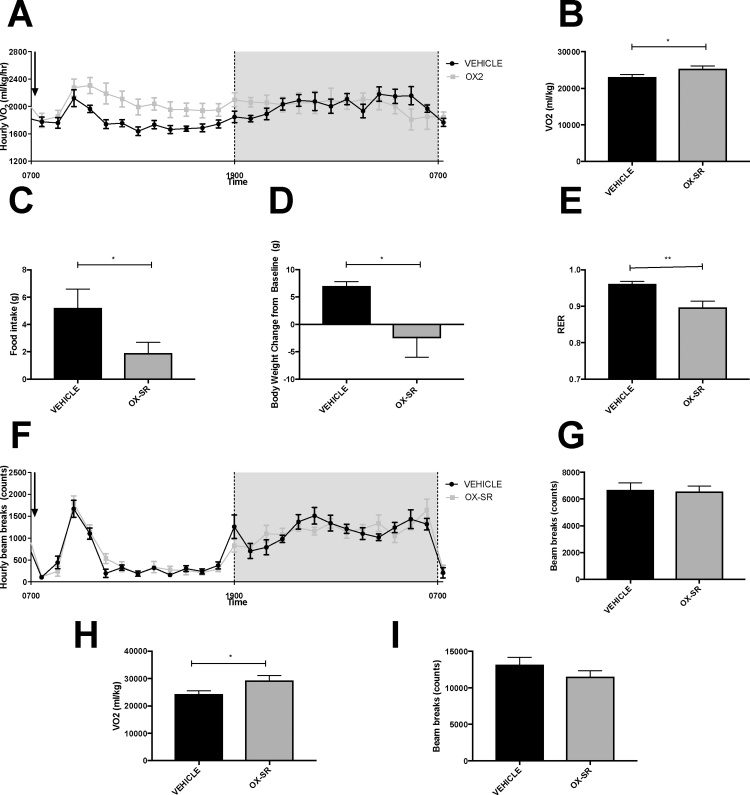
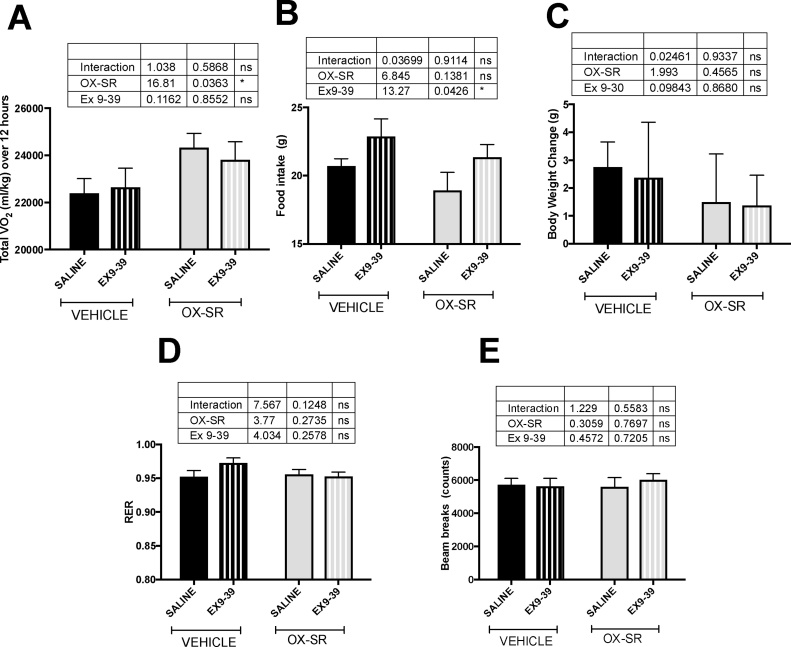
The gut hormone oxyntomodulin (OXM) causes weight loss by reducing appetite and increasing energy expenditure. Several analogues are being developed to treat obesity. Exactly how oxyntomodulin works, however, remains controversial. OXM can activate both glucagon and GLP-1 receptors but no specific receptor has been identified. It is thought that the anorectic effect occurs predominantly through GLP-1 receptor activation but, to date, it has not been formally confirmed which receptor is responsible for the increased energy expenditure. We developed OX-SR, a sustained-release OXM analogue. It produces a significant and sustained increase in energy expenditure in rats as measured by indirect calorimetry. We now show that this increase in energy expenditure occurs via activation of the glucagon receptor. Blockade of the GLP-1 receptor with Exendin 9-39 does not block the increase in oxygen consumption caused by OX-SR. However, when activity at the glucagon receptor is lost, there is no increase in energy expenditure. Glucagon receptor activity therefore appears to be essential for OX-SR's effects on energy expenditure. The development of future 'dual agonist' analogues will require careful balancing of GLP-1 and glucagon receptor activities to obtain optimal effects.
肠激素胰高血糖素样肽 1(GLP-1)通过降低食欲和增加能量消耗来减肥。目前正在开发几种类似物来治疗肥胖症。然而,胰高血糖素样肽 1 的作用机制仍存在争议。胰高血糖素样肽 1 可以激活胰高血糖素和 GLP-1 受体,但尚未确定特定的受体。人们认为,厌食作用主要通过 GLP-1 受体激活来实现,但迄今为止,尚未正式证实哪种受体负责增加能量消耗。我们开发了 OX-SR,一种持续释放的胰高血糖素样肽 1 类似物。它通过间接热量测定法在大鼠中产生显著且持续的能量消耗增加。我们现在表明,这种能量消耗的增加是通过激活胰高血糖素受体引起的。用 Exendin 9-39 阻断 GLP-1 受体不会阻断 OX-SR 引起的耗氧量增加。然而,当胰高血糖素受体失活时,能量消耗不会增加。因此,胰高血糖素受体活性似乎对 OX-SR 对能量消耗的影响至关重要。未来“双重激动剂”类似物的开发将需要仔细平衡 GLP-1 和胰高血糖素受体的活性,以获得最佳效果。