Department of Neurology, Shanghai Xuhui Central Hospital, 996 Middle Huaihai Road, Shanghai 200031, China.
Department of Neurology, Yangpu Hospital, Tongji University School of Medicine, 450 Tengyue Road, Shanghai 200092, China.
Biomed Res Int. 2018 Feb 26;2018:2321797. doi: 10.1155/2018/2321797. eCollection 2018.
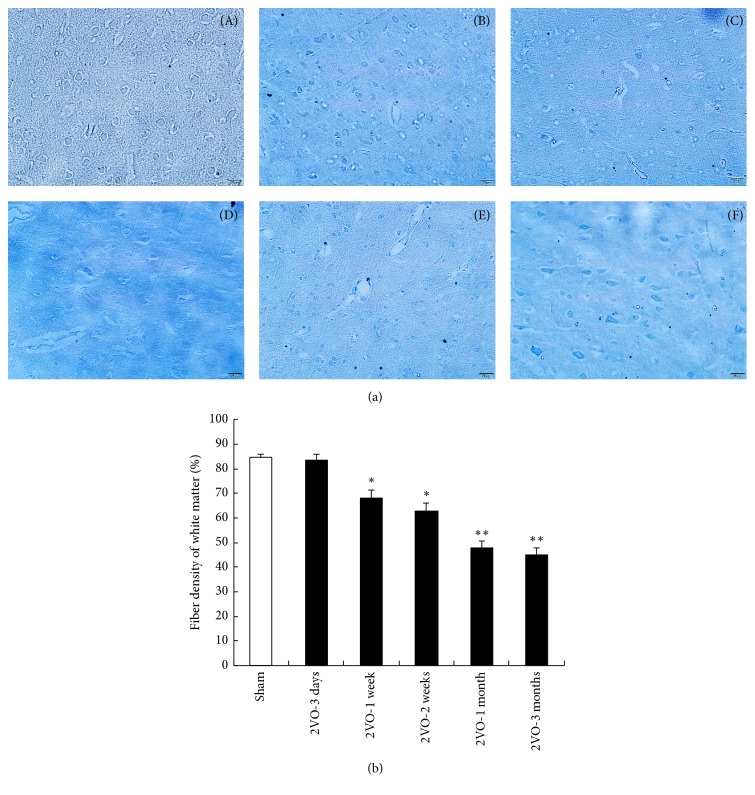
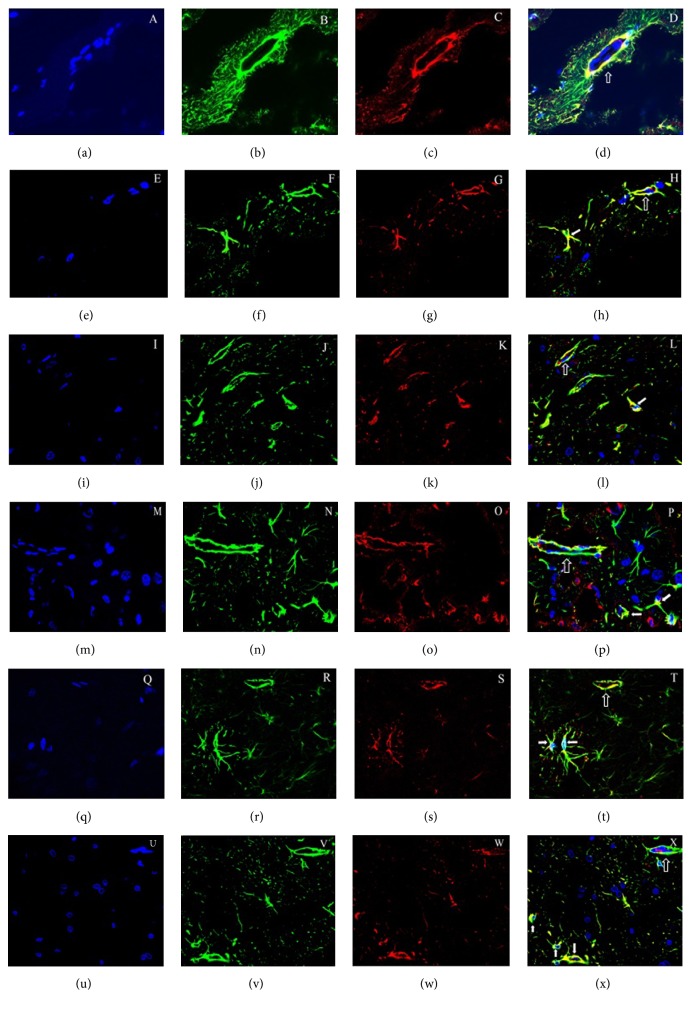
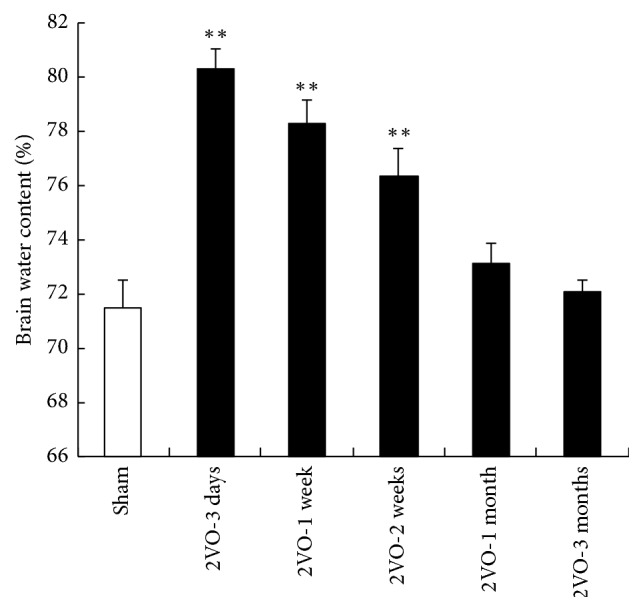
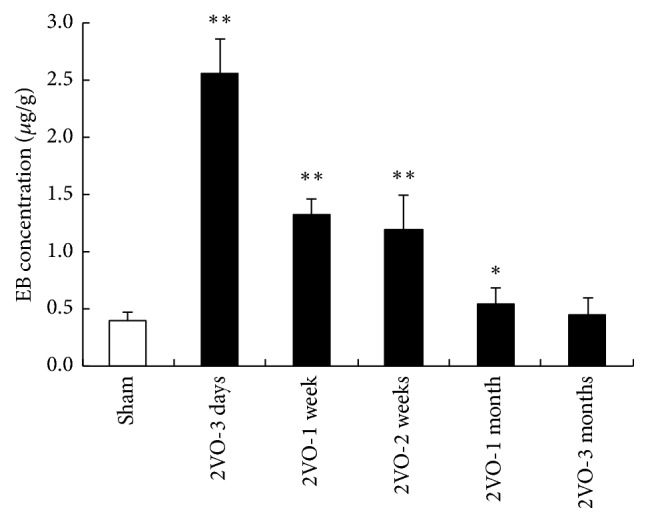
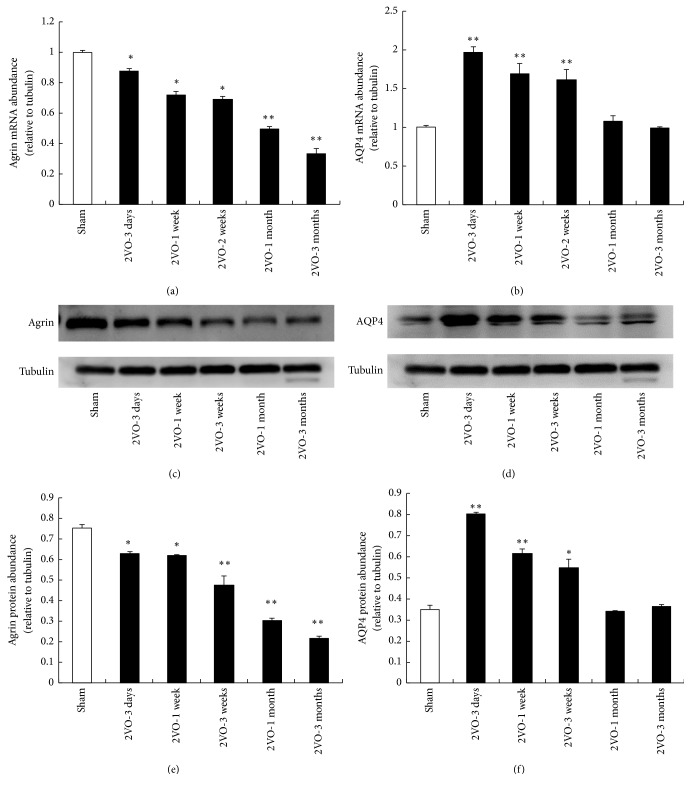
White matter lesion (WML) is popular in the patients aged over 65. Brain edema and blood-brain barrier (BBB) dysfunction due to cerebral chronic hypoperfusion (CCH) contributed to WML. Preserving astrocyte polarity is vital for BBB integrity. In our experiment, CCH model is established by bilateral carotid arteries occlusion (2VO). Leukoaraiosis was verified by fiber density stain, and brain edema was evaluated using brain water content measuring. The expressions of agrin and aquaporin-4 (AQP4) were evaluated, as well as the integrity of BBB. Astrocyte polarity was assessed by visualizing the distribution of AQP4 on astrocyte end-feet membranes. The results showed that expression of AQP4 firstly increased and then decreased, as agrin expression decreased gradually. At 3 days after 2VO, AQP4 and agrin displayed the most opposite expression with the former increasing and the latter decreasing; at the same time, brain edema reached high point as well as BBB permeability, and astrocyte polarity was degeneration. In the later phase, brain edema and BBB permeability were getting recovered, but WML was getting more evident. In accordance with that, agrin and AQP4 expression decreased significantly with astrocyte polarity reducing. We speculated that agrin and AQP4 played key roles in development of WML by mediating BBB damage in CCH, and BBB dysfunction due to reduced astrocyte polarity is the starting point of WMH.
脑白质病变(WML)在 65 岁以上的患者中较为常见。脑慢性低灌注(CCH)导致的脑水肿和血脑屏障(BBB)功能障碍是导致 WML 的原因。保持星形胶质细胞极性对于 BBB 的完整性至关重要。在我们的实验中,通过双侧颈总动脉闭塞(2VO)建立 CCH 模型。用纤维密度染色验证脑白质疏松症,用脑水含量测量评估脑水肿。评估了神经胶质纤维酸性蛋白(GFAP)和水通道蛋白 4(AQP4)的表达以及 BBB 的完整性。通过观察 AQP4 在星形胶质细胞终足膜上的分布来评估星形胶质细胞极性。结果表明,AQP4 的表达先增加后减少,而神经胶质纤维酸性蛋白(GFAP)的表达逐渐减少。在 2VO 后 3 天,AQP4 和神经胶质纤维酸性蛋白(GFAP)的表达最相反,前者增加,后者减少;同时,脑水肿达到高峰,BBB 通透性增加,星形胶质细胞极性退化。在后期,脑水肿和 BBB 通透性逐渐恢复,但 WML 变得更加明显。相应地,AQP4 和神经胶质纤维酸性蛋白(GFAP)的表达显著减少,星形胶质细胞极性降低。我们推测,神经胶质纤维酸性蛋白(GFAP)和 AQP4 通过介导 CCH 中 BBB 损伤在 WML 的发展中起关键作用,而由于星形胶质细胞极性降低导致的 BBB 功能障碍是 WMH 的起点。