Center for Research on Aging of the Jewish Home, San Francisco, CA, United States of America.
Department of Medicine, University of California, San Francisco, CA, United States of America.
PLoS One. 2018 Apr 23;13(4):e0196109. doi: 10.1371/journal.pone.0196109. eCollection 2018.
Polypharmacy is common in older patients but relationships between polypharmacy and common co-morbid conditions have not been elucidated. Our goal was to determine relationships between daily oral medication use and common co-morbid disease dyads and triads using comprehensive medication and diagnostic data from a national sample of nursing homes (NH).
Retrospective, cross-sectional study.
Nationally representative sample of U.S. Nursing Homes.
Nationally representative sample of long-term stay residents (n = 11734, 75% women) aged 65 years or older.
Diagnosis and medication data were analyzed. Proportion of daily oral medication intake attributed to treatment of common two-(dyads) and three-disease (triad) combinations and "health maintenance" agents (vitamins, dietary supplements, stool softeners without related diagnoses) was determined.
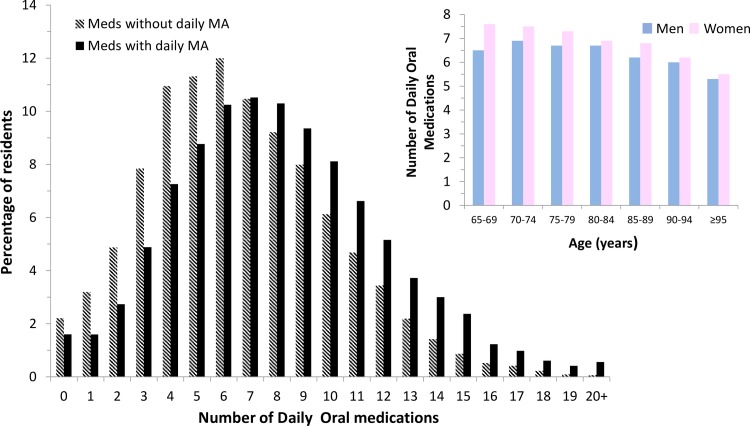
Older NH residents received slightly >8 oral medications/day with the number related to number of medical diagnoses (p < .0001). One third of chronic oral medication intake/day (excluding health maintenance agents) could be attributed to dyad combinations and about half to triad combinations despite an average of 5 other diagnoses. Triads were comprised of hypertension +/- arthritis +/- vascular disease, +/-depression, +/- osteoporosis +/- gastroesophageal reflux disease and +/- diabetes. Health maintenance agents accounted for 15-17% of daily oral medication intake (1.4 medications) such that almost two-thirds of daily oral medications were attributable to disease triads plus health maintenance. Fewer medications were prescribed for NH residents over age 85 (decreased ACE inhibitor and HMG CoA reductase inhibitor USE (p < .001)) while use of Alzheimer medications was higher (p < .01).
A large fraction of daily oral medications were attributed to management of common co-morbid disease dyads and triads. Efforts to reduce polypharmacy and unwanted medication interactions could focus on regimens for common co-morbid dyads and triads in varying populations.
多药治疗在老年患者中很常见,但多药治疗与常见合并症之间的关系尚未阐明。我们的目标是使用来自全国样本的养老院(NH)的综合药物和诊断数据,确定每日口服药物使用与常见合并疾病对和三联症之间的关系。
回顾性、横断面研究。
具有全国代表性的美国疗养院样本。
年龄在 65 岁或以上的长期居住者(n = 11734,75%为女性)的全国代表性样本。
分析诊断和药物数据。确定每天口服药物摄入量中归因于常见两种(对)和三种疾病(三联症)组合以及“维持健康”药物(维生素、膳食补充剂、无相关诊断的大便软化剂)的比例。
NH 老年居民每天服用略多于 8 种口服药物,数量与医疗诊断数量相关(p <.0001)。尽管平均有 5 种其他诊断,每天慢性口服药物摄入量(不包括维持健康药物)的三分之一可归因于对组合,大约一半可归因于三联症组合。三联症由高血压 +/-关节炎 +/-血管疾病、 +/-抑郁、 +/-骨质疏松 +/-胃食管反流病和 +/-糖尿病组成。维持健康的药物占每日口服药物摄入量的 15-17%(1.4 种药物),使得近三分之二的每日口服药物归因于疾病三联症加维持健康。85 岁以上 NH 居民的处方药物较少(ACE 抑制剂和 HMG CoA 还原酶抑制剂的使用减少(p <.001)),而阿尔茨海默病药物的使用更高(p <.01)。
大量的每日口服药物归因于常见合并症对和三联症的治疗。减少多药治疗和不必要的药物相互作用的努力可以集中在不同人群中常见的合并症对和三联症的治疗方案上。