Department of Ecology and Evolutionary Biology, University of Michigan, Ann Arbor, MI, USA.
Department of Biology, Stanford University, Stanford, CA, USA.
Nat Ecol Evol. 2018 Jun;2(6):1025-1032. doi: 10.1038/s41559-018-0549-8. Epub 2018 Apr 23.
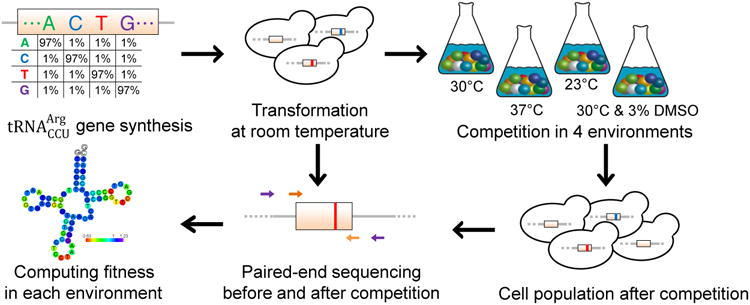
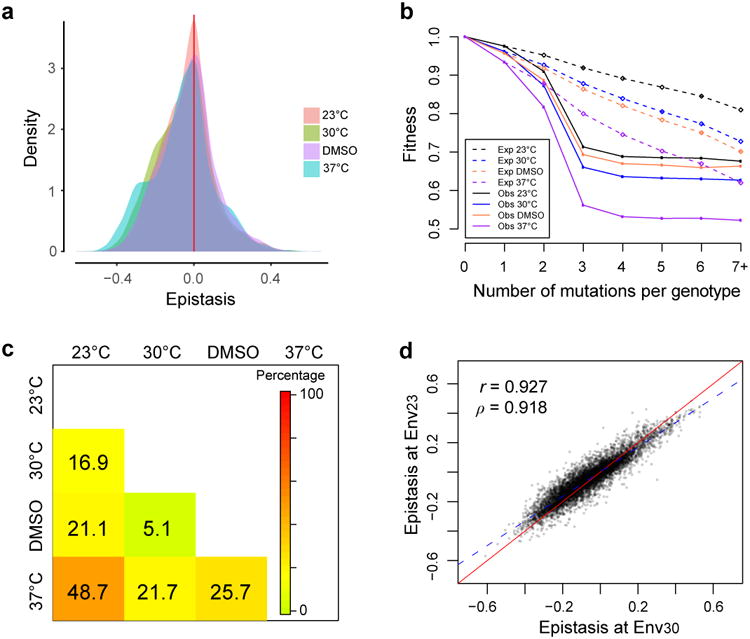
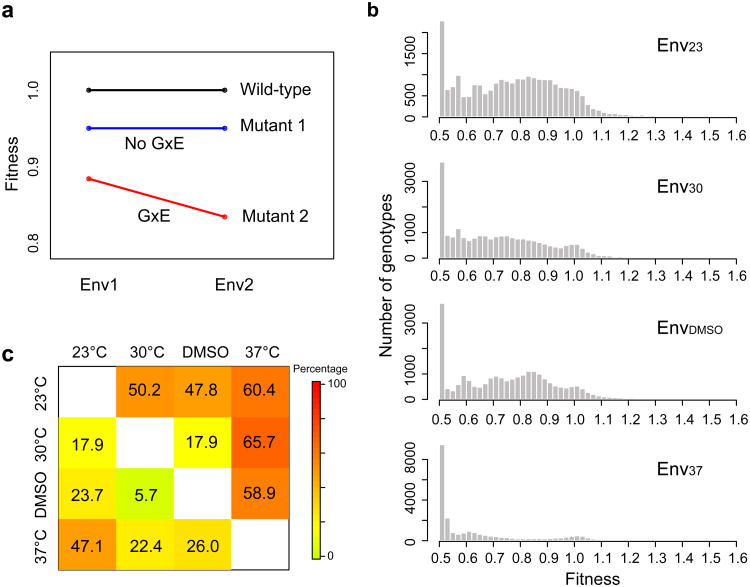
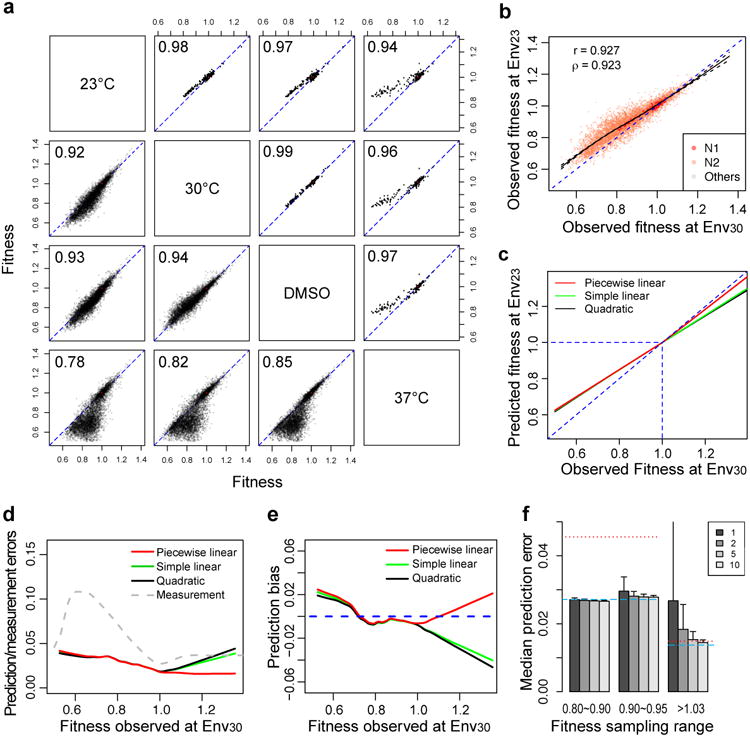
A fitness landscape (FL) describes the genotype-fitness relationship in a given environment. To explain and predict evolution, it is imperative to measure the FL in multiple environments because the natural environment changes frequently. Using a high-throughput method that combines precise gene replacement with next-generation sequencing, we determine the in vivo FL of a yeast tRNA gene comprising over 23,000 genotypes in four environments. Although genotype-by-environment interaction is abundantly detected, its pattern is so simple that we can transform an existing FL to that in a new environment with fitness measures of only a few genotypes in the new environment. Under each environment, we observe prevalent, negatively biased epistasis between mutations. Epistasis-by-environment interaction is also prevalent, but trends in epistasis difference between environments are predictable. Our study thus reveals simple rules underlying seemingly complex FLs, opening the door to understanding and predicting FLs in general.
适应景观(FL)描述了给定环境中的基因型与适应度之间的关系。为了解释和预测进化,必须在多个环境中测量 FL,因为自然环境经常变化。我们使用一种高通量的方法,将精确的基因替换与下一代测序相结合,确定了一个包含超过 23000 种基因型的酵母 tRNA 基因的体内 FL 在四种环境中。尽管基因型与环境的相互作用大量存在,但它的模式非常简单,我们可以将现有的 FL 转化为新环境中的 FL,只需在新环境中测量少数几个基因型的适应度。在每种环境下,我们观察到突变之间普遍存在负偏差的上位性。上位性与环境的相互作用也很普遍,但环境之间的上位性差异趋势是可预测的。因此,我们的研究揭示了看似复杂的 FL 背后的简单规则,为理解和预测一般的 FL 开辟了道路。