Department of Hepatobiliary Surgery, Affiliated Hospital of Binzhou Medical University, Binzhou 256603, Shandong Province, China.
Department of Hepatobiliary Surgery, Clinical Nutrition Support Center, Affiliated Hospital of Binzhou Medical University; Clinical Nutrition and Metabolism Key Laboratory of Shandong Province, Binzhou 256603, Shandong Province, China.
World J Gastroenterol. 2018 Apr 21;24(15):1666-1678. doi: 10.3748/wjg.v24.i15.1666.
To evaluate the impact of enhanced recovery after surgery (ERAS) programs on postoperative complications of pancreatic surgery.
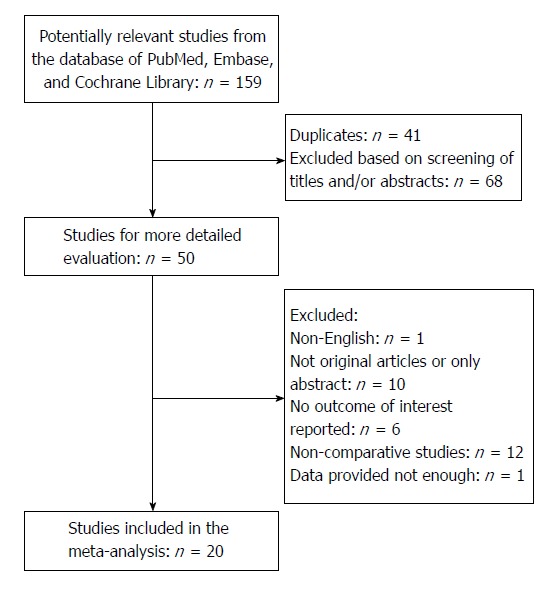
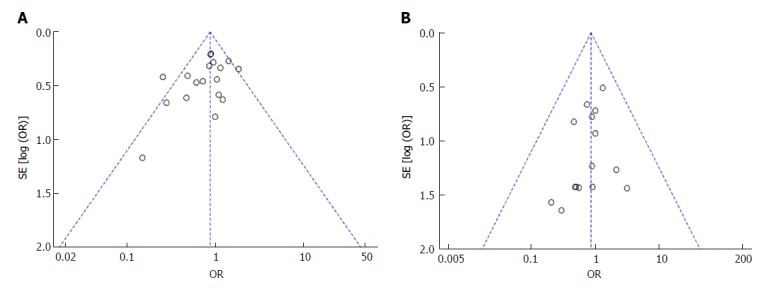
Computer searches were performed in databases (including PubMed, Cochrane Library and Embase) for randomized controlled trials or case-control studies describing ERAS programs in patients undergoing pancreatic surgery published between January 1995 and August 2017. Two researchers independently evaluated the quality of the studies' extracted data that met the inclusion criteria and performed a meta-analysis using RevMan5.3.5 software. Forest plots, demonstrating the outcomes of the ERAS group the control group after pancreatic surgery, and funnel plots were used to evaluate potential publication bias.
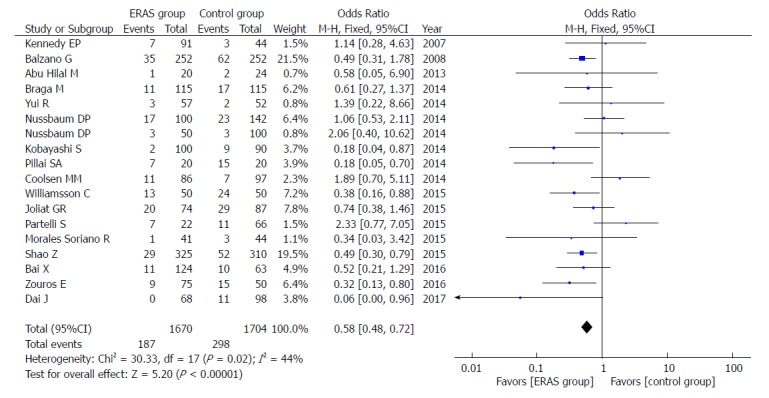
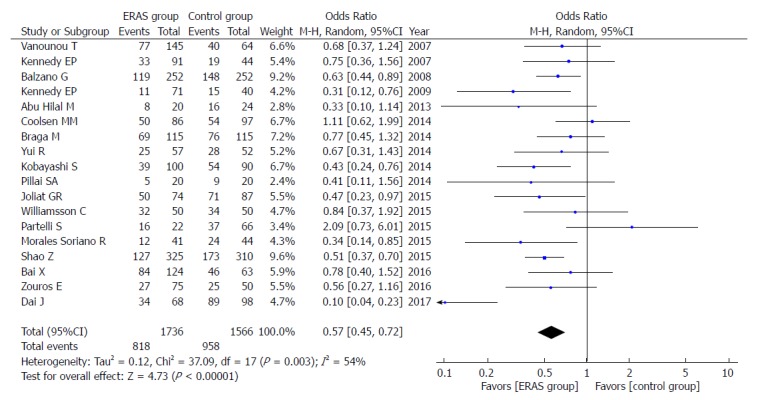
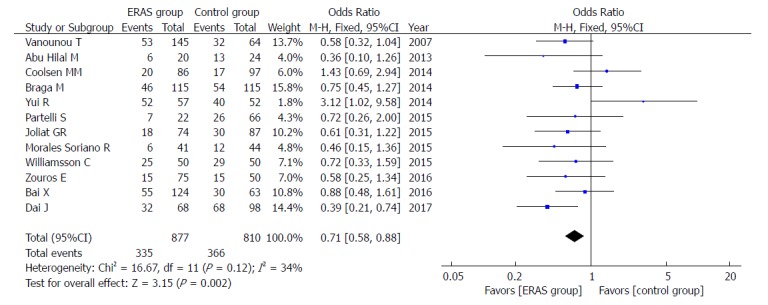
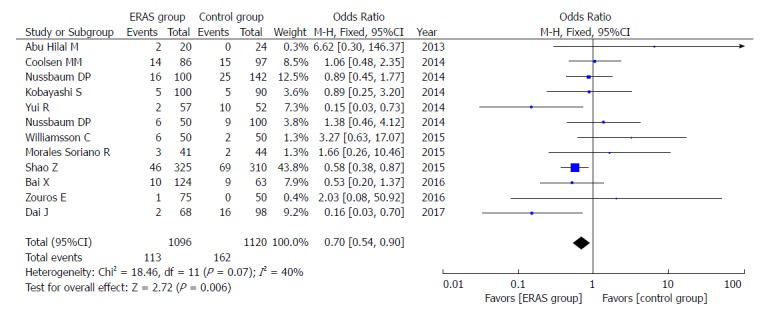
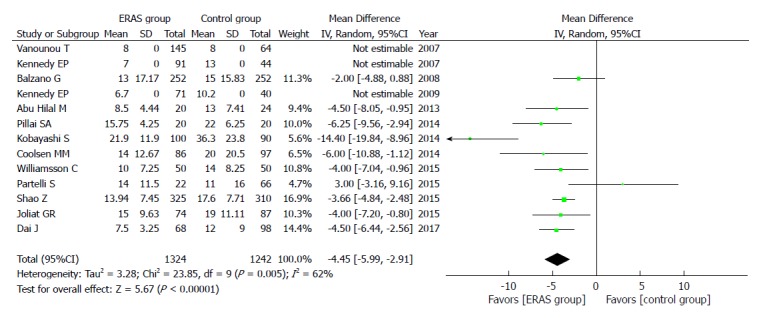
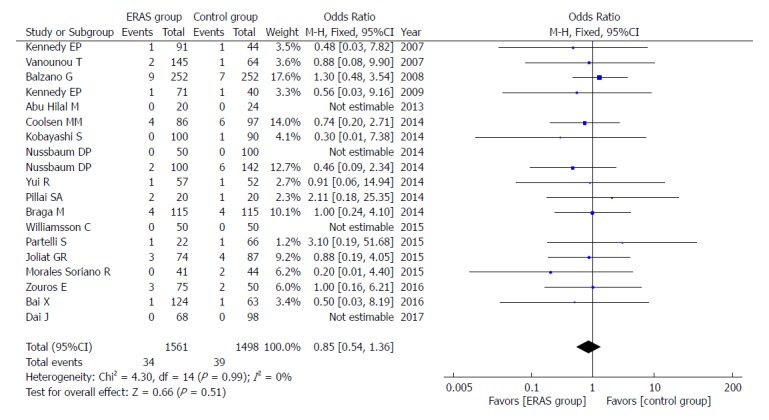
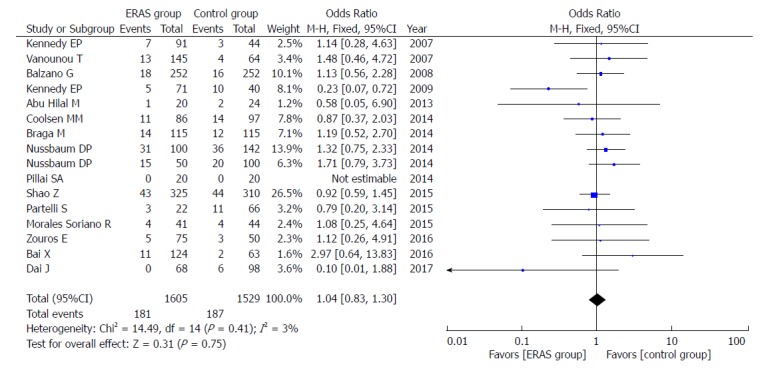
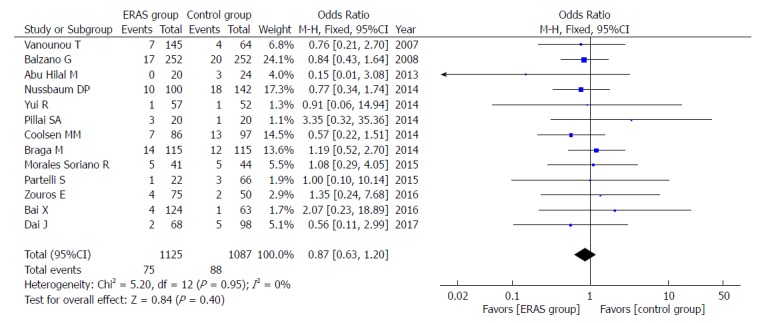
Twenty case-control studies including 3694 patients, published between January 1995 and August 2017, were selected for the meta-analysis. This study included the ERAS group ( = 1886) and the control group ( = 1808), which adopted the traditional perioperative management. Compared to the control group, the ERAS group had lower delayed gastric emptying rates [odds ratio (OR) = 0.58, 95% confidence interval (CI): 0.48-0.72, < 0.00001], lower postoperative complication rates (OR = 0.57, 95%CI: 0.45-0.72, < 0.00001), particularly for the mild postoperative complications (Clavien-Dindo I-II) (OR = 0.71, 95%CI: 0.58-0.88, = 0.002), lower abdominal infection rates (OR = 0.70, 95%CI: 0.54-0.90, = 0.006), and shorter postoperative length of hospital stay (PLOS) (WMD = -4.45, 95%CI: -5.99 to -2.91, < 0.00001). However, there were no significant differences in complications, such as, postoperative pancreatic fistulas, moderate to severe complications (Clavien-Dindo III- V), mortality, readmission and unintended reoperation, in both groups.
The perioperative implementation of ERAS programs in pancreatic surgery is safe and effective, can decrease postoperative complication rates, and can promote recovery for patients.
评估加速康复外科(ERAS)方案对胰腺手术后并发症的影响。
计算机检索 1995 年 1 月至 2017 年 8 月期间在 PubMed、Cochrane 图书馆和 Embase 数据库中发表的关于胰腺手术患者中 ERAS 方案的随机对照试验或病例对照研究,描述 ERAS 方案。两名研究人员独立评估符合纳入标准的研究数据的质量,并使用 RevMan5.3.5 软件进行荟萃分析。森林图,展示胰腺手术后 ERAS 组和对照组的结果,并使用漏斗图评估潜在的发表偏倚。
选择了 20 项病例对照研究,共 3694 例患者,发表于 1995 年 1 月至 2017 年 8 月,进行荟萃分析。本研究包括 ERAS 组(n = 1886)和对照组(n = 1808),采用传统围手术期管理。与对照组相比,ERAS 组的胃排空延迟率较低[比值比(OR)= 0.58,95%置信区间(CI):0.48-0.72, < 0.00001],术后并发症发生率较低(OR = 0.57,95%CI:0.45-0.72, < 0.00001),尤其是轻度术后并发症(Clavien-Dindo 分级 I-II)(OR = 0.71,95%CI:0.58-0.88, = 0.002),腹部感染率较低(OR = 0.70,95%CI:0.54-0.90, = 0.006),术后住院时间(PLOS)较短(WMD = -4.45,95%CI:-5.99 至 -2.91, < 0.00001)。然而,两组间的并发症(如术后胰瘘、中重度并发症(Clavien-Dindo 分级 III-V)、死亡率、再入院和非计划再次手术)无显著差异。
胰腺手术围手术期实施 ERAS 方案安全有效,可降低术后并发症发生率,促进患者康复。