Department of Respiratory Disease, Daping Hospital, Third Military Medical University, Chongqing 400042, China.
Department of Nuclear Medicine, Daping Hospital, Third Military Medical University, Chongqing 400042, China.
Biomed Res Int. 2018 Mar 1;2018:1823710. doi: 10.1155/2018/1823710. eCollection 2018.
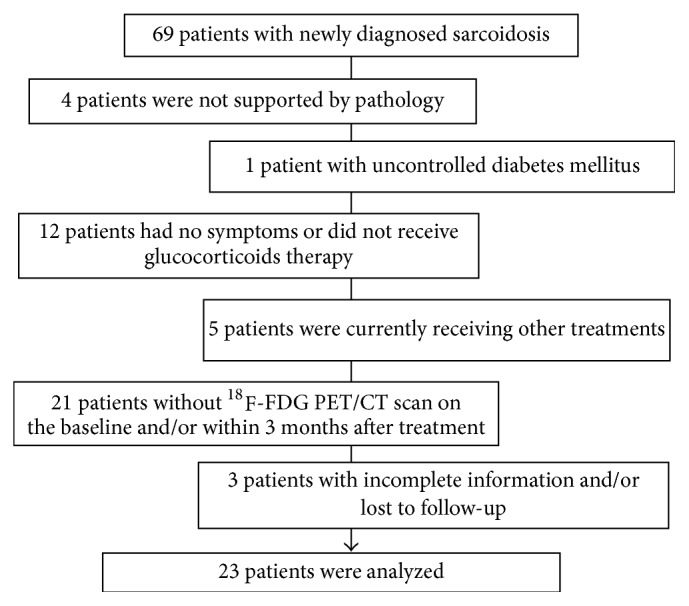
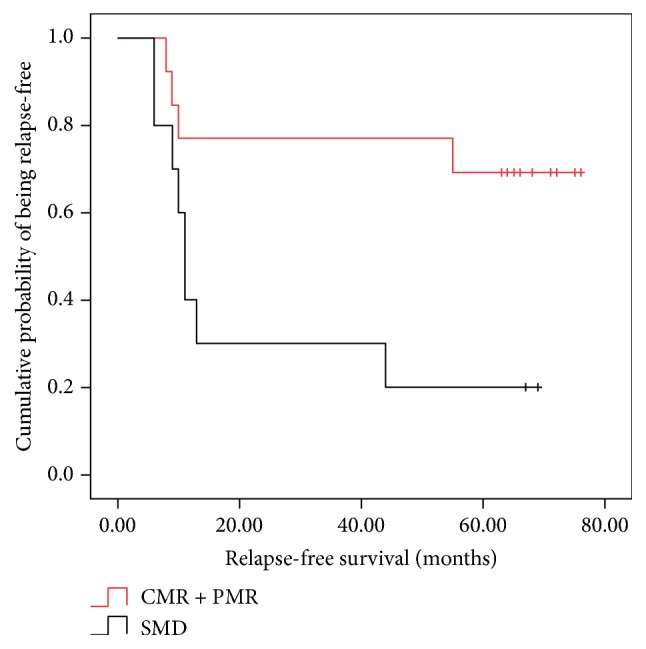
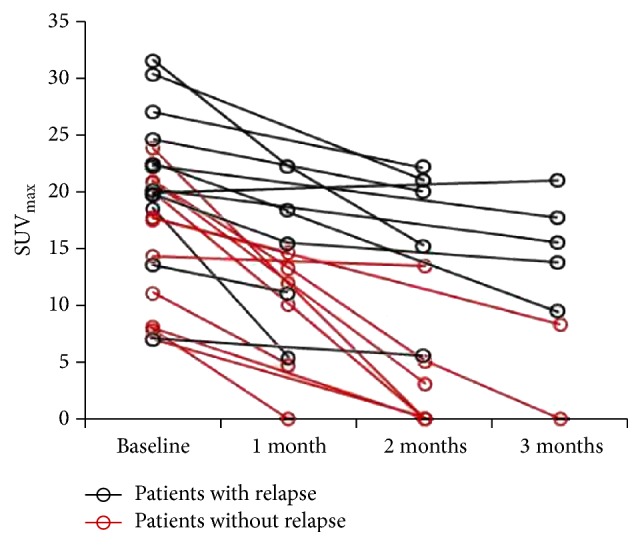
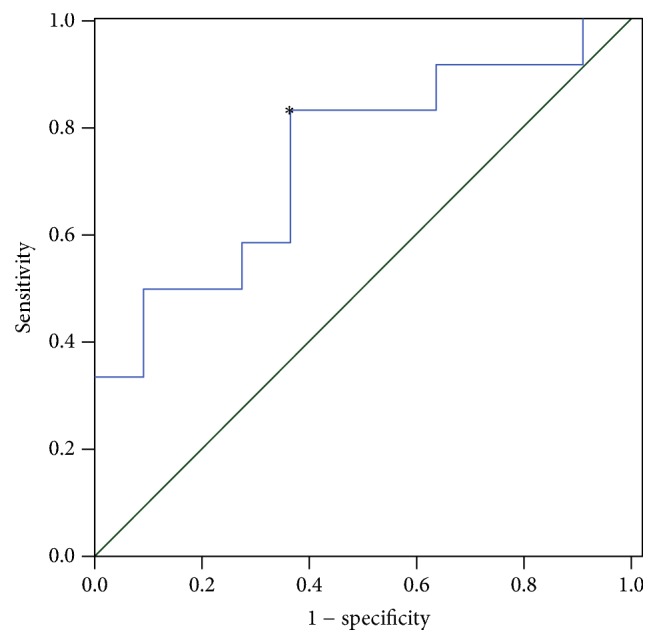
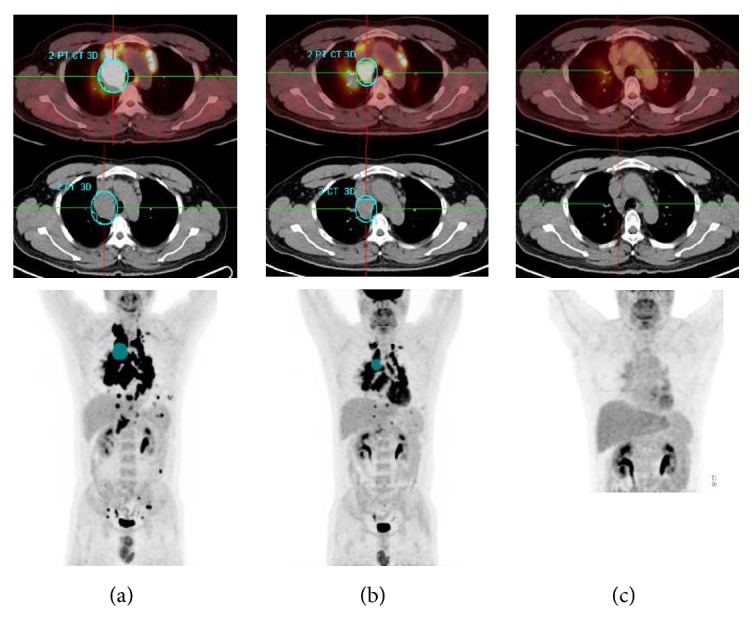
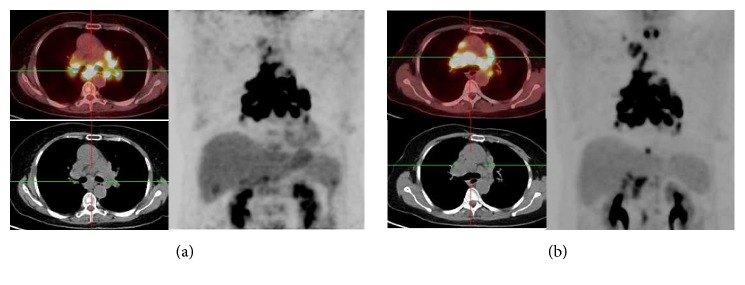
Sarcoidosis has significant heterogeneity involving multiple organs; treatment of the disease is a significant therapeutic challenge due to the difficulties in accurately monitoring disease activity and estimating prognosis. Fluorine-18-fluorodeoxyglucose positron emission tomography/computed tomography (F-FDG-PET/CT) plays an important role in assessing the metabolic activity. However, there is not enough evidence about the influence of this method in the clinical management and prognosis prediction for sarcoidosis. This study aims to investigate the clinical utility of F-FDG PET/CT for therapeutic evaluation and prognostic prediction in sarcoidosis. We had retrospectively enrolled 23 patients with sarcoidosis assigned to receive systemic glucocorticoids. All patients underwent baseline F-FDG PET/CT before initiating therapy and follow-up F-FDG PET/CT within 3 months after the therapy. The metabolic and clinical responses were classified. The baseline F-FDG PET/CT showed increased uptake in all patients. Based solely on biopsy-proven sites, the sensitivity of F-FDG PET/CT was 91.7%, and the sensitivity improved to 100% after excluding skin involvement. In the subsequent follow-up PET scans within 3 months after glucocorticoids therapy, the SUV were variously decreased except one; there are significant differences in the clinical remission rates and the relapse rates between patients with a favorable response and cases with no response on follow-up PET scan, the increasing metabolic response was associated with the increase in clinical remission rates and the reduction in recurrence rates. In conclusion, the present study shows that F-FDG PET/CT is an effective way to monitor the early therapeutic reaction and is helpful in predicting the long-term prognosis of sarcoidosis.
结节病涉及多个器官,具有显著的异质性;由于难以准确监测疾病活动和估计预后,该病的治疗是一个重大的治疗挑战。氟-18-氟代脱氧葡萄糖正电子发射断层扫描/计算机断层扫描(F-FDG-PET/CT)在评估代谢活性方面发挥着重要作用。然而,关于该方法在结节病的临床管理和预后预测中的影响,证据还不够充分。本研究旨在探讨 F-FDG PET/CT 在结节病的治疗评估和预后预测中的临床应用价值。我们回顾性纳入了 23 例接受全身糖皮质激素治疗的结节病患者。所有患者在开始治疗前均行基线 F-FDG PET/CT 检查,并在治疗后 3 个月内行随访 F-FDG PET/CT 检查。对代谢和临床反应进行分类。基线 F-FDG PET/CT 显示所有患者均有摄取增加。仅基于活检证实的部位,F-FDG PET/CT 的敏感性为 91.7%,排除皮肤受累后敏感性提高至 100%。在糖皮质激素治疗后 3 个月内的后续随访 PET 扫描中,SUV 除 1 例外均不同程度降低;在随访 PET 扫描中无反应者与有反应者之间,临床缓解率和复发率存在显著差异,代谢反应增加与临床缓解率增加和复发率降低相关。总之,本研究表明 F-FDG PET/CT 是监测早期治疗反应的有效方法,有助于预测结节病的长期预后。