Subdirección de Investigación Clínica, INER, Calz. de Tlalpan 4502, Tlalpan, Sección XVI, C.P. 14080, Ciudad de México, México.
Departamento de Fisiología Respiratoria INER, México city, México.
Respir Res. 2018 Apr 24;19(1):72. doi: 10.1186/s12931-018-0775-2.
Radiation pneumonitis (RP) is a frequent complication of concurrent chemoradiotherapy (CCRT) and is associated with severe symptoms that decrease quality of life and might result in pulmonary fibrosis or death. The aim of this study is to identify whether pulmonary function test (PFT) abnormalities may predict RP in non-small cell lung cancer (NSCLC) patients.
A prospective multi-institutional study was conducted with locally advanced and oligometastatic NSCLC patients. All participants were evaluated at baseline, end of CCRT, week 6, 12, 24, and 48 post-CCRT. They completed forced spirometry with a bronchodilator, body plethysmography, impulse oscillometry, carbon monoxide diffusing capacity (DLCO), molar mass of CO, six-minute walk test and exhaled fraction of nitric oxide (FeNO). Radiation pneumonitis was assessed with RTOG and CTCAE. The protocol was registered in www.clinicaltrials.gov (NCT01580579), registered April 19, 2012.
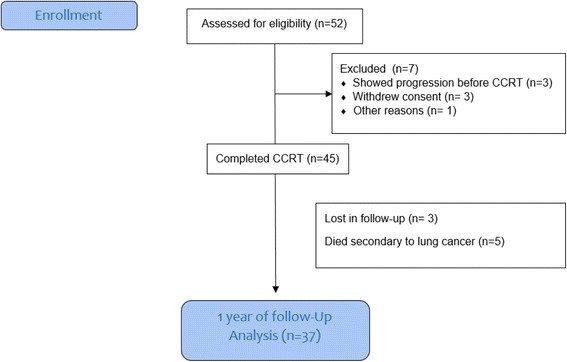
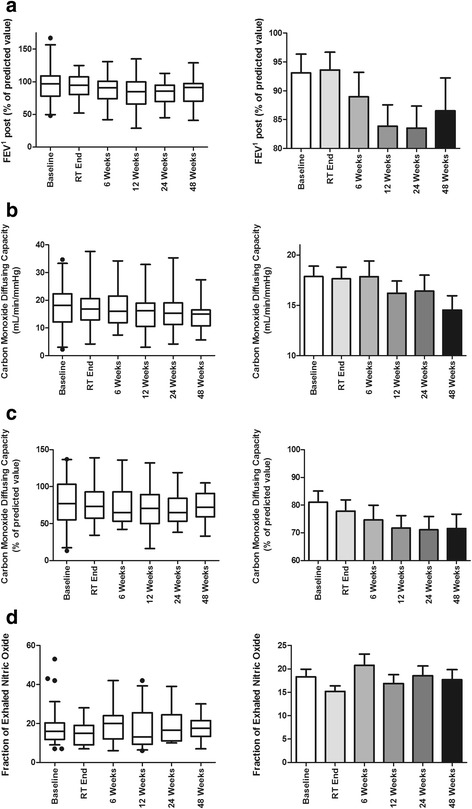
Fifty-two patients were enrolled; 37 completed one-year follow-up. RP ≥ Grade 2 was present in 11/37 (29%) for RTOG and 15/37 (40%) for CTCAE. Factors associated with RP were age over 60 years and hypofractionated dose. PFT abnormalities at baseline that correlated with the development of RP included lower forced expiratory volume in one second after bronchodilator (p = 0.02), DLCO (p = 0.02) and FeNO (p = 0.04). All PFT results decreased after CCRT and did not return to basal values at follow-up.
FEV, DLCO and FeNO prior to CCRT predict the development of RP in NSCLC. This study suggests that all patients under CCRT should be assessed by PFT to identify high-risk patients for close follow-up and early treatment.
放射性肺炎(RP)是同期放化疗(CCRT)的常见并发症,与严重症状相关,降低生活质量,并可能导致肺纤维化或死亡。本研究旨在确定肺功能检查(PFT)异常是否可预测非小细胞肺癌(NSCLC)患者的放射性肺炎。
进行了一项前瞻性多机构研究,纳入局部晚期和寡转移 NSCLC 患者。所有患者在基线、CCRT 结束时、CCRT 后 6、12、24 和 48 周进行评估。他们完成了支气管扩张剂用力肺活量、体描法、脉冲震荡法、一氧化碳弥散量(DLCO)、一氧化碳摩尔质量、6 分钟步行试验和呼出气一氧化氮分数(FeNO)检查。采用 RTOG 和 CTCAE 评估放射性肺炎。该方案在 www.clinicaltrials.gov (NCT01580579)上注册,于 2012 年 4 月 19 日注册。
共纳入 52 例患者,37 例完成了 1 年随访。RTOG 分级≥2 级的放射性肺炎 11/37 例(29%),CTCAE 分级≥2 级的放射性肺炎 15/37 例(40%)。与放射性肺炎相关的因素包括年龄>60 岁和低分割剂量。与放射性肺炎发生相关的基线时的 PFT 异常包括支气管扩张剂后用力呼气量第一秒(FEV1)下降(p=0.02)、DLCO 下降(p=0.02)和 FeNO 升高(p=0.04)。所有 PFT 结果在 CCRT 后均下降,在随访时未恢复到基础值。
CCRT 前 FEV1、DLCO 和 FeNO 可预测 NSCLC 放射性肺炎的发生。本研究表明,所有接受 CCRT 的患者均应进行 PFT 评估,以识别高危患者,进行密切随访和早期治疗。