Kenya Medical Research Institute-Wellcome Trust Research Programme, Kilifi, Kenya.
Centre for Immunity, Infection and Evolution, Institute of Immunology and Infection Research, School of Biological Sciences, University of Edinburgh, Edinburgh, United Kingdom.
Elife. 2018 Apr 25;7:e31579. doi: 10.7554/eLife.31579.
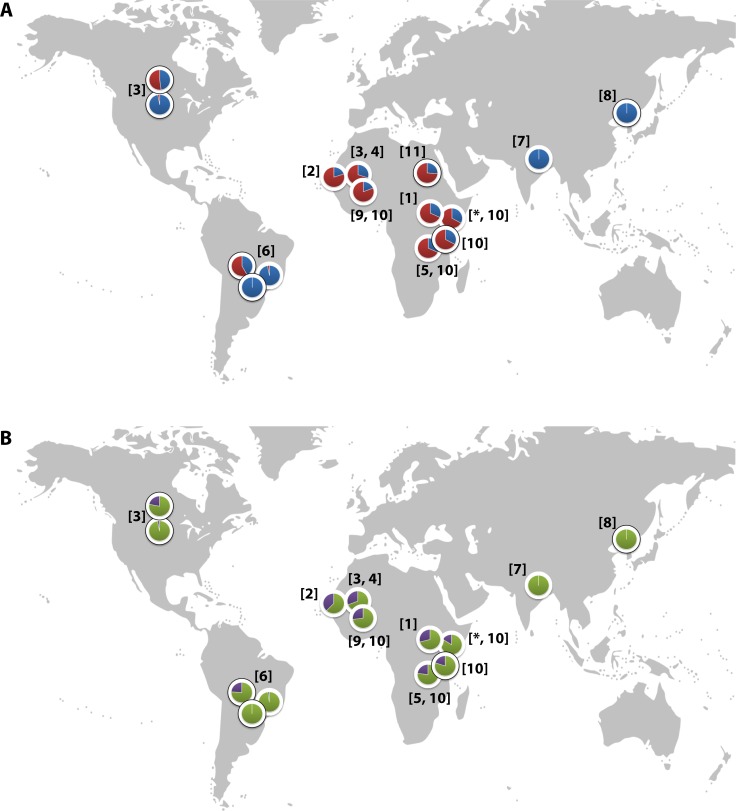
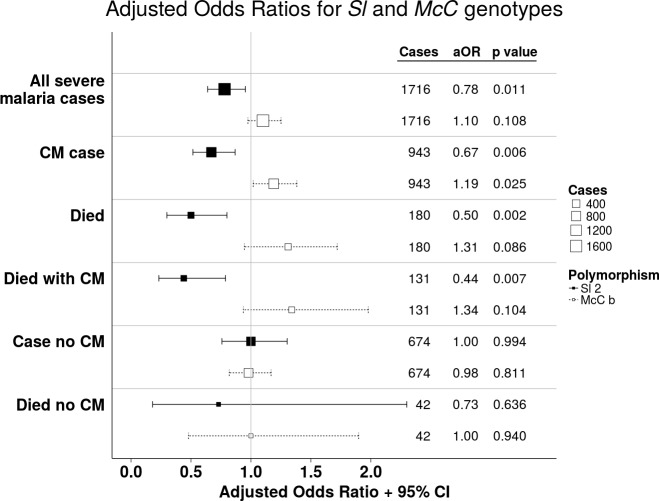
Malaria has been a major driving force in the evolution of the human genome. In sub-Saharan African populations, two neighbouring polymorphisms in the Complement Receptor One () gene, named and , occur at high frequencies, consistent with selection by malaria. Previous studies have been inconclusive. Using a large case-control study of severe malaria in Kenyan children and statistical models adjusted for confounders, we estimate the relationship between and and malaria phenotypes, and find they have opposing associations. The polymorphism is associated with markedly reduced odds of cerebral malaria and death, while the polymorphism is associated with increased odds of cerebral malaria. We also identify an apparent interaction between and αthalassaemia, with the protective association of greatest in children with normal α-globin. The complex relationship between these three mutations may explain previous conflicting findings, highlighting the importance of considering genetic interactions in disease-association studies.
疟疾是人类基因组进化的主要驱动力。在撒哈拉以南非洲人群中,补体受体 1()基因中的两个相邻多态性,分别命名为和,以高频率发生,与疟疾的选择一致。先前的研究尚无定论。本研究使用肯尼亚儿童严重疟疾的大型病例对照研究和针对混杂因素进行调整的统计模型,估计和与疟疾表型之间的关系,并发现它们具有相反的关联。多态性与明显降低的脑型疟疾和死亡几率相关,而多态性与增加的脑型疟疾几率相关。我们还发现和α-地中海贫血之间存在明显的相互作用,在正常α-球蛋白的儿童中,的保护相关性最大。这三种突变之间的复杂关系可能解释了之前相互矛盾的发现,突出了在疾病关联研究中考虑遗传相互作用的重要性。