Research Unit, Hospital General La Mancha Centro, Alcázar de San Juan, Ciudad. Real, Spain.
Centro de Investigación Biomédica en Red de Enfermedades Hepáticas y Digestivas (CIBEREHD), Madrid, Spain.
Clin Transl Gastroenterol. 2018 Apr 25;9(4):147. doi: 10.1038/s41424-018-0017-4.
Esophageal microbiota and regulation of adaptive immunity are increasingly being investigated in eosinophilic esophagitis (EoE). Toll-like receptors (TLRs) play a central role in the initiation and maintenance of innate immune activity. Our objective was to characterize the esophageal and duodenal innate immune response in EoE and its modulation by dietary therapy.
Esophageal and duodenal biopsy samples were collected from 10 adults with untreated EoE, before and after effective treatment with a six-food elimination diet (SFED), and 10 controls with normal esophagus. In all cases, bacterial load (by mRNA expression of 16S), TLRs, mucins, transcription factors, interleukins, components of the NKG2D system, and innate immunity effectors were assessed by qPCR. Protein expression of TLRs were also determined by immunofluorescence.
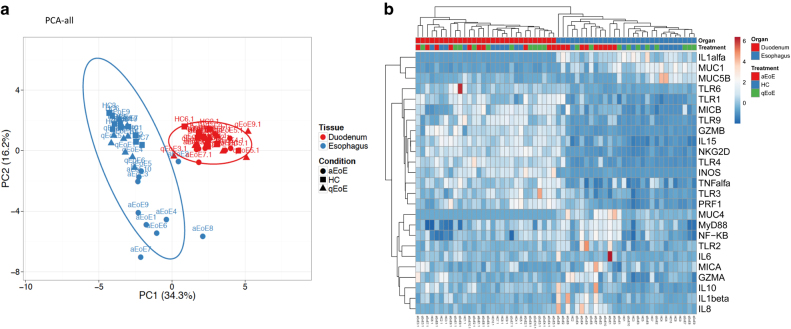
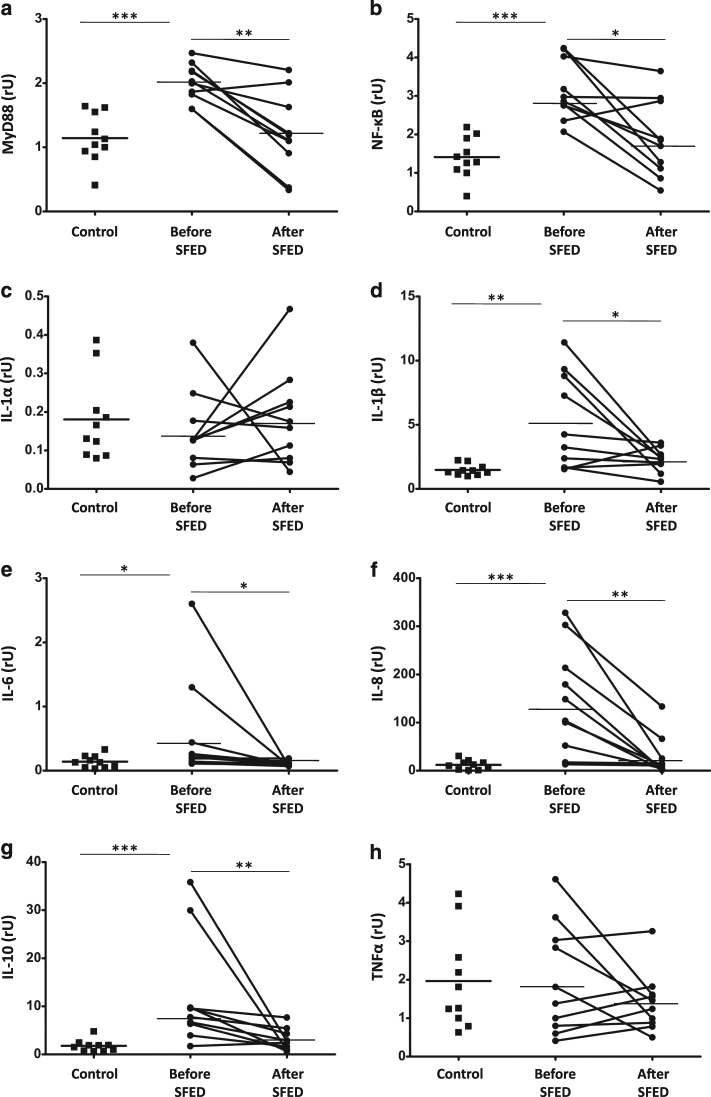
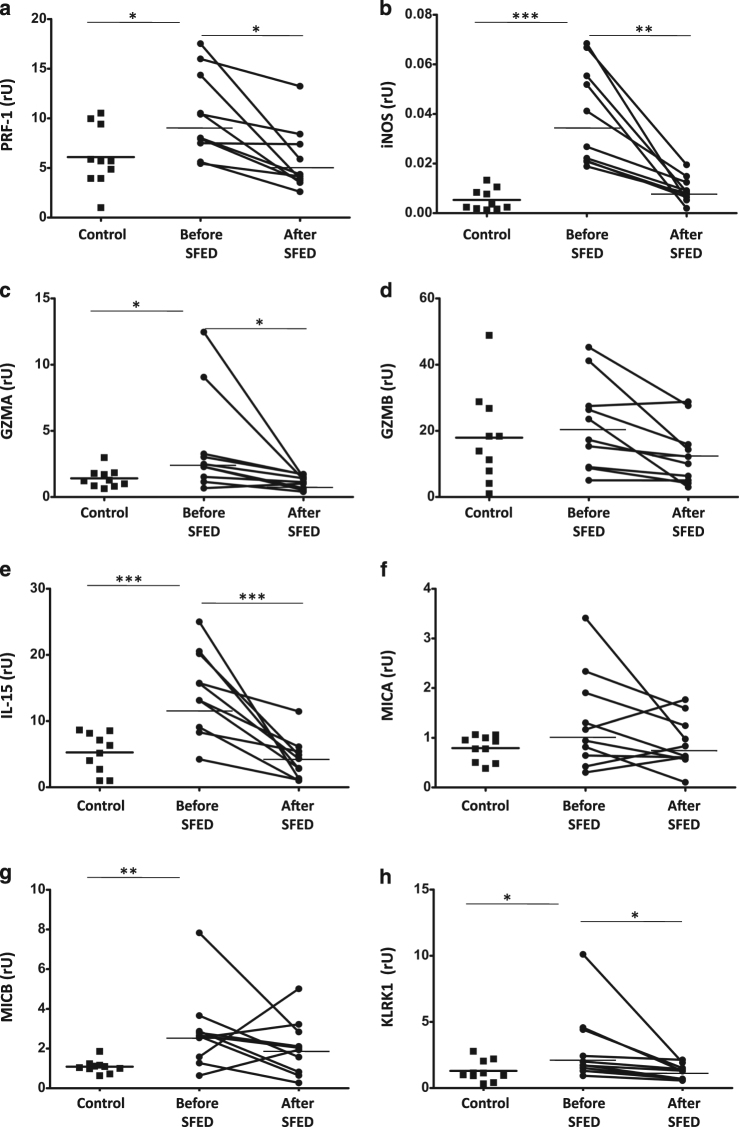
Bacterial load and TLR1, TLR2, TLR4, and TLR9 were overexpressed on biopsies with active EoE compared with controls. Muc1 and Muc5B genes were downregulated while Muc4 was overexpressed. Upregulation of MyD88 and NFκB was found together with IL-1β, IL-6, IL-8, and IL-10 mediators and PER-1, iNOS, and GRZA effectors. NG-K2D components (KLRK1, IL-15, MICB) were also upregulated. In all cases, changes in active EoE were normalized following SFED and mucosal healing. Duodenal samples also showed increased expressions of TLR-1, TLR-2, and TLR-4, but not 16S or any other mediators nor effectors of inflammation.
Esophageal TLR-dependent signaling pathways in EoE support the potential implication of microbiota and the innate immune system in the pathogenesis of this disease.
嗜酸性粒细胞性食管炎 (EoE) 中越来越多地研究食管微生物群和适应性免疫的调节。 Toll 样受体 (TLR) 在先天免疫活性的启动和维持中发挥核心作用。我们的目的是描述 EoE 中的食管和十二指肠固有免疫反应及其通过饮食治疗的调节。
收集 10 例未经治疗的 EoE 成人、有效治疗后(六食物排除饮食 (SFED))和 10 例正常食管对照者的食管和十二指肠活检样本。在所有情况下,均通过 qPCR 评估细菌负荷(通过 16S 的 mRNA 表达)、TLR、粘蛋白、转录因子、白细胞介素、NKG2D 系统成分和固有免疫效应物。还通过免疫荧光法测定 TLR 的蛋白表达。
与对照组相比,活动期 EoE 活检中细菌负荷和 TLR1、TLR2、TLR4 和 TLR9 过度表达。Muc1 和 Muc5B 基因下调,而 Muc4 过度表达。发现 MyD88 和 NFκB 上调,同时伴有 IL-1β、IL-6、IL-8 和 IL-10 介质和 PER-1、iNOS 和 GRZA 效应物。NG-K2D 成分(KLRK1、IL-15、MICB)也上调。在所有情况下,SFED 和黏膜愈合后,活动期 EoE 的变化均得到正常化。十二指肠样本也显示 TLR-1、TLR-2 和 TLR-4 的表达增加,但 16S 或任何其他介质或炎症效应物均未增加。
EoE 中食管 TLR 依赖性信号通路支持微生物群和固有免疫系统在该疾病发病机制中的潜在作用。