Center for Research in Scientific Computation, North Carolina State University, Raleigh, NC, United States of America.
Department of Ecology, Swedish University of Agricultural Sciences, Uppsala, Sweden.
PLoS One. 2018 Apr 25;13(4):e0195919. doi: 10.1371/journal.pone.0195919. eCollection 2018.
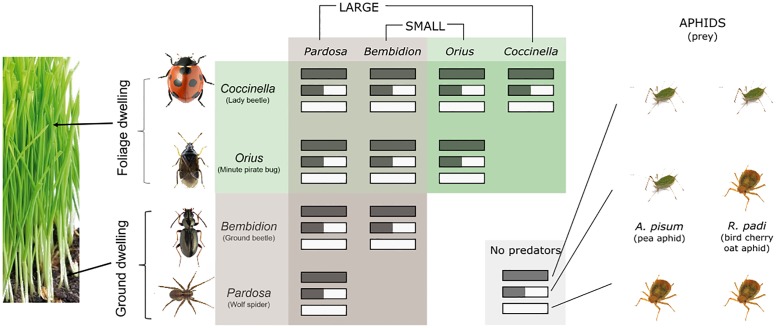
Successfully applying theoretical models to natural communities and predicting ecosystem behavior under changing conditions is the backbone of predictive ecology. However, the experiments required to test these models are dictated by practical constraints, and models are often opportunistically validated against data for which they were never intended. Alternatively, we can inform and improve experimental design by an in-depth pre-experimental analysis of the model, generating experiments better targeted at testing the validity of a theory. Here, we describe this process for a specific experiment. Starting from food web ecological theory, we formulate a model and design an experiment to optimally test the validity of the theory, supplementing traditional design considerations with model analysis. The experiment itself will be run and described in a separate paper. The theory we test is that trophic population dynamics are dictated by species traits, and we study this in a community of terrestrial arthropods. We depart from the Allometric Trophic Network (ATN) model and hypothesize that including habitat use, in addition to body mass, is necessary to better model trophic interactions. We therefore formulate new terms which account for micro-habitat use as well as intra- and interspecific interference in the ATN model. We design an experiment and an effective sampling regime to test this model and the underlying assumptions about the traits dominating trophic interactions. We arrive at a detailed sampling protocol to maximize information content in the empirical data obtained from the experiment and, relying on theoretical analysis of the proposed model, explore potential shortcomings of our design. Consequently, since this is a "pre-experimental" exercise aimed at improving the links between hypothesis formulation, model construction, experimental design and data collection, we hasten to publish our findings before analyzing data from the actual experiment, thus setting the stage for strong inference.
成功地将理论模型应用于自然群落,并预测变化条件下的生态系统行为是预测生态学的基础。然而,为了检验这些模型而进行的实验受到实际限制的制约,而且这些模型往往是根据它们从未打算用于的数据进行机会性验证的。或者,我们可以通过对模型进行深入的实验前分析来告知和改进实验设计,从而生成更有针对性地检验理论有效性的实验。在这里,我们描述了一个具体实验的这个过程。从食物网生态学理论出发,我们构建了一个模型并设计了一个实验,以最佳地检验该理论的有效性,并用模型分析补充了传统的设计考虑因素。该实验本身将在另一篇论文中进行描述。我们要检验的理论是,营养种群动态是由物种特征决定的,我们在一个陆地节肢动物群落中研究这个理论。我们从营养级网络(ATN)模型出发,并假设除了体重之外,还需要包含栖息地利用,才能更好地模拟营养相互作用。因此,我们提出了新的术语,这些术语考虑了微生境利用以及 ATN 模型中的种内和种间干扰。我们设计了一个实验和一个有效的采样方案来检验这个模型以及支配营养相互作用的特征的基本假设。我们制定了一个详细的采样方案,以最大限度地提高从实验中获得的经验数据的信息量,并依靠对提出的模型的理论分析,探索我们设计的潜在缺陷。因此,由于这是一项旨在改善假设制定、模型构建、实验设计和数据收集之间联系的“实验前”练习,我们急于在分析实际实验数据之前公布我们的发现,从而为强推断奠定基础。