Ecological Modelling Group, School of Bioscience, University of Skövde, Skövde, Sweden.
Ecological and Environmental Modeling, Department of Physics, Chemistry and Biology, Linköping University, Linköping, Sweden.
PLoS One. 2024 Sep 4;19(9):e0309664. doi: 10.1371/journal.pone.0309664. eCollection 2024.
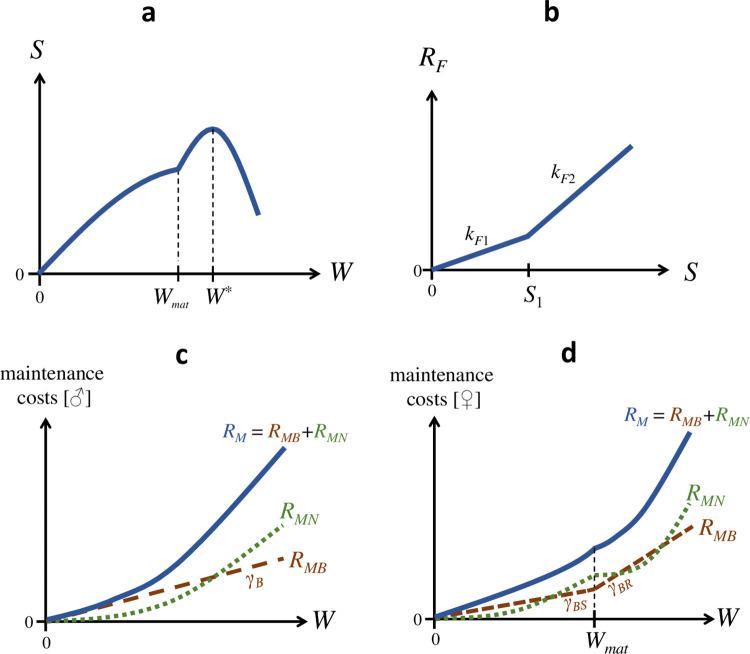
Metabolic theories in ecology interpret ecological patterns at different levels through the lens of metabolism, typically applying allometric power scaling laws to describe rates of energy use. This requires a sound theory for metabolism at the individual level. Commonly used mechanistic growth models lack some potentially important aspects and fail to accurately capture a growth pattern often observed in insects. Recently, a new model (MGM-the Maintenance-Growth Model) was developed for ontogenetic and post-mature growth, based on an energy balance that expresses growth as the net result of assimilation and metabolic costs for maintenance and feeding. The most important contributions of MGM are: 1) the division of maintenance costs into a non-negotiable and a negotiable part, potentially resulting in maintenance costs that increase faster than linearly with mass and are regulated in response to food restriction; 2) differentiated energy allocation strategies between sexes and 3) explicit description of costs for finding and processing food. MGM may also account for effects of body composition and type of growth at the cellular level. The model was here calibrated and evaluated using empirical data from an experiment on house crickets growing under ad libitum conditions. The procedure involved parameter estimations from the literature and collected data, using statistical models to account for individual variation in parameter values. It was found that ingestion rate cannot be generally described by a simple allometry, here requiring a more complex description after maturity. Neither could feeding costs be related to ingestion rate in a simplistic manner. By the unusual feature of maintenance costs increasing faster than linearly with body mass, MGM could well capture the differentiated growth patterns of male and female crickets. Some other mechanistic growth models have been able to provide good predictions of insect growth during early ontogeny, but MGM may accurately describe the trajectory until terminated growth.
生态代谢理论通过代谢的视角来解释不同层次的生态模式,通常应用异速生长幂律来描述能量利用的速率。这需要个体水平上有一个健全的代谢理论。常用的机械生长模型缺乏一些潜在的重要方面,无法准确捕捉昆虫中常见的生长模式。最近,一种新的模型(MGM-维持-生长模型)被开发出来,用于个体发生和成熟后的生长,基于一个能量平衡,将生长表示为同化和维持以及进食代谢成本的净结果。MGM 的最重要贡献是:1)将维持成本分为不可协商和可协商的部分,可能导致维持成本随质量的增加而呈指数级增长,并根据食物限制进行调节;2)雌雄之间的能量分配策略有差异;3)明确描述寻找和处理食物的成本。MGM 还可以解释细胞水平上的身体成分和生长类型的影响。该模型在这里使用自由生长条件下生长的家蟋蟀实验的经验数据进行了校准和评估。该过程涉及从文献和收集的数据中进行参数估计,使用统计模型来解释个体参数值的变化。结果发现,摄食率不能用简单的异速生长来普遍描述,这里需要在成熟后用更复杂的描述。摄食成本也不能以简单的方式与摄食率相关。由于维持成本随体重增加的速度快于线性,MGM 可以很好地捕捉雌雄蟋蟀的不同生长模式。一些其他的机械生长模型能够很好地预测昆虫早期的生长,但 MGM 可以准确地描述终止生长之前的生长轨迹。