Max Planck Institute for Brain Research, 60438 Frankfurt, Germany.
Department of Integrative Neurophysiology, Center for Neurogenomics and Cognitive Research, VU University Amsterdam, De Boelelaan 1085, 1081 HV Amsterdam, the Netherlands.
Cell Rep. 2018 Apr 24;23(4):951-958. doi: 10.1016/j.celrep.2018.03.111.
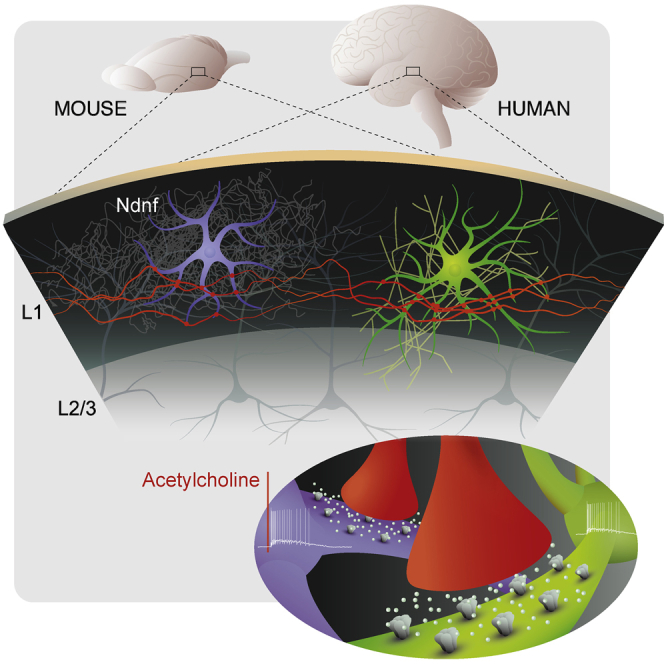
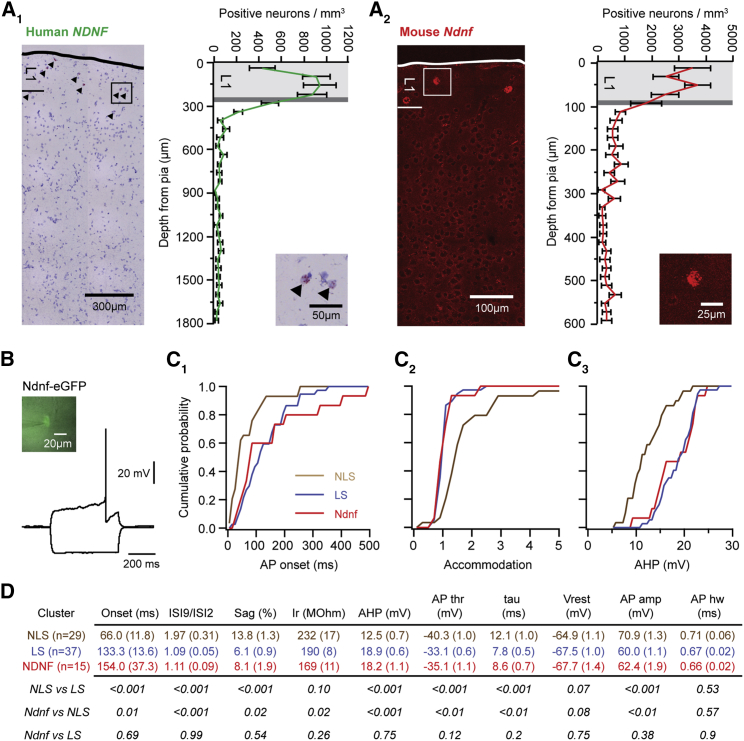
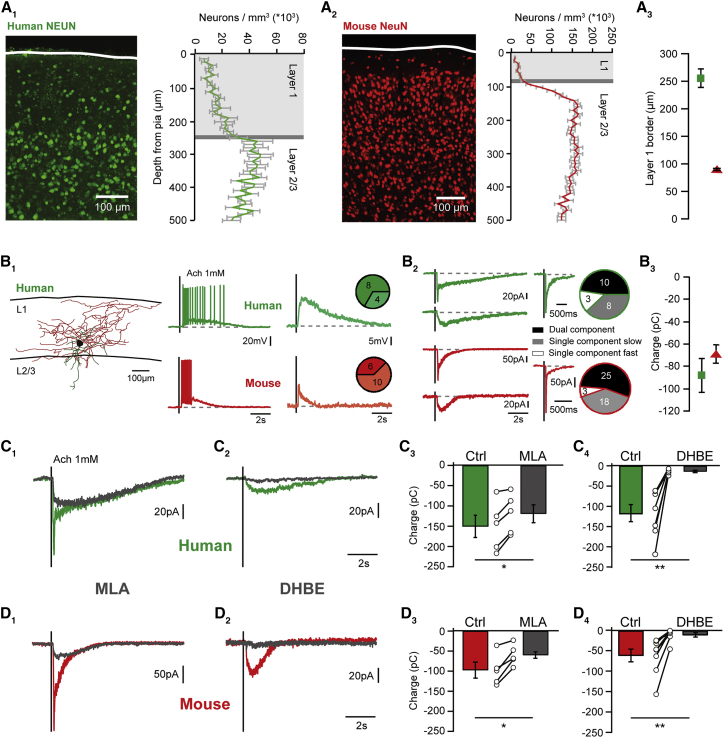
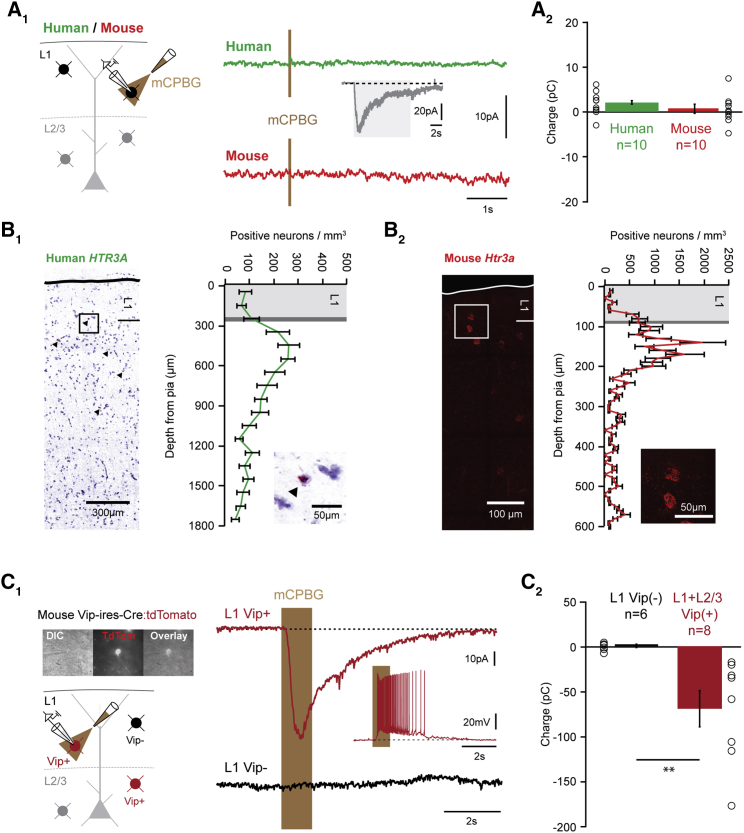
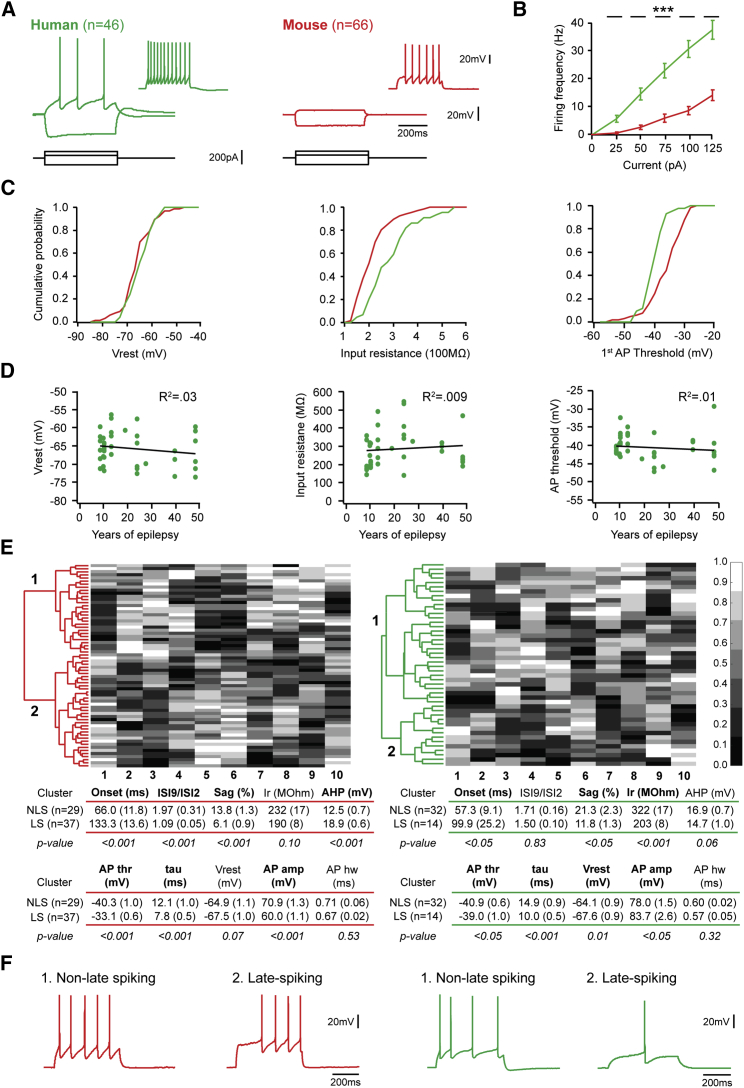
Inhibitory interneurons govern virtually all computations in neocortical circuits and are in turn controlled by neuromodulation. While a detailed understanding of the distinct marker expression, physiology, and neuromodulator responses of different interneuron types exists for rodents and recent studies have highlighted the role of specific interneurons in converting rapid neuromodulatory signals into altered sensory processing during locomotion, attention, and associative learning, it remains little understood whether similar mechanisms exist in human neocortex. Here, we use whole-cell recordings combined with agonist application, transgenic mouse lines, in situ hybridization, and unbiased clustering to directly determine these features in human layer 1 interneurons (L1-INs). Our results indicate pronounced nicotinic recruitment of all L1-INs, whereas only a small subset co-expresses the ionotropic HTR3 receptor. In addition to human specializations, we observe two comparable physiologically and genetically distinct L1-IN types in both species, together indicating conserved rapid neuromodulation of human neocortical circuits through layer 1.
抑制性中间神经元几乎控制着新皮层回路中的所有计算,反过来又受到神经调质的控制。虽然对于啮齿动物,不同中间神经元类型的独特标记表达、生理学和神经调质反应已经有了详细的了解,并且最近的研究强调了特定中间神经元在将快速神经调质信号转换为运动、注意和联想学习过程中改变感觉处理的作用,但对于类似的机制是否存在于人类新皮层中,仍知之甚少。在这里,我们使用全细胞膜片钳记录技术结合激动剂应用、转基因小鼠系、原位杂交和无偏聚类,直接确定人类第 1 层中间神经元(L1-INs)的这些特征。我们的结果表明,所有 L1-IN 都明显招募了烟碱,而只有一小部分共同表达离子型 HTR3 受体。除了人类的特化之外,我们还在两个物种中观察到两种具有可比性的生理和遗传上不同的 L1-IN 类型,这共同表明通过第 1 层对人类新皮层回路进行了保守的快速神经调质调节。