Grube Markus, Hagen Paul, Jedlitschky Gabriele
Department of Pharmacology, Center of Drug Absorption and Transport, University Medicine Greifswald, Greifswald, Germany.
Front Pharmacol. 2018 Apr 11;9:354. doi: 10.3389/fphar.2018.00354. eCollection 2018.
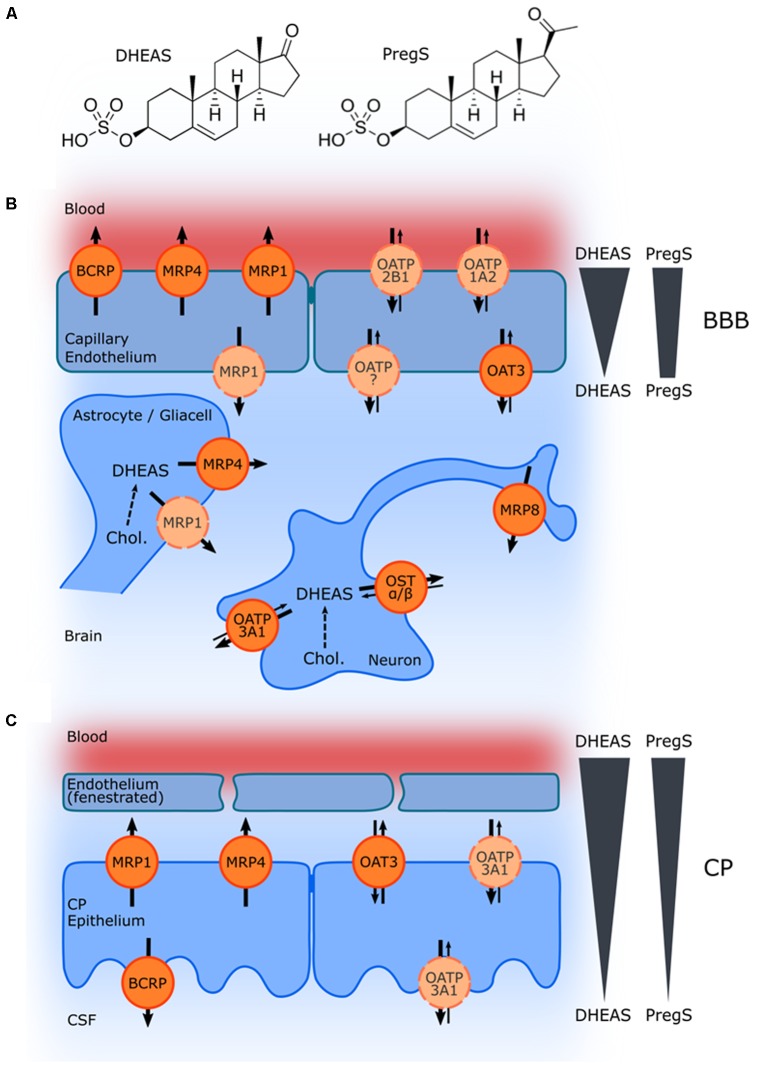
Neurosteroids, comprising pregnane, androstane, and sulfated steroids can alter neuronal excitability through interaction with ligand-gated ion channels and other receptors and have therefore a therapeutic potential in several brain disorders. They can be formed in brain cells or are synthesized by an endocrine gland and reach the brain by penetrating the blood-brain barrier (BBB). Especially sulfated steroids such as pregnenolone sulfate (PregS) and dehydroepiandrosterone sulfate (DHEAS) depend on transporter proteins to cross membranes. In this review, we discuss the involvement of ATP-binding cassette (ABC)- and solute carrier (SLC)-type membrane proteins in the transport of these compounds at the BBB and in the choroid plexus (CP), but also in the secretion from neurons and glial cells. Among the ABC transporters, especially BCRP (ABCG2) and several MRP/ABCC subfamily members (MRP1, MRP4, MRP8) are expressed in the brain and known to efflux conjugated steroids. Furthermore, several SLC transporters have been shown to mediate cellular uptake of steroid sulfates. These include members of the OATP/SLCO subfamily, namely OATP1A2 and OATP2B1, as well as OAT3 (SLC22A3), which have been reported to be expressed at the BBB, in the CP and in part in neurons. Furthermore, a role of the organic solute transporter OSTα-OSTβ (SLC51A/B) in brain DHEAS/PregS homeostasis has been proposed. This transporter was reported to be localized especially in steroidogenic cells of the cerebellum and hippocampus. To date, the impact of transporters on neurosteroid homeostasis is still poorly understood. Further insights are desirable also with regard to the therapeutic potential of these compounds.
神经甾体包括孕烷、雄烷和硫酸化甾体,可通过与配体门控离子通道及其他受体相互作用来改变神经元兴奋性,因此在多种脑部疾病中具有治疗潜力。它们可在脑细胞中形成,或由内分泌腺合成,并通过穿透血脑屏障(BBB)进入大脑。尤其是硫酸化甾体,如硫酸孕烯醇酮(PregS)和硫酸脱氢表雄酮(DHEAS),需要转运蛋白来跨膜。在本综述中,我们讨论了ATP结合盒(ABC)和溶质载体(SLC)型膜蛋白在这些化合物于血脑屏障和脉络丛(CP)处的转运中的作用,以及它们在神经元和神经胶质细胞分泌过程中的作用。在ABC转运蛋白中,尤其是乳腺癌耐药蛋白(BCRP,ABCG2)和几个多药耐药相关蛋白/MRP/ABCC亚家族成员(MRP1、MRP4、MRP8)在大脑中表达,并且已知可外排结合型甾体。此外,几种SLC转运蛋白已被证明可介导甾体硫酸盐的细胞摄取。这些包括有机阴离子转运多肽/OATP/SLCO亚家族的成员,即OATP1A2和OATP2B1,以及OAT3(SLC22A3),据报道它们在血脑屏障、脉络丛以及部分神经元中表达。此外,有人提出有机溶质转运体OSTα - OSTβ(SLC51A/B)在脑内DHEAS/PregS稳态中起作用。据报道,这种转运体尤其定位于小脑和海马体的类固醇生成细胞中。迄今为止,转运蛋白对神经甾体稳态的影响仍知之甚少。关于这些化合物的治疗潜力,也需要进一步深入了解。