Bigeard Jean, Hirt Heribert
Institute of Plant Sciences Paris-Saclay IPS2, Centre National de la Recherche Scientifique, Institut National de la Recherche Agronomique, Université Paris-Sud, Université Evry, Université Paris-Saclay, Orsay, France.
Institute of Plant Sciences Paris-Saclay IPS2, Paris Diderot, Sorbonne Paris-Cité, Orsay, France.
Front Plant Sci. 2018 Apr 11;9:469. doi: 10.3389/fpls.2018.00469. eCollection 2018.
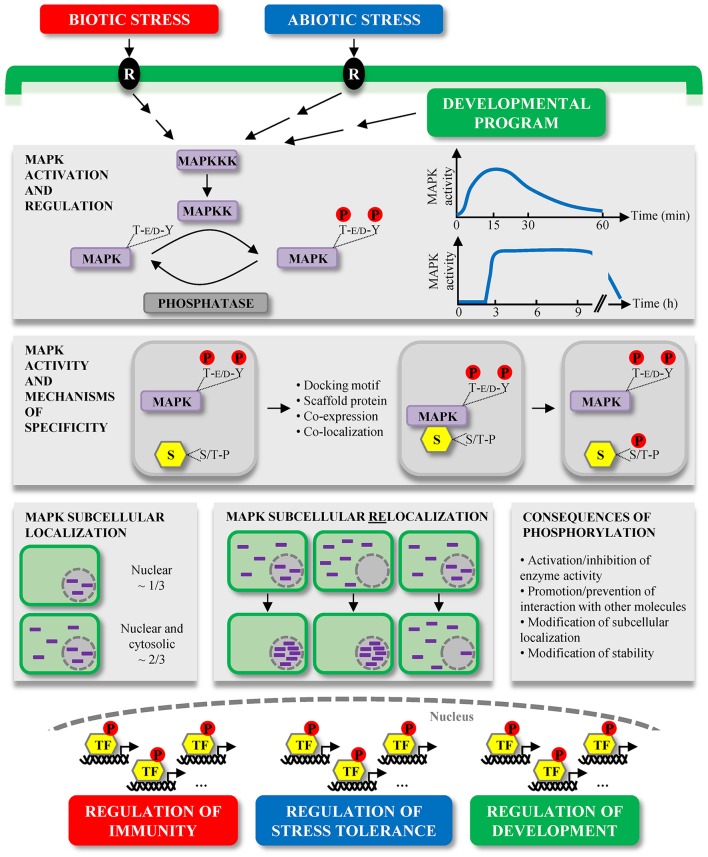
Mitogen-activated protein kinases (MAPKs) are conserved protein kinases in eukaryotes that establish signaling modules where MAPK kinase kinases (MAPKKKs) activate MAPK kinases (MAPKKs) which in turn activate MAPKs. In plants, they are involved in the signaling of multiple environmental stresses and developmental programs. MAPKs phosphorylate their substrates and this post-translational modification (PTM) contributes to the regulation of proteins. PTMs may indeed modify the activity, subcellular localization, stability or trans-interactions of modified proteins. Plant MAPKs usually localize to the cytosol and/or nucleus, and in some instances they may also translocate from the cytosol to the nucleus. Upon the detection of environmental changes at the cell surface, MAPKs participate in the signal transduction to the nucleus, allowing an adequate transcriptional reprogramming. The identification of plant MAPK substrates largely contributed to a better understanding of the underlying signaling mechanisms. In this review, we highlight the nuclear signaling of plant MAPKs. We discuss the activation, regulation and activity of plant MAPKs, as well as their nuclear re-localization. We also describe and discuss known nuclear substrates of plant MAPKs in the context of biotic stress, abiotic stress and development and consider future research directions in the field of plant MAPKs.
丝裂原活化蛋白激酶(MAPKs)是真核生物中保守的蛋白激酶,它们构建信号模块,其中MAPK激酶激酶(MAPKKKs)激活MAPK激酶(MAPKKs),而MAPKKs又激活MAPKs。在植物中,它们参与多种环境胁迫信号传导和发育程序。MAPKs使底物磷酸化,这种翻译后修饰(PTM)有助于蛋白质的调控。PTMs确实可能会改变被修饰蛋白质的活性、亚细胞定位、稳定性或反式相互作用。植物MAPKs通常定位于细胞质和/或细胞核,在某些情况下,它们也可能从细胞质转运到细胞核。在细胞表面检测到环境变化后,MAPKs参与向细胞核的信号转导,从而实现适当的转录重编程。植物MAPK底物的鉴定在很大程度上有助于更好地理解潜在的信号传导机制。在本综述中,我们重点介绍植物MAPKs的核信号传导。我们讨论了植物MAPKs的激活、调控和活性,以及它们的核重新定位。我们还在生物胁迫、非生物胁迫和发育的背景下描述和讨论了已知的植物MAPKs的核底物,并考虑了植物MAPKs领域未来的研究方向。