Department of Ophthalmology, Medical Faculty, Comenius University, Bratislava, Slovakia.
Association for Innovation and Biomedical Research on Light and Image (AIBILI, Portugal), University of Coimbra, Coimbra, Portugal.
Acta Ophthalmol. 2018 Dec;96(8):e942-e949. doi: 10.1111/aos.13771. Epub 2018 Apr 25.
Antivascular endothelial growth factor agents are increasingly used in diabetic macular oedema (DME); however, there are few studies exploring their use in DME in real-world settings.
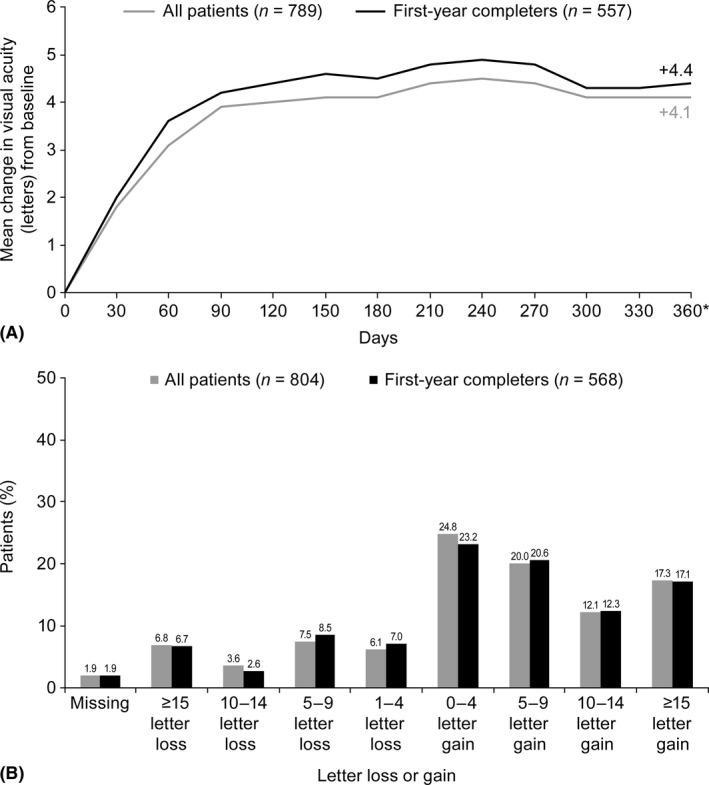
POLARIS was a noninterventional, multicentre study to monitor 12-month outcomes in patients starting ranibizumab treatment in routine practices. The primary outcome was mean change in visual acuity (VA) from baseline to month 12 (last observation carried forward approach). Other outcomes included mean change in central retinal thickness (CRT) and resource utilization. Visual acuity (VA) outcomes were also stratified by country, baseline visual acuity score (VAS), sex, age and injection frequency.
Outcomes were analysed from all treated patients (n = 804) and from first-year completers (patients who had a visual acuity assessment at 12 months; n = 568). The mean (SD) baseline VAS was 59.4 (15.9) letters, and the mean change in visual acuity was 4.4 letters (95% confidence interval: 3.3-5.4) at month 12 (study eye; first-year completers). The mean number of injections (study eye) was 4.9, and the mean number of all visits (any eye) was 10 (58% were injection visits) over 12 months (first-year completers). The mean (SD) baseline CRT was 410.6 (128.8) μm, and the mean change in CRT was -115.2 μm at month 12 (study eye; first-year completers). Visual acuity (VA) outcomes were generally comparable across most countries and subgroups and were greatest in patients with the lowest baseline VAS (≤60 letters).
POLARIS showed that real-world outcomes in DME patients starting treatment with ranibizumab were lower than those observed in clinical studies, in spite of extensive monitoring.
抗血管内皮生长因子药物在糖尿病黄斑水肿(DME)中的应用日益增多;然而,在真实环境中探索这些药物在 DME 中的应用的研究很少。
POLARIS 是一项非干预性、多中心研究,旨在监测接受雷珠单抗治疗的患者在常规实践中 12 个月的治疗结果。主要结局是从基线到第 12 个月(末次观察结转法)的视力(VA)平均变化。其他结局包括中央视网膜厚度(CRT)和资源利用的平均变化。视力(VA)结果还按国家、基线视力评分(VAS)、性别、年龄和注射频率进行分层。
对所有接受治疗的患者(n=804)和第一年完成者(在第 12 个月有视力评估的患者;n=568)进行了结果分析。平均(SD)基线 VAS 为 59.4(15.9)个字母,第 12 个月(研究眼;第一年完成者)视力平均提高 4.4 个字母(95%置信区间:3.3-5.4)。研究眼的平均注射次数为 4.9 次,12 个月内(第一年完成者)所有就诊次数(任何一只眼)平均为 10 次(58%为注射就诊)。平均(SD)基线 CRT 为 410.6(128.8)μm,第 12 个月 CRT 平均减少 115.2μm(研究眼;第一年完成者)。在大多数国家和亚组中,视力(VA)结果总体上是可比的,并且在基线 VAS 最低(≤60 个字母)的患者中效果最好。
尽管进行了广泛的监测,但 POLARIS 表明,开始接受雷珠单抗治疗的 DME 患者的真实世界结局低于临床研究中的观察结果。