Van Aken Elisabeth, Favreau Mérédis, Ramboer Eva, Denhaerynck Kris, MacDonald Karen, Abraham Ivo, Brié Heidi
Department of Ophthalmology, AZ Sint-Elisabeth, Zottegem, Belgium.
Department of Head and Skin, Ghent University, Ghent, Belgium.
Clin Ophthalmol. 2020 Dec 2;14:4173-4185. doi: 10.2147/OPTH.S281501. eCollection 2020.
Evaluate long-term real-world treatment patterns and associated effectiveness and safety outcomes in patients with diabetic macular edema (DME) treated ≥36 months with 0.5mg ranibizumab.
Open-label observational effectiveness study in 9 Belgian clinics. Included were primary treated eyes of 55 DME patients between August 2014 and March 2015 and followed for 3.5±1.8 years. Eyes were 21.8% treatment (TX)-naïve, 9.1% non-naïve with exclusive prior anti-VEGF treatment (PRIOR-anti-VEGF), and 63.6% non-naïve with other prior treatments (PRIOR-other). Intravitreal injections with ranibizumab were administered per ophthalmologists' best clinical judgment. Trend testing of changes in best-corrected visual acuity (BCVA) and central retinal thickness (CRT) over time occurred using mixed regression analysis.
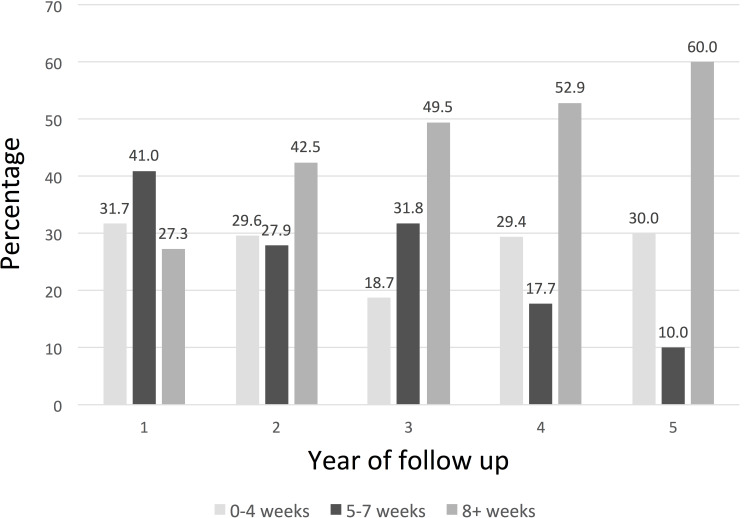
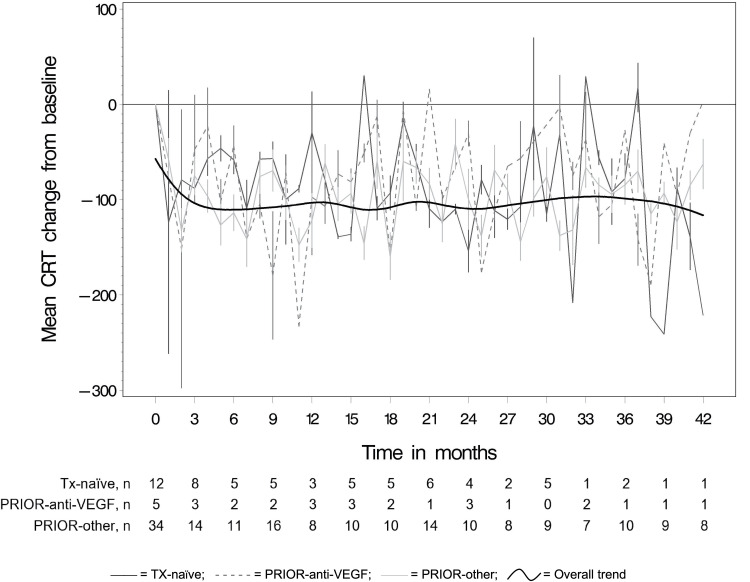
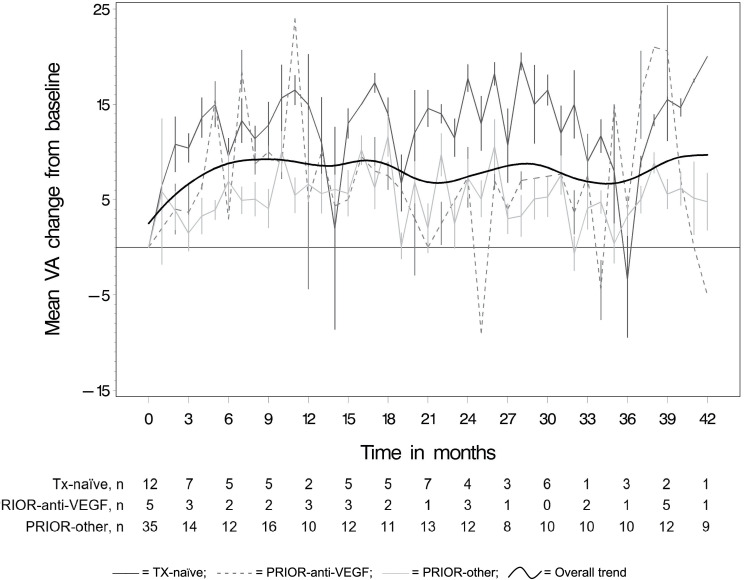
The mean±SD number of treatments in the first year was 5.1±3.0 (TX-naïve), 4.5±2.7 (PRIOR-anti-VEGF) and 5.6±3.1 (PRIOR-other). At 12 months, BCVA increased by 8.9±16.4 letters from 59.7±9.3 at baseline in TX-naïve (p<0.0001), by 11.8±9.9 from 61.6±8.5 in PRIOR-anti-VEGF (p=0.03), and by 4.2±10.6 from 58.2±14.6 in PRIOR-other groups (p=0.0002). BCVA remained stable for the remainder of follow-up in all groups. CRT decreased over the first 2 months by monthly rates of -43.8µm in TX-naïve (p=0.04), -75.7µm in PRIOR-anti-VEGF (p=0.02), and -65.8µm in PRIOR-other eyes (p=0.0003), showing stability afterwards. No unknown adverse events were recorded; a painful eye following injection was registered with a possible relationship to the treatment.
This real-world study confirms the effectiveness of ranibizumab in preventing a decline in BCVA and demonstrated initial improvement and subsequent retention of BCVA in DME patients ≥36 months. Ranibizumab initially reduced and then maintained CRT. However, these data reveal that treatment intensity and BCVA and CRT outcomes are lower than those found in early efficacy trials. Under-treatment likely accounts for this efficacy-effectiveness gap. Yet, intravitreal ranibizumab is an effective and safe long-term treatment for DME under conditions of significant heterogeneity in patients and treatment patterns.
评估接受0.5mg雷珠单抗治疗≥36个月的糖尿病性黄斑水肿(DME)患者的长期真实世界治疗模式以及相关的有效性和安全性结果。
在比利时的9家诊所进行的开放标签观察性有效性研究。纳入了2014年8月至2015年3月期间55例DME患者的初治眼,并随访3.5±1.8年。初治眼占21.8%,单纯接受过抗VEGF治疗的非初治眼占9.1%(既往抗VEGF治疗),接受过其他治疗的非初治眼占63.6%(既往其他治疗)。根据眼科医生的最佳临床判断进行玻璃体内注射雷珠单抗。使用混合回归分析对最佳矫正视力(BCVA)和中心视网膜厚度(CRT)随时间的变化进行趋势测试。
第一年的平均治疗次数±标准差为5.1±3.0(初治眼)、4.5±2.7(既往抗VEGF治疗)和5.6±3.1(既往其他治疗)。在12个月时,初治眼的BCVA从基线时的59.7±9.3提高了8.9±16.4个字母(p<0.0001),既往抗VEGF治疗组从61.6±8.5提高了11.8±9.9个字母(p=0.03),既往其他治疗组从58.2±14.6提高了4.2±10.6个字母(p=0.0002)。在所有组的随访剩余时间内,BCVA保持稳定。CRT在最初2个月内下降,初治眼每月下降-43.8µm(p=0.04),既往抗VEGF治疗组每月下降-75.7µm(p=0.02),既往其他治疗组每月下降-65.8µm(p=0.0003),之后显示稳定。未记录到未知不良事件;记录到1例注射后眼痛,可能与治疗有关。
这项真实世界研究证实了雷珠单抗在预防BCVA下降方面的有效性,并证明了≥36个月的DME患者BCVA最初改善并随后保持。雷珠单抗最初降低然后维持CRT。然而,这些数据表明治疗强度以及BCVA和CRT结果低于早期疗效试验中的结果。治疗不足可能是造成这种疗效-有效性差距的原因。然而,在患者和治疗模式存在显著异质性的情况下,玻璃体内注射雷珠单抗是一种有效且安全的DME长期治疗方法。