Wolfson Centre for Age-Related Diseases, King's College London, London, United Kingdom.
Developmental Biology and Cancer, UCL Great Ormond Street Institute of Child Health, London, United Kingdom.
Pain. 2018 Aug;159(8):1641-1651. doi: 10.1097/j.pain.0000000000001255.
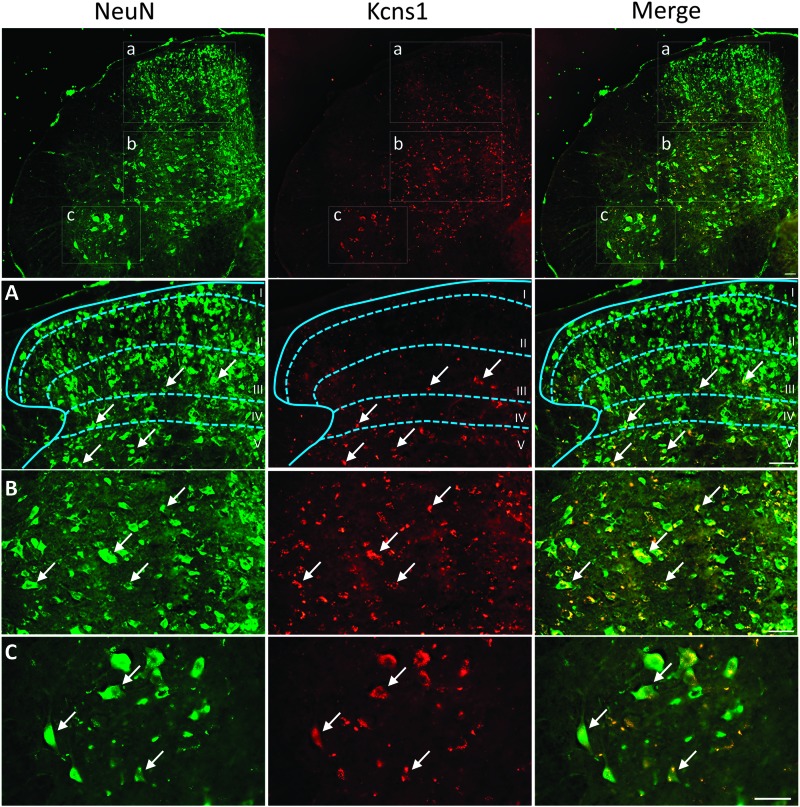
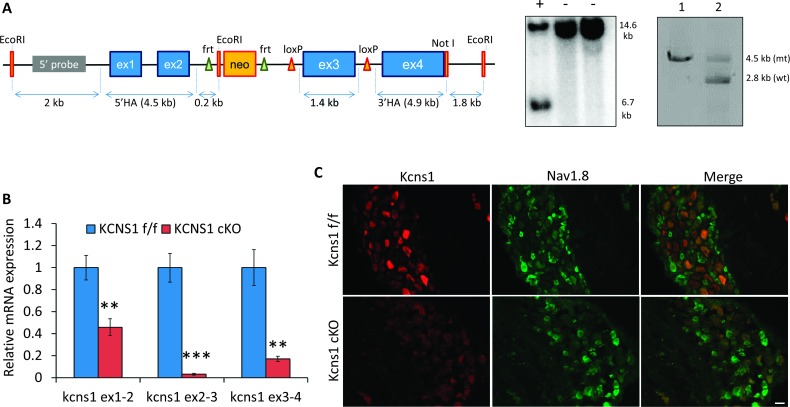
Voltage-gated potassium (Kv) channels are increasingly recognised as key regulators of nociceptive excitability. Kcns1 is one of the first potassium channels to be associated with neuronal hyperexcitability and mechanical sensitivity in the rat, as well as pain intensity and risk of developing chronic pain in humans. Here, we show that in mice, Kcns1 is predominantly expressed in the cell body and axons of myelinated sensory neurons positive for neurofilament-200, including Aδ-fiber nociceptors and low-threshold Aβ mechanoreceptors. In the spinal cord, Kcns1 was detected in laminae III to V of the dorsal horn where most sensory A fibers terminate, as well as large motoneurons of the ventral horn. To investigate Kcns1 function specifically in the periphery, we generated transgenic mice in which the gene is deleted in all sensory neurons but retained in the central nervous system. Kcns1 ablation resulted in a modest increase in basal mechanical pain, with no change in thermal pain processing. After neuropathic injury, Kcns1 KO mice exhibited exaggerated mechanical pain responses and hypersensitivity to both noxious and innocuous cold, consistent with increased A-fiber activity. Interestingly, Kcns1 deletion also improved locomotor performance in the rotarod test, indicative of augmented proprioceptive signalling. Our results suggest that restoring Kcns1 function in the periphery may be of some use in ameliorating mechanical and cold pain in chronic states.
电压门控钾 (Kv) 通道越来越被认为是调节伤害感受兴奋性的关键调节因子。Kcns1 是最早与大鼠神经元过度兴奋和机械敏感性以及人类疼痛强度和发展为慢性疼痛风险相关的钾通道之一。在这里,我们表明,在小鼠中,Kcns1 主要表达在神经丝-200 阳性的有髓感觉神经元的胞体和轴突中,包括 Aδ 纤维伤害感受器和低阈值 Aβ 机械感受器。在脊髓中,Kcns1 存在于背角的 III 至 V 层中,大多数感觉 A 纤维终止于此,以及腹角的大型运动神经元中。为了专门研究 Kcns1 在周围神经系统中的功能,我们生成了转基因小鼠,其中该基因在所有感觉神经元中缺失,但在中枢神经系统中保留。Kcns1 缺失导致基础机械疼痛适度增加,而热痛处理没有变化。在神经病理性损伤后,Kcns1 KO 小鼠表现出机械性疼痛反应过度和对有害和无害冷的超敏反应,这与 A 纤维活性增加一致。有趣的是,Kcns1 缺失也改善了旋转棒测试中的运动表现,表明本体感觉信号增强。我们的结果表明,在外周恢复 Kcns1 功能可能有助于改善慢性状态下的机械性和冷性疼痛。