Schäfer Axel Georg Meender, Zalpour Christoff, von Piekartz Harry, Hall Toby Maxwell, Paelke Volker
Course of Study Speech and Language Therapy, Occupational Therapy and Physiotherapy, Faculty of Social Work and Health, University of Applied Sciences and Arts Hildesheim, Hildesheim, Germany.
Institut für angewandte Physiotherapie und Osteopathie, Fakultät Wirtschafts- und Sozialwissenschaften, University of Applied Sciences Osnabrück, Osnabrück, Germany.
J Med Internet Res. 2018 Apr 26;20(4):e152. doi: 10.2196/jmir.9465.
Osteoarthritis of the knee is the most common cause for disability and limited mobility in the elderly, with considerable individual suffering and high direct and indirect disease-related costs. Nonsurgical interventions such as exercise, enhanced physical activity, and self-management have shown beneficial effects for pain reduction, physical function, and quality of life (QoL), but access to these treatments may be limited. Therefore, home therapy is strongly recommended. However, adherence to these programs is low. Patients report lack of motivation, feedback, and personal interaction as the main barriers to home therapy adherence. To overcome these barriers, electronic health (eHealth) is seen as a promising opportunity. Although beneficial effects have been shown in the literature for other chronic diseases such as chronic pain, cardiovascular disease, and diabetes, a systematic literature review on the efficacy of eHealth interventions for patients with osteoarthritis of knee is missing so far.
The aim of this study was to compare the efficacy of eHealth-supported home exercise interventions with no or other interventions regarding pain, physical function, and health-related QoL in patients with osteoarthritis of the knee.
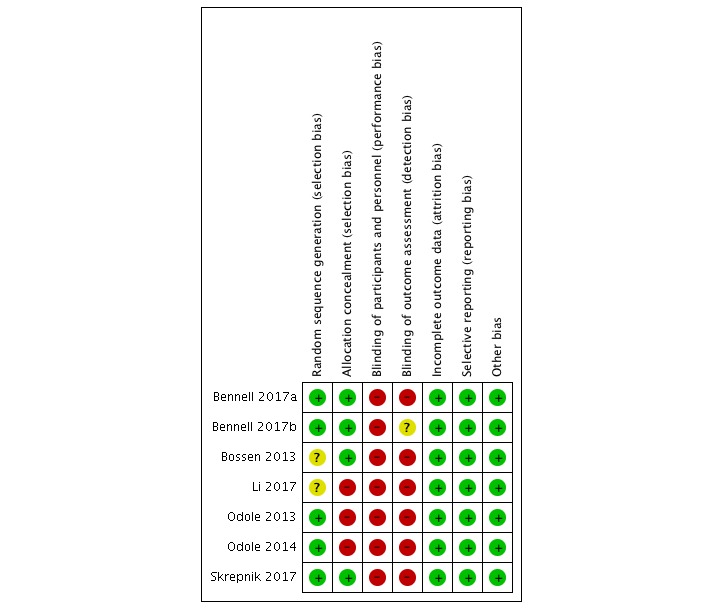
MEDLINE, CENTRAL, CINAHL, and PEDro were systematically searched using the keywords osteoarthritis knee, eHealth, and exercise. An inverse variance random-effects meta-analysis was carried out pooling standardized mean differences (SMDs) of individual studies. The Cochrane tool was used to assess risk of bias in individual studies, and the quality of evidence across studies was evaluated following the Grading of Recommendations, Assessment, Development, and Evaluation approach.
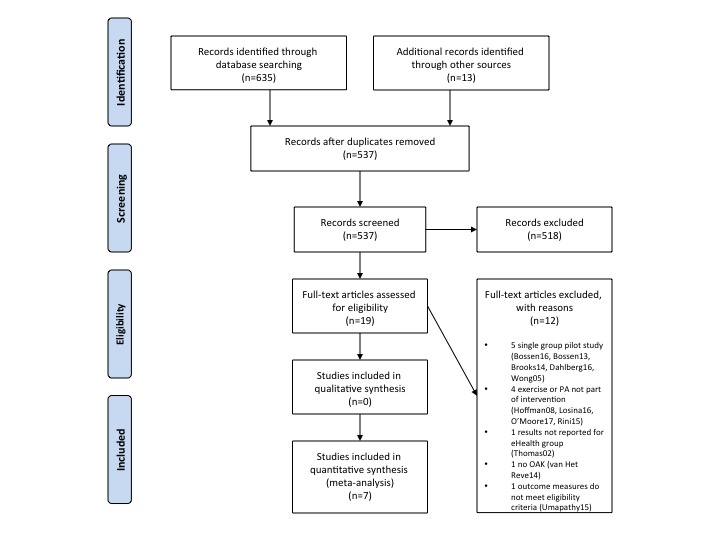
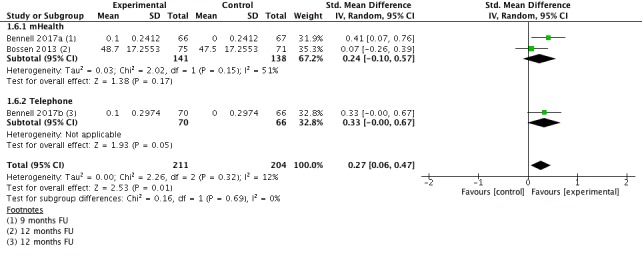
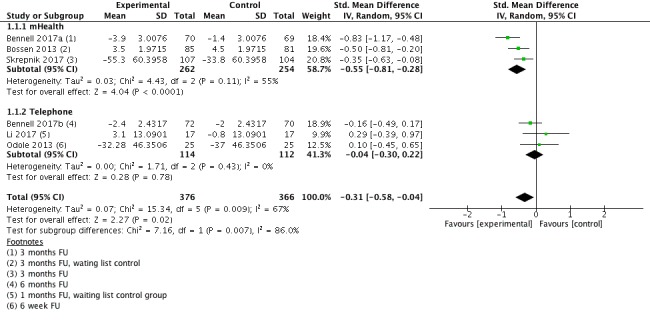
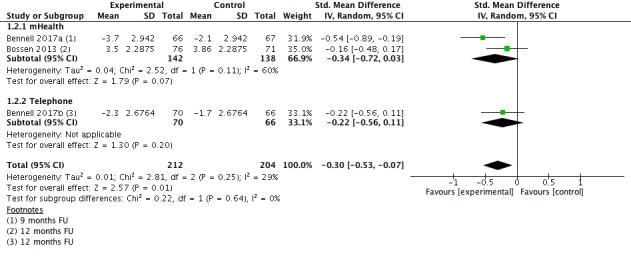
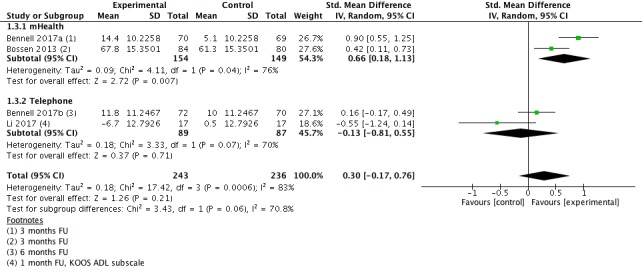
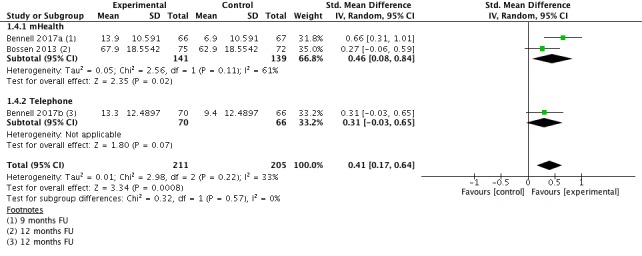
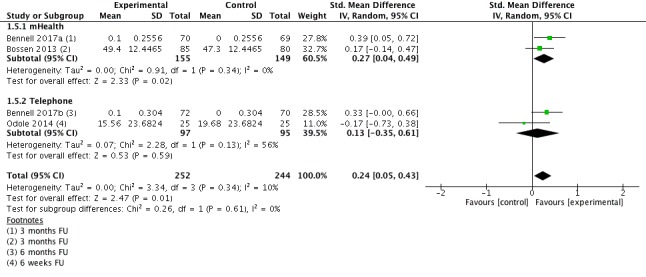
The literature search yielded a total of 648 results. After screening of titles, abstracts, and full-texts, seven randomized controlled trials were included. Pooling the data of individual studies demonstrated beneficial short-term (pain SMD=−0.31, 95% CI −0.58 to −0.04, low quality; QoL SMD=0.24, 95% CI 0.05-0.43, moderate quality) and long-term effects (pain −0.30, 95% CI −0.07 to −0.53, moderate quality; physical function 0.41, 95% CI 0.17-0.64, high quality; and QoL SMD=0.27, 95% CI 0.06-0.47, high quality).
eHealth-supported exercise interventions resulted in less pain, improved physical function, and health-related QoL compared with no or other interventions; however, these improvements were small (SMD<0.5) and may not make a meaningful difference for individual patients. Low adherence is seen as one limiting factor of eHealth interventions. Future research should focus on participatory development of eHealth technology integrating evidence-based principles of exercise science and ways of increasing patient motivation and adherence.
膝关节骨关节炎是老年人残疾和行动受限的最常见原因,给个人带来巨大痛苦,并产生高昂的直接和间接疾病相关成本。运动、增加体力活动和自我管理等非手术干预措施已显示出对减轻疼痛、改善身体功能和提高生活质量(QoL)有益,但这些治疗方法的可及性可能有限。因此,强烈推荐家庭治疗。然而,患者对这些方案的依从性较低。患者报告缺乏动力、反馈和人际互动是家庭治疗依从性的主要障碍。为克服这些障碍,电子健康(eHealth)被视为一个有前景的机会。尽管文献表明eHealth干预措施对慢性疼痛、心血管疾病和糖尿病等其他慢性病有益,但目前还缺少关于eHealth干预措施对膝关节骨关节炎患者疗效的系统文献综述。
本研究旨在比较eHealth支持的家庭锻炼干预措施与无干预或其他干预措施在膝关节骨关节炎患者的疼痛、身体功能和健康相关生活质量方面的疗效。
使用关键词“膝关节骨关节炎”“eHealth”和“锻炼”对MEDLINE、CENTRAL、CINAHL和PEDro进行系统检索。采用逆方差随机效应荟萃分析汇总个体研究的标准化均值差(SMD)。使用Cochrane工具评估个体研究的偏倚风险,并按照推荐分级、评估、制定和评价方法评估各研究的证据质量。
文献检索共获得648条结果。在筛选标题、摘要和全文后,纳入了7项随机对照试验。汇总个体研究数据显示,短期(疼痛SMD = -0.31,95%CI -0.58至-0.04,低质量;生活质量SMD = 0.24,95%CI 0.05 - 0.43,中等质量)和长期(疼痛-0.30,95%CI -0.07至-0.53,中等质量;身体功能0.41,95%CI 0.17 - 0.64,高质量;生活质量SMD = 0.27,95%CI 0.06 - 0.47,高质量)均有有益效果。
与无干预或其他干预措施相比,eHealth支持的锻炼干预措施可减轻疼痛、改善身体功能和提高健康相关生活质量;然而,这些改善较小(SMD < 0.5),可能对个体患者无显著意义。低依从性被视为eHealth干预措施的一个限制因素。未来研究应聚焦于结合运动科学循证原则的eHealth技术的参与式开发,以及提高患者动力和依从性的方法。